Diabetes EMR Documentation Workflow: ICD-10-CM Source-Backed Checklist for Clinics
Official Source Basis
- Diabetes code families: The April 1, 2026 ICD-10-CM tabular file lists E08 for diabetes due to underlying condition, E09 for drug or chemical induced diabetes, E10 for type 1 diabetes, E11 for type 2 diabetes, and E13 for other specified diabetes.
- Medication context: The diabetes categories include Use Additional Code notes to identify control using insulin, oral antidiabetic drugs, or injectable non-insulin antidiabetic drugs where applicable.
- Sequencing context: Some diabetes categories include Code First or Use Additional Code notes, which is why final selection needs trained review.
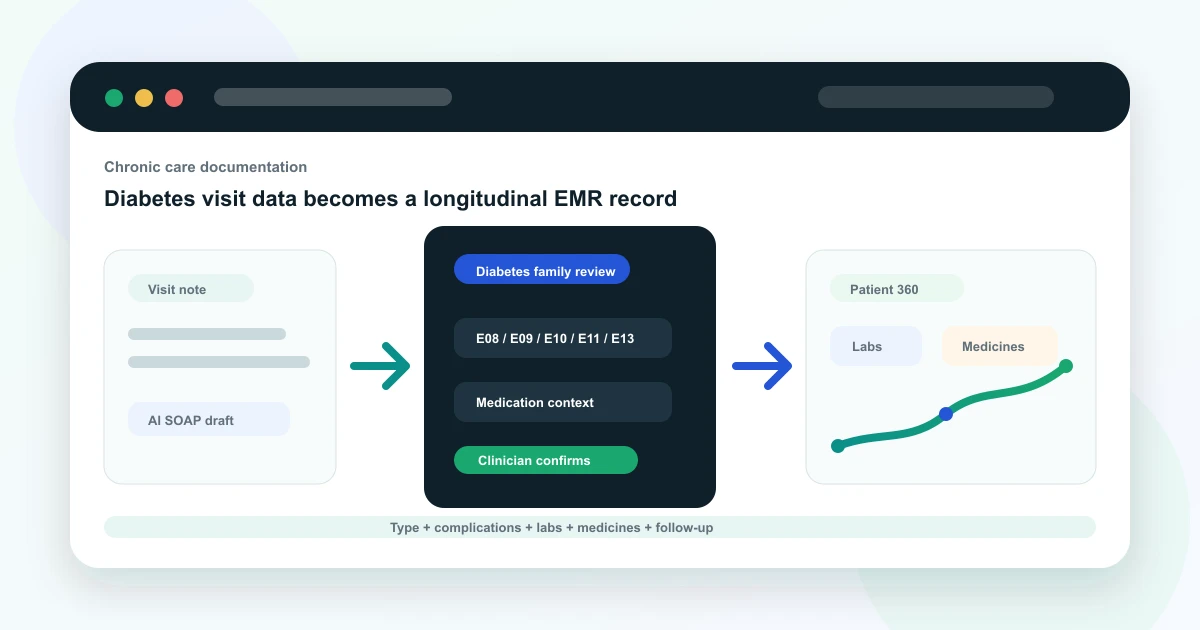
Diabetes documentation is a longitudinal EMR workflow
Diabetes care does not fit neatly into a single visit note. A clinic needs to see diagnosis history, medications, complications, lab trends, lifestyle counseling, referrals, and follow-up plans across time. That is why diabetes is a strong test of EMR documentation quality.
If the EMR only stores a free-text assessment, teams lose the ability to track patients who need recall, review medication context, or understand diabetes-related service demand. Structured diagnosis data makes chronic care workflows easier to manage.
ICD-10-CM diabetes code families to understand
Source note: this article uses the CDC/NCHS ICD-10-CM Tabular List, Index, and April 1, 2026 update files as the coding source. It is written for EMR workflow education, not as a substitute for official coding review.
The official April 1, 2026 ICD-10-CM tabular file separates diabetes into multiple categories, including diabetes due to underlying condition, drug or chemical induced diabetes, type 1 diabetes, type 2 diabetes, and other specified diabetes. That structure shows why a doctor or coder often needs more information than the word diabetes.
For example, diabetes type, underlying cause, medication context, and complications can all affect documentation and review. The EMR should prompt the care team to capture clinically useful context without making the consultation slower.
- E08: diabetes mellitus due to underlying condition.
- E09: drug or chemical induced diabetes mellitus.
- E10: type 1 diabetes mellitus.
- E11: type 2 diabetes mellitus.
- E13: other specified diabetes mellitus.
Fields clinics should capture in the EMR
A diabetes visit should connect the patient’s current symptoms, diagnosis context, medication plan, allergies, lab history, vitals, complications, lifestyle counseling, and follow-up. The goal is not to force the doctor through a long form. The goal is to keep the most important chronic care signals visible.
Patient 360 matters here. A doctor should be able to review previous HbA1c or glucose trends if available, medication changes, eye or kidney screening notes, and missed follow-ups without hunting across paper files.
- Diabetes type or documented context.
- Current medicines and adherence concerns.
- Relevant labs and trend history.
- Complications, comorbidities, and referrals.
- Follow-up interval and patient instructions.
Where AI can help
An AI medical scribe can draft the diabetes visit note from the conversation, capture medication changes, summarize counseling, and highlight missing follow-up details. It can also surface candidate diagnosis families for review when the note contains enough context.
AI is especially useful in high-volume clinics where doctors repeat similar counseling and follow-up documentation many times a day.
Where doctor and coder review is required
The final diagnosis, complications, sequencing, and medication-related coding context require qualified review. The EMR should make official-source reminders and documentation gaps visible, but the clinical and coding decision should remain human-reviewed.
This article is educational and does not replace certified medical coding guidance. Final code selection should be reviewed by qualified clinical or coding staff using the official ICD-10-CM guidelines for the correct date of service.
How Vivalyn EMR supports chronic disease workflows
Vivalyn EMR supports department-aware workflows, Patient 360, AI-assisted clinical notes, prescriptions, billing, and follow-up. For diabetes clinics and internal medicine OPDs, that means the visit note can become part of a usable longitudinal care record rather than a static document.
Want to turn source-backed clinical documentation into an operational EMR workflow? Vivalyn EMR connects AI-assisted notes, doctor review, Patient 360, billing, analytics, and department workflows in one platform.
Continue From Coding Education to EMR Evaluation
Use this guide with the Vivalyn EMR feature set, department workflows, billing pages, and demo path.
Vivalyn EMR Hub
Start with the core AI EMR product page for clinics and hospitals.
Next pathEMR Features
Review OPD, IPD, Patient 360, billing, lab, pharmacy, and AI workflows.
Next pathEMR Software India
Commercial product page for ABDM-ready EMR software in India.
Next pathClinic Management Software
Evaluate front desk, appointments, billing, inventory, and self check-in.
Next pathEMR by Department
Find specialty and hospital department workflows mapped to EMR use cases.
Next pathPatient Experience
Review patient self check-in, reminders, engagement, and front-desk flow.
Next pathCompliance & Security
Evaluate privacy, access controls, audit trails, and deployment governance.
Next pathEMR by Country
Browse international EMR software pages by country and deployment context.
Next pathEMR by City
Explore city-specific EMR pages for Hyderabad, Bengaluru, Mumbai, and Delhi.
Next pathEMR Alternatives
Compare Vivalyn EMR with common clinic and hospital software alternatives.
Next path2026 EMR Burden Dataset
Use the benchmark dataset on Indian EMR adoption and documentation burden.
Next pathStart 30-Day Free Trial
Move from research to product walkthrough, trial, and implementation planning.
Next pathEMR Knowledge Hub
Read implementation, migration, ABDM, and hospital workflow guides.