EMR Billing Workflow: From Diagnosis Codes to Claims Review
Official Source Basis
- Coding is documentation-dependent: ICD-10-CM descriptions and official instructions depend on documented clinical context, not only a keyword found in the note.
- Guidelines are a companion: The official coding guidelines are used with the ICD-10-CM classification and its tabular/index instructions.
- No payer assumptions: This article does not make payer-specific reimbursement claims; claim rules should be reviewed locally.
Billing problems often begin inside the clinical note
When billing teams struggle with missing diagnosis context, the problem is rarely only a billing problem. It often starts earlier: incomplete clinical documentation, unclear assessment wording, missing comorbidity detail, or disconnected service capture.
An EMR billing workflow should connect the doctor note, diagnosis, orders, services, invoices, and claims review. If each step lives in a separate tool, billing staff spend time chasing context that should already be part of the encounter record.
How diagnosis data flows into billing
Source note: this article uses the CDC/NCHS ICD-10-CM Tabular List, Index, and April 1, 2026 update files as the coding source. It is written for EMR workflow education, not as a substitute for official coding review.
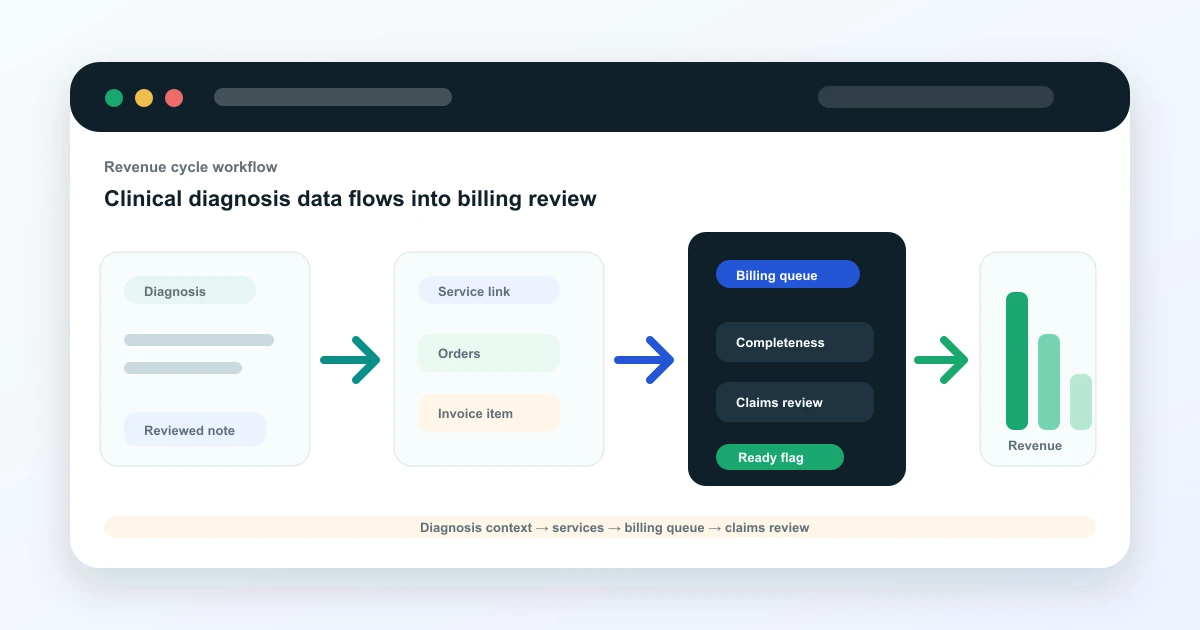
The clinical encounter creates the record. The diagnosis captures why the patient was seen and what the clinician assessed. Orders, procedures, medicines, and services capture what happened next. Billing teams need that chain to be visible before claim review.
A connected EMR can show the diagnosis beside the visit note, services, lab orders, pharmacy handoff, and invoice. That helps billing teams review the record without asking the doctor to reconstruct the encounter later.
A practical claim-readiness workflow
A patient arrives at the clinic, completes registration, and sees the doctor. The doctor documents the visit and confirms the assessment. The EMR links diagnosis context to ordered services and invoice items. Billing staff review the encounter for completeness before claim submission or internal reporting.
This does not mean the EMR should auto-submit claims from AI output. It means the system should reduce missing context and make review easier.
- Clinical note is completed and reviewed.
- Diagnosis context is selected or confirmed.
- Orders and services are linked to the encounter.
- Billing staff review documentation completeness.
- Revenue dashboards reflect structured encounter data.
Where AI can help billing teams
AI can help detect gaps before the note is locked. It can identify when a visit note mentions a condition but the assessment is blank, when a follow-up plan lacks diagnosis context, or when a billing handoff needs human review.
The highest-value use is not replacing coders. It is making the encounter cleaner before it reaches them.
Where human review is required
Billing and coding staff must still review the final diagnosis, service linkage, payer requirements, and organization policy. Official ICD-10-CM instructions and local billing rules matter, especially when documentation is ambiguous or a claim is high risk.
This article is educational and does not replace certified medical coding guidance. Final code selection should be reviewed by qualified clinical or coding staff using the official ICD-10-CM guidelines for the correct date of service.
How Vivalyn EMR connects billing and diagnosis context
Vivalyn EMR includes clinical documentation, billing, claims, patient records, analytics, and AI-assisted note workflows in one platform path. That lets clinics and hospitals reduce the gap between care delivery and revenue-cycle review.
Want to turn source-backed clinical documentation into an operational EMR workflow? Vivalyn EMR connects AI-assisted notes, doctor review, Patient 360, billing, analytics, and department workflows in one platform.
Continue From Coding Education to EMR Evaluation
Use this guide with the Vivalyn EMR feature set, department workflows, billing pages, and demo path.
Vivalyn EMR Hub
Start with the core AI EMR product page for clinics and hospitals.
Next pathEMR Features
Review OPD, IPD, Patient 360, billing, lab, pharmacy, and AI workflows.
Next pathEMR Software India
Commercial product page for ABDM-ready EMR software in India.
Next pathClinic Management Software
Evaluate front desk, appointments, billing, inventory, and self check-in.
Next pathEMR by Department
Find specialty and hospital department workflows mapped to EMR use cases.
Next pathPatient Experience
Review patient self check-in, reminders, engagement, and front-desk flow.
Next pathCompliance & Security
Evaluate privacy, access controls, audit trails, and deployment governance.
Next pathEMR by Country
Browse international EMR software pages by country and deployment context.
Next pathEMR by City
Explore city-specific EMR pages for Hyderabad, Bengaluru, Mumbai, and Delhi.
Next pathEMR Alternatives
Compare Vivalyn EMR with common clinic and hospital software alternatives.
Next path2026 EMR Burden Dataset
Use the benchmark dataset on Indian EMR adoption and documentation burden.
Next pathStart 30-Day Free Trial
Move from research to product walkthrough, trial, and implementation planning.
Next pathEMR Knowledge Hub
Read implementation, migration, ABDM, and hospital workflow guides.