Hypertension EMR Documentation Workflow: Diagnosis Capture, Follow-Ups, and Coding Review
Official Source Basis
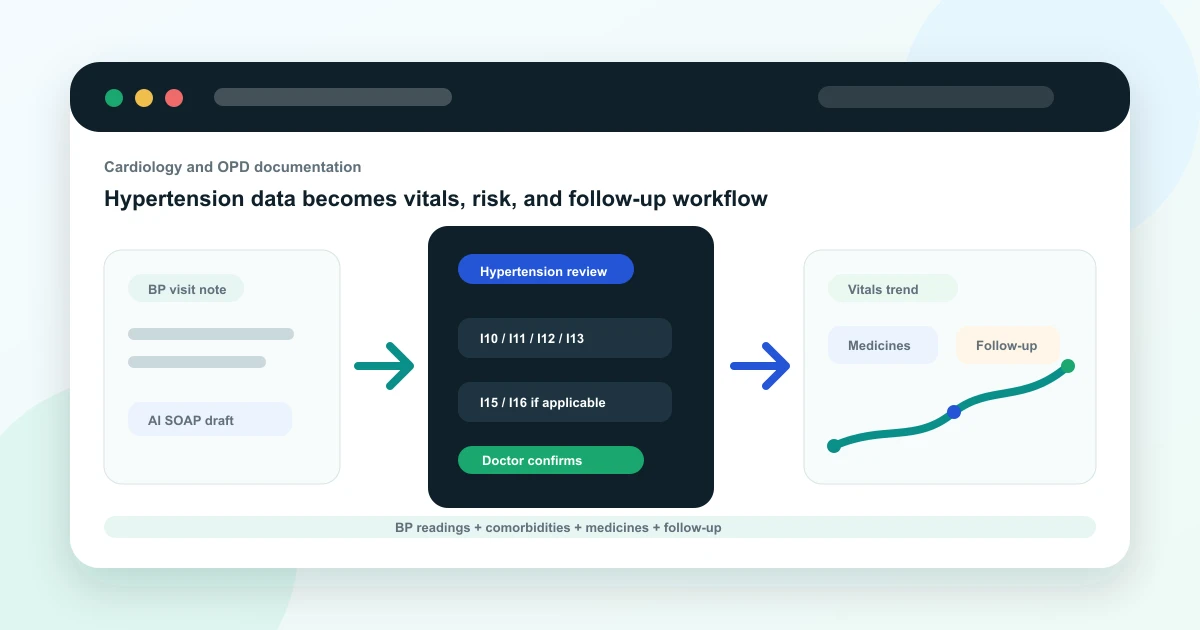
- Hypertension families: The April 1, 2026 ICD-10-CM tabular file lists I10 for essential hypertension, I11 for hypertensive heart disease, I12 for hypertensive chronic kidney disease, I13 for hypertensive heart and chronic kidney disease, I15 for secondary hypertension, and I16 for hypertensive crisis.
- Pregnancy exclusion: I10 includes an Excludes1 note for hypertensive disease complicating pregnancy, childbirth, and the puerperium.
- Additional context: I15 and I16 include Code Also notes, so review of underlying conditions and related hypertensive disease matters.
Hypertension documentation is more than one blood pressure value
Hypertension appears simple until the EMR has to support real OPD care. A doctor may need prior readings, current medicines, adherence concerns, kidney or heart comorbidity, lifestyle counseling, and the next follow-up date in one view.
When those signals are stored as disconnected notes, the clinic cannot easily find uncontrolled patients, missed follow-ups, or patients who need more structured review.
ICD-10-CM hypertension families to understand
Source note: this article uses the CDC/NCHS ICD-10-CM Tabular List, Index, and April 1, 2026 update files as the coding source. It is written for EMR workflow education, not as a substitute for official coding review.
The official tabular file separates primary hypertension, hypertensive heart disease, hypertensive chronic kidney disease, combined heart and kidney disease, secondary hypertension, and hypertensive crisis.
A useful EMR should prompt for comorbidities and follow-up context without slowing the consultation. The goal is to make the doctor's clinical work more complete and reusable.
- I10: essential primary hypertension.
- I11: hypertensive heart disease.
- I12: hypertensive chronic kidney disease.
- I13: hypertensive heart and chronic kidney disease.
- I15 and I16: secondary hypertension and hypertensive crisis contexts.
What the EMR should capture
A hypertension workflow should keep vitals, medication changes, symptoms, comorbidities, investigations, and follow-up plans visible. It should also support longitudinal review, because one visit rarely tells the whole story.
- Blood pressure readings and trends.
- Medication changes and adherence concerns.
- Heart, kidney, pregnancy, or secondary-cause context when relevant.
- Follow-up interval and patient instructions.
- Billing and analytics handoff after review.
Where AI can help
AI can draft the visit note, summarize medication changes, identify missing follow-up details, and surface candidate diagnosis families for review. It can also help busy doctors capture counseling and risk context without typing everything manually.
Where doctor and coder review is required
Hypertension coding can depend on comorbidity, pregnancy context, secondary causes, crisis context, and official notes. The clinician confirms the assessment, and coding or billing staff review final use cases when needed.
This article is educational and does not replace certified medical coding guidance. Final code selection should be reviewed by qualified clinical or coding staff using the official ICD-10-CM guidelines for the correct date of service.
How Vivalyn EMR supports hypertension workflows
Vivalyn EMR connects vitals, AI-assisted notes, Patient 360, cardiology workflows, prescriptions, follow-up reminders, billing, and analytics so chronic disease documentation becomes useful operational data.
Want to turn source-backed clinical documentation into an operational EMR workflow? Vivalyn EMR connects AI-assisted notes, doctor review, Patient 360, billing, analytics, and department workflows in one platform.
Continue From Coding Education to EMR Evaluation
Use this guide with the Vivalyn EMR feature set, department workflows, billing pages, and demo path.
Vivalyn EMR Hub
Start with the core AI EMR product page for clinics and hospitals.
Next pathEMR Features
Review OPD, IPD, Patient 360, billing, lab, pharmacy, and AI workflows.
Next pathEMR Software India
Commercial product page for ABDM-ready EMR software in India.
Next pathClinic Management Software
Evaluate front desk, appointments, billing, inventory, and self check-in.
Next pathEMR by Department
Find specialty and hospital department workflows mapped to EMR use cases.
Next pathPatient Experience
Review patient self check-in, reminders, engagement, and front-desk flow.
Next pathCompliance & Security
Evaluate privacy, access controls, audit trails, and deployment governance.
Next pathEMR by Country
Browse international EMR software pages by country and deployment context.
Next pathEMR by City
Explore city-specific EMR pages for Hyderabad, Bengaluru, Mumbai, and Delhi.
Next pathEMR Alternatives
Compare Vivalyn EMR with common clinic and hospital software alternatives.
Next path2026 EMR Burden Dataset
Use the benchmark dataset on Indian EMR adoption and documentation burden.
Next pathStart 30-Day Free Trial
Move from research to product walkthrough, trial, and implementation planning.
Next pathEMR Knowledge Hub
Read implementation, migration, ABDM, and hospital workflow guides.