Pediatric EMR Diagnosis Documentation: Growth, Vaccines, Visit Codes, and Follow-Up
Official Source Basis
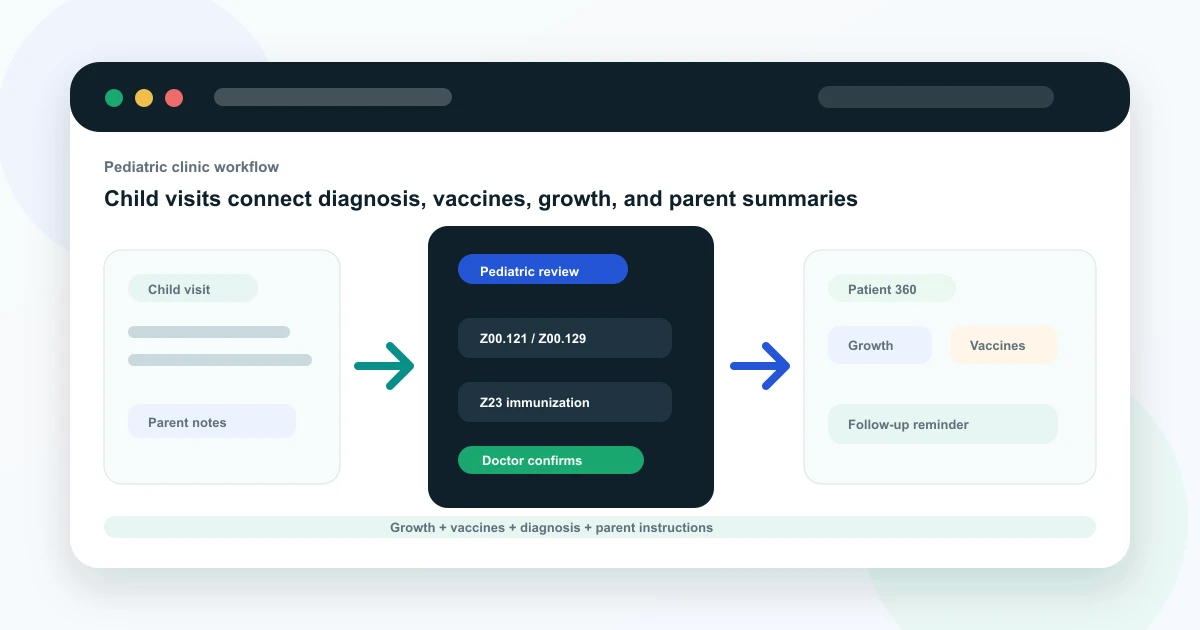
- Child health exam: The April 1, 2026 ICD-10-CM tabular file lists Z00.12 for encounter for routine child health examination.
- With or without abnormal findings: Z00.121 is routine child health examination with abnormal findings, and Z00.129 is routine child health examination without abnormal findings.
- Immunization encounter: Z23 is encounter for immunization and includes a Code First note for any routine childhood examination.
Pediatric EMR documentation combines care and communication
Pediatric visits often include diagnosis context, growth review, vaccines, parent questions, weight-aware medication context, and follow-up instructions. The EMR has to support the doctor and also produce clear information for caregivers.
That makes pediatrics different from a generic adult OPD template.
ICD-10-CM pediatric visit source context
Source note: this article uses the CDC/NCHS ICD-10-CM Tabular List, Index, and April 1, 2026 update files as the coding source. It is written for EMR workflow education, not as a substitute for official coding review.
The official tabular file includes routine child health examination entries under Z00.12, including with abnormal findings and without abnormal findings. It also lists Z23 for encounter for immunization and notes that routine childhood examination may need to be coded first.
For EMR workflow design, this means pediatric documentation should keep exam, vaccine, growth, and abnormal-finding context visible.
- Z00.12: encounter for routine child health examination.
- Z00.121: with abnormal findings.
- Z00.129: without abnormal findings.
- Z23: encounter for immunization.
What the EMR should capture
A pediatric EMR should make it easy to capture growth, weight, vaccine status, symptoms, allergies, medicines, developmental notes, caregiver instructions, and follow-up.
- Age, weight, growth, and developmental context.
- Vaccination status and immunization encounter details.
- Symptoms, diagnosis, allergies, and medicines.
- Parent instructions and follow-up reminders.
- Patient 360 history across repeat visits.
Where AI can help
AI can draft the visit note, summarize parent questions, capture vaccine or follow-up reminders, and generate parent-friendly summaries for doctor review. It should never replace clinical judgment or pediatric dosing review.
Where doctor and coder review is required
The pediatrician must confirm diagnosis, vaccine context, abnormal findings, medicine instructions, and follow-up. Coding staff should review official notes and organization policy where needed.
This article is educational and does not replace certified medical coding guidance. Final code selection should be reviewed by qualified clinical or coding staff using the official ICD-10-CM guidelines for the correct date of service.
How Vivalyn EMR supports pediatric workflows
Vivalyn EMR supports pediatric departments with Patient 360, AI-assisted notes, prescription workflows, reminders, caregiver summaries, and department-aware documentation paths.
Want to turn source-backed clinical documentation into an operational EMR workflow? Vivalyn EMR connects AI-assisted notes, doctor review, Patient 360, billing, analytics, and department workflows in one platform.
Continue From Coding Education to EMR Evaluation
Use this guide with the Vivalyn EMR feature set, department workflows, billing pages, and demo path.
Vivalyn EMR Hub
Start with the core AI EMR product page for clinics and hospitals.
Next pathEMR Features
Review OPD, IPD, Patient 360, billing, lab, pharmacy, and AI workflows.
Next pathEMR Software India
Commercial product page for ABDM-ready EMR software in India.
Next pathClinic Management Software
Evaluate front desk, appointments, billing, inventory, and self check-in.
Next pathEMR by Department
Find specialty and hospital department workflows mapped to EMR use cases.
Next pathPatient Experience
Review patient self check-in, reminders, engagement, and front-desk flow.
Next pathCompliance & Security
Evaluate privacy, access controls, audit trails, and deployment governance.
Next pathEMR by Country
Browse international EMR software pages by country and deployment context.
Next pathEMR by City
Explore city-specific EMR pages for Hyderabad, Bengaluru, Mumbai, and Delhi.
Next pathEMR Alternatives
Compare Vivalyn EMR with common clinic and hospital software alternatives.
Next path2026 EMR Burden Dataset
Use the benchmark dataset on Indian EMR adoption and documentation burden.
Next pathStart 30-Day Free Trial
Move from research to product walkthrough, trial, and implementation planning.
Next pathEMR Knowledge Hub
Read implementation, migration, ABDM, and hospital workflow guides.