Fast OPD and Consultations
Register patients, manage walk-ins, open Patient 360, write prescriptions, order labs, and close the visit without switching systems.
Replace paper files, disconnected billing tools, and manual clinical documentation with one AI-powered EMR platform for OPD, Patient 360, prescriptions, lab, pharmacy, billing, follow-ups, analytics, and secure deployment.
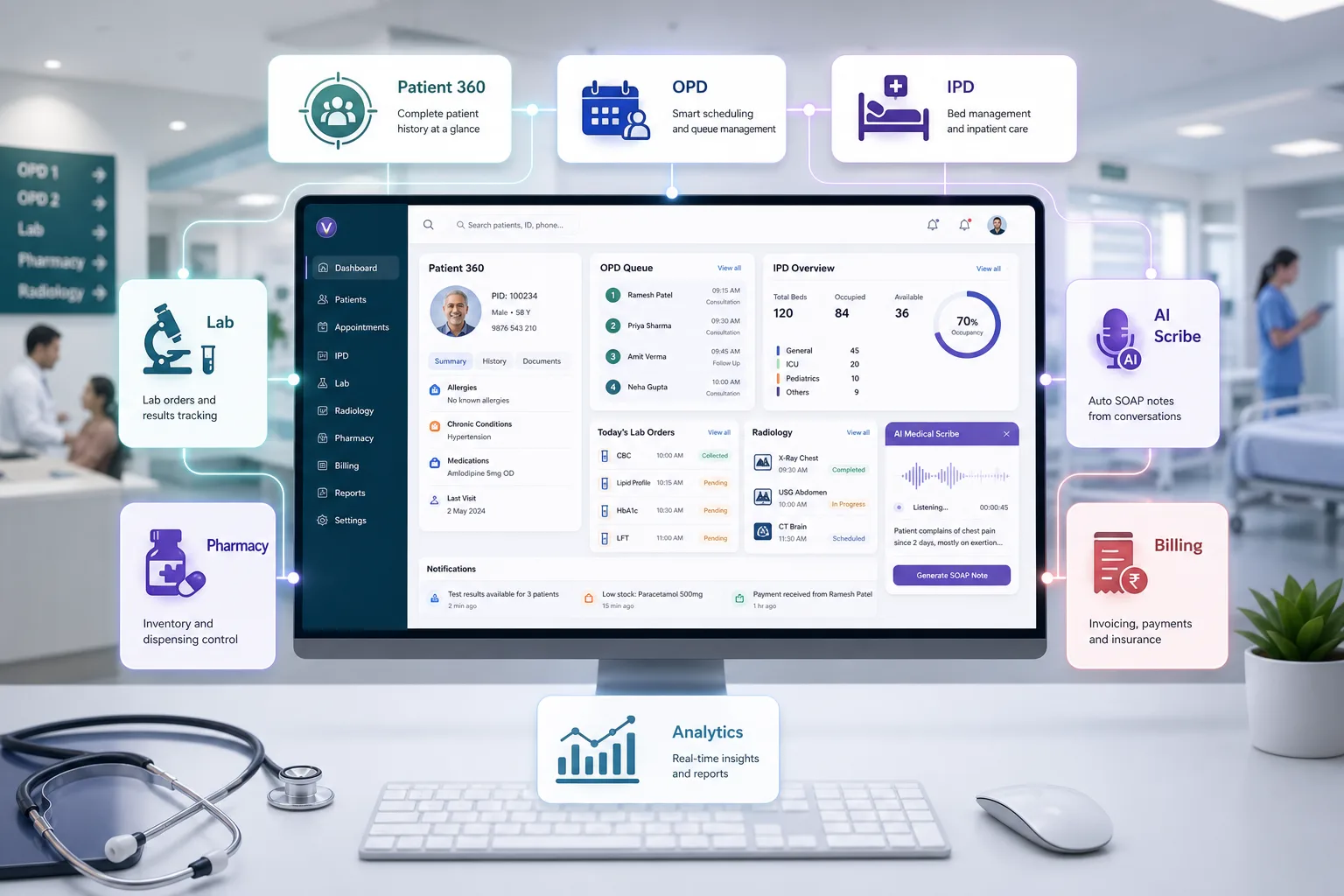
Vivalyn EMR is commercial EMR software for Indian clinics and hospitals. It connects care delivery, operations, and revenue workflows so teams do not need separate tools for records, prescriptions, billing, lab, pharmacy, and follow-up.
Register patients, manage walk-ins, open Patient 360, write prescriptions, order labs, and close the visit without switching systems.
Convert doctor-patient conversations into structured clinical notes, SOAP documentation, summaries, and follow-up context.
Create invoices, collect payments, track patient ledgers, manage packages, and reduce missed charge capture.
Send investigations from consultation, manage lab work queues, attach reports, and keep results inside the patient record.
Connect prescriptions to dispensing, stock visibility, medicine availability, and pharmacy handoffs.
Plan for ABHA, consent-aware workflows, audit logs, role-based access, and secure healthcare data governance.
The product experience follows familiar software landing page patterns: dashboard visibility, patient record context, work queues, billing indicators, and action-first clinical screens. Clinics can evaluate how Vivalyn EMR fits daily work before rollout.
Vivalyn EMR reduces duplicate entry by moving patient context through the clinic: registration, consultation, documentation, prescriptions, diagnostics, billing, pharmacy, reminders, and analytics.
Front desk registers patient and manages appointment or walk-in queue
Doctor opens Patient 360 with previous visits, prescriptions, labs, vitals, and notes
AI MedScribe drafts consultation notes while the doctor focuses on the patient
Prescription, lab order, pharmacy request, and billing move forward from the same encounter
Follow-up reminders, reports, payments, and analytics stay connected to the patient journey
Yes. Vivalyn EMR supports small clinics with OPD, appointments, Patient 360, prescriptions, billing, follow-ups, and AI documentation while keeping the workflow simple for doctors and front desk teams.
Yes. Hospitals can use Vivalyn EMR for clinical records, department workflows, lab, pharmacy, billing, analytics, patient communication, and deployment models that match their IT governance.
Vivalyn EMR is designed with ABDM-ready architecture, auditability, secure access control, and health-data workflows that help clinics and hospitals prepare for ABHA and consent-driven interoperability.
See how ABDM-compliant EMR software can simplify documentation, operations, billing, lab, pharmacy, and patient engagement for your clinic or hospital.