Introduction
Academic Affairs teams in teaching hospitals, medical colleges, and training-led clinical environments often balance patient care documentation with supervision, case discussion, and learner development. An AI medical scribe in India can support this balance by turning consultation conversations into structured draft notes that clinicians review before finalizing. For departments that manage OPD teaching, resident oversight, and documentation quality, the goal is not to replace clinical judgment. It is to reduce repetitive note-writing, improve consistency, and help faculty and trainees spend more time on patient interaction and academic review.
MedScribe is designed as an AI documentation copilot for day-to-day clinical workflows. It converts consultation audio into usable clinical drafts, including SOAP-style notes, while also supporting coding suggestions and multilingual conversations. In Academic Affairs settings, this can be useful where faculty supervise residents, where documentation habits need standardization, and where departments want a practical way to support note quality across varied clinics. The focus remains operational: capture the encounter, structure the information, review the draft, edit where needed, and sign off with the clinician in charge.
Department workflow
Academic Affairs workflows are different from a standard single-doctor clinic because documentation often intersects with teaching and supervision. A patient visit may involve a consultant, a resident, and sometimes an intern or observer. Notes may need to reflect history, examination findings, assessment, and plan clearly enough for continuity of care while also supporting internal teaching standards. In busy OPDs, this creates friction: clinicians need complete records, trainees need guidance, and faculty need visibility into what was documented.
An AI medical scribe in India fits into this environment by helping teams move from free-flowing conversation to structured draft documentation. Speaker diarization can help distinguish participants in the encounter. Multilingual support can be useful when patient conversations shift between English, Hindi, or regional languages. Automatic SOAP note drafting can give residents a starting point, while faculty retain control through review and edits. Coding suggestions can also support cleaner downstream documentation workflows without making billing the central message.
For Academic Affairs leaders, the practical value is consistency. Departments can support more uniform note structures across consultants and trainees, reduce after-hours documentation burden, and create a clearer review path before records are finalized. This is especially relevant in teaching hospitals where documentation quality is part of both patient care and training culture.
Features mapped to workflow
Conversation capture: The product supports consultation capture as the starting point for documentation. This helps clinicians avoid writing every detail during the encounter and can support more natural patient interaction.
Transcription with structure: Raw conversation is converted into organized clinical text rather than left as a plain transcript. This is useful for departments that need notes to be readable, reviewable, and aligned with routine OPD documentation habits.
Automatic SOAP note generation: Draft subjective, objective, assessment, and plan sections help clinicians and trainees move faster from encounter to note completion. This is one of the most practical capabilities for Academic Affairs teams trying to standardize note quality.
Speaker diarization: In teaching settings, multiple voices may be present. Distinguishing speakers can improve clarity when a consultant, resident, and patient all contribute to the encounter.
ICD-10 and CPT suggestions: Coding support can help teams review likely codes alongside the clinical draft. These remain suggestions for clinician review, not automatic final coding decisions.
Multilingual support: Many Indian care settings involve mixed-language consultations. This can be helpful for departments serving diverse patient populations while maintaining English-language records where needed.
On-premise or private deployment posture: For institutions with stricter governance preferences, deployment choices can be made based on internal IT, workflow, and data handling expectations. This supports workflows aligned with institutional requirements without making blanket compliance claims.
How It Works
The workflow for an AI medical scribe in India should be clear, review-driven, and easy to adopt in OPD and teaching environments. A practical implementation typically follows these steps:
- Capture the consultation conversation: During the patient visit, the encounter audio is captured through the configured workflow. This may include consultant-patient discussion and, where relevant, resident participation in history taking or case presentation.
- Transcribe and identify speakers: The system converts speech into text and applies speaker diarization to separate voices where possible. This is useful in Academic Affairs settings where more than one clinician may speak during the encounter.
- Structure the transcript into a clinical draft: The conversation is organized into clinically useful sections, with automatic SOAP note generation creating a draft that reflects the encounter in a familiar format rather than leaving staff with a long raw transcript.
- Add coding support: Based on the drafted note, the system can surface ICD-10 and CPT suggestions for review. These suggestions support documentation workflows and should be checked by the clinician or authorized team member before use.
- Clinician review, edits, and sign-off: The doctor or supervising consultant reviews the draft, corrects details, adds missing findings, and confirms the final note before the record is completed. This human checkpoint is essential for accuracy and accountability.
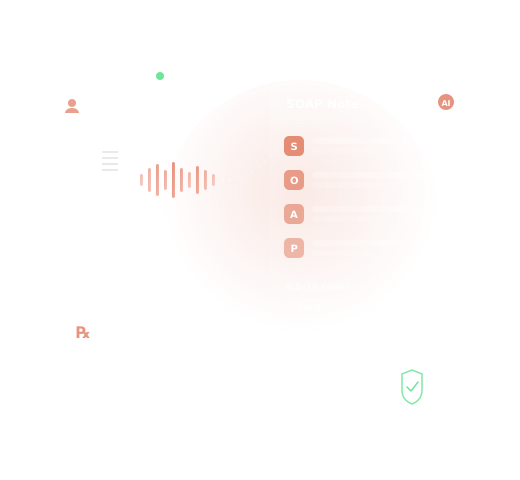
Deployment can also be planned according to institutional workflow. Some organizations may prefer a private or on-premise posture based on internal governance, IT architecture, or operational preferences. In practice, this is a workflow and implementation decision that should be aligned with how the hospital manages systems, access, and review responsibilities.
Local context
In India, Academic Affairs teams often work across high-volume OPDs, mixed digital maturity, and multilingual patient interactions. That makes practicality more important than theory. An AI medical scribe in India should support real consultation patterns, not force clinicians into rigid templates that slow them down. Teaching hospitals may also need a solution that works for consultants, senior residents, and junior doctors with different documentation habits.
This is where workflow fit matters. Multilingual support can help when patient history is taken in one language and documented in another. Structured drafts can help departments create more consistent records across units. Review checkpoints are especially important in academic settings because supervising clinicians remain responsible for the final note. For institutions evaluating an AI medical scribe in India, the key questions are usually around usability, review control, deployment preference, and how well the system supports everyday OPD documentation without adding friction.
Use cases
Teaching hospital OPDs: Support consultants and residents with faster draft note creation during busy clinics.
Resident supervision: Give trainees a structured starting point while allowing faculty to review, edit, and sign off.
Documentation standardization: Encourage more consistent SOAP-style notes across departments and batches of trainees.
Multilingual consultations: Help teams manage encounters where patient communication and clinical documentation happen across different languages.
Coding-assisted workflows: Surface coding suggestions alongside notes to support cleaner downstream administrative processes.
Institutional deployment planning: Evaluate private or on-premise options where governance and IT teams prefer tighter operational control.
FAQ
Can this be used in teaching hospitals?
Yes. It is well suited to environments where consultants supervise residents and need a faster way to review draft documentation before final sign-off.
Does it replace clinician documentation responsibility?
No. The system creates draft notes and suggestions, but the clinician reviews, edits, and approves the final record.
Can it handle multilingual consultations common in India?
It is designed with multilingual support, which can help in settings where patient conversations and clinical records use different languages.
How does coding support work?
The product can surface ICD-10 and CPT suggestions based on the drafted note. These are intended for review, not automatic final coding.
CTA
If your Academic Affairs team is evaluating documentation tools for teaching clinics or hospital OPDs, consider a workflow-first approach. MedScribe helps convert consultation conversations into structured drafts, supports SOAP note generation, and keeps clinicians in control through review and sign-off. Explore the product pages for features, integrations, and implementation options to assess whether this AI medical scribe in India matches your department's documentation and supervision needs.