Introduction
An AI medical scribe in India can help hospitals and clinics reduce documentation friction during admission and discharge coordination. In an Admission Discharge Lounge, teams often manage handovers, discharge summaries, medication instructions, follow-up planning, and communication between clinicians, nursing staff, billing, and patient attendants. These steps are time-sensitive and documentation-heavy. An AI medical documentation copilot supports this environment by converting spoken clinical conversations into structured notes that clinicians can review, edit, and sign off before records are finalized.
For Indian healthcare teams, the value is practical: less time spent typing repetitive notes, clearer summaries for transitions of care, and better continuity between consultation, discharge preparation, and final documentation. Rather than replacing clinical judgment, the tool is designed to assist doctors and care teams with draft creation, coding support, and workflow consistency. This makes an AI medical scribe in India relevant not only for OPD consultations but also for high-turnover hospital areas where accurate discharge communication matters.
Department workflow
The Admission Discharge Lounge sits at a critical point in the patient journey. Patients may arrive here after inpatient treatment is complete, while teams prepare final instructions, reconcile medications, confirm investigations, and coordinate transport or follow-up. Documentation in this setting usually includes a concise clinical summary, diagnosis references, procedure details where relevant, discharge advice, and communication notes for the next point of care.
In many hospitals, this workflow depends on multiple handoffs. A doctor may explain the discharge plan, a nurse may reinforce instructions, and administrative staff may align paperwork. When notes are delayed or incomplete, discharge can slow down. An AI medical scribe in India supports these workflows by capturing the conversation, structuring the transcript, and drafting usable clinical documentation that can be reviewed quickly. This is especially useful when teams need consistency across shifts, specialties, and multilingual patient interactions.
Features mapped to workflow
Conversation capture: The product listens to the clinical interaction and converts it into text, reducing manual note-taking during discharge counseling or final review discussions.
Speaker diarization: By distinguishing between speakers, the system helps separate clinician instructions, patient responses, and attendant questions, which is useful in busy lounge settings.
Automatic SOAP note generation: Draft SOAP-style documentation can help clinicians organize the encounter into a familiar structure before adapting it for discharge or transition notes.
ICD-10 and CPT suggestions: Coding support can assist teams during record completion and billing coordination, while keeping the clinician in control of final selection.
Multilingual support: In India, discharge conversations may move between English and regional languages. Multilingual capability helps preserve context from real-world interactions.
On-premise or private deployment options: Hospitals that prefer tighter control over infrastructure can evaluate deployment choices based on workflow, IT governance, and data handling preferences.
These capabilities make AI medical scribe India healthcare workflows more practical for departments that need speed without losing review checkpoints.
How It Works
The workflow is designed to move from live conversation to clinician-approved documentation in a controlled sequence.
- Capture the discharge or transition conversation: During the clinician-patient discussion, the system records the interaction through the configured setup. This may include discharge counseling, medication explanation, or a final review of diagnosis and follow-up instructions.
- Transcribe and structure the interaction: The audio is converted into text with speaker diarization, helping identify who said what. The transcript is then organized into clinically relevant sections so the care team does not have to start from a blank screen.
- Draft SOAP notes and summary content: Based on the conversation, the product generates a draft note in a structured format such as SOAP. For Admission Discharge Lounge use, clinicians can adapt this draft into discharge-ready documentation, care summaries, and instruction notes.
- Add coding support for review: The system can surface ICD-10 and CPT suggestions linked to the documented encounter. These are prompts for clinician or coding-team review, not automatic final coding decisions.
- Clinician review, edits, and sign-off: The doctor or authorized team member reviews the draft, corrects details, confirms medications and follow-up advice, and signs off before the record is finalized. Human review remains the operational checkpoint that protects accuracy.
- Choose deployment posture to fit operations: Hospitals can evaluate on-premise or private deployment approaches based on internal workflow and governance needs. This supports documentation operations aligned with local IT preferences without presenting deployment as a compliance guarantee.
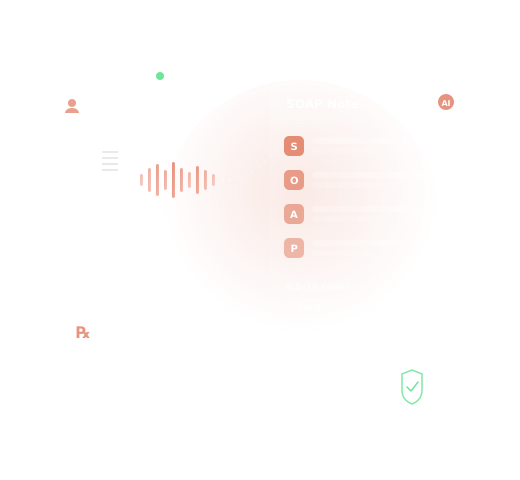
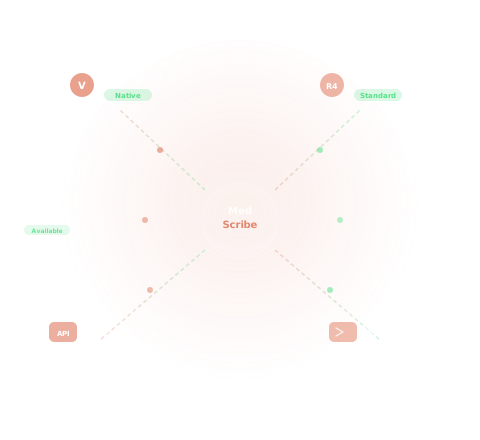
This stepwise model is why an AI medical scribe in India can fit practical hospital documentation needs: it supports speed, but keeps clinicians in control of the final record.
Local context
Hospitals in India often manage high patient volumes, multilingual communication, and variable documentation practices across departments. In an Admission Discharge Lounge, these realities become visible quickly. A patient may receive instructions in English, Hindi, or another regional language, while the final record still needs a clear clinical summary. Teams also need to coordinate with billing, pharmacy, and follow-up scheduling without extending discharge turnaround unnecessarily.
That is where an AI medical scribe in India becomes useful as an operational tool. It supports clinicians and hospital teams who want more consistent documentation without adding another manual step. For facilities evaluating digital documentation maturity, it can also complement broader workflow improvement efforts by making note creation faster and more standardized.
Use cases
Discharge counseling documentation: Capture the doctor-patient conversation and convert it into a draft summary for review.
Medication and follow-up instructions: Structure spoken guidance into clearer notes that can be checked before handover.
Short-stay and day-care workflows: Support rapid documentation where patient turnover is high and summaries must be completed promptly.
Multispecialty hospital coordination: Help standardize note drafting across departments that feed into a common discharge area.
Private hospital governance choices: Evaluate on-premise or private deployment where infrastructure control is part of the operational decision.
These examples show how AI medical scribe India healthcare adoption can be tied to everyday workflow improvement rather than abstract technology goals.
FAQ
Can this be used only for OPD consultations?
No. While the product narrative is rooted in consultation documentation, the same capture-to-draft workflow can support discharge counseling, transition summaries, and related documentation in an Admission Discharge Lounge.
Does the system finalize notes automatically?
No. It generates draft documentation and coding suggestions, but clinician review, edits, and final sign-off remain essential before records are completed.
How does multilingual support help in India?
It helps when conversations shift between English and regional languages, allowing teams to preserve more of the original context before converting it into structured documentation.
Is deployment flexible for hospitals?
Yes. Hospitals can evaluate on-premise or private deployment options based on workflow, IT environment, and governance preferences.
CTA
If your hospital wants to reduce documentation burden in discharge and transition workflows, explore how an AI medical scribe in India can support faster draft creation, clearer summaries, and clinician-led finalization. Review the core product at /medscribe, explore capabilities at /medscribe/features, and assess fit for your Admission Discharge Lounge workflow.