Introduction
Adolescent medicine consultations often require careful listening, sensitive communication, and structured documentation across physical, emotional, developmental, and family contexts. An AI medical scribe in India can help clinicians reduce manual note-taking during OPD visits by turning consultation conversations into draft clinical documentation that is ready for review. For hospitals, specialty clinics, and growing outpatient teams, the goal is practical: spend more attention on the young person and less time typing after every encounter.
MedScribe is designed as an AI documentation copilot for doctors and care teams. It converts consultation audio into structured notes, supports SOAP drafting, and provides coding suggestions that clinicians can verify before finalizing the record. In adolescent medicine, where visits may include preventive counselling, menstrual health, nutrition, mental wellbeing, sports participation, chronic disease follow-up, and confidential discussions, documentation needs to be both efficient and clinically usable. This is where an AI medical scribe in India becomes valuable as a workflow tool rather than a replacement for clinical judgment.
The product is built for day-to-day healthcare operations and supports workflows aligned with institutional documentation practices. It can fit clinics that want faster note completion, more consistent structure, and easier review across busy schedules.
Department workflow
Adolescent medicine workflows are different from many adult specialties because the consultation may move between the adolescent, parent, and clinician within the same visit. A typical OPD flow includes registration, history taking, symptom review, developmental and psychosocial assessment, examination findings, counselling, treatment planning, and follow-up instructions. Documentation can become time-consuming when the clinician must capture multiple perspectives, sensitive topics, and longitudinal context in one note.
An AI medical scribe in India can support this workflow by organizing the conversation into clinically meaningful sections. Instead of relying on fragmented handwritten notes or delayed typing after clinic hours, the doctor gets a draft that reflects the encounter structure. This is especially useful for repeat visits involving acne, obesity, PCOS-related concerns, menstrual issues, school stress, anxiety symptoms, asthma follow-up, diabetes education, vaccination counselling, or sports clearance discussions.
For adolescent medicine teams in India, multilingual interactions are common. A consultation may include English medical terminology mixed with Hindi or regional language phrases from the patient or parent. Documentation tools that support multilingual capture and speaker separation can help preserve context while keeping the final note reviewable by the clinician.
Features mapped to workflow
MedScribe focuses on documentation tasks that directly map to outpatient care delivery. Automatic SOAP note generation helps convert a free-flowing consultation into a familiar format for review. Speaker diarization helps distinguish who said what during a visit that may involve both adolescent and caregiver. Multilingual support is useful when clinicians switch between English and local languages during counselling or history taking.
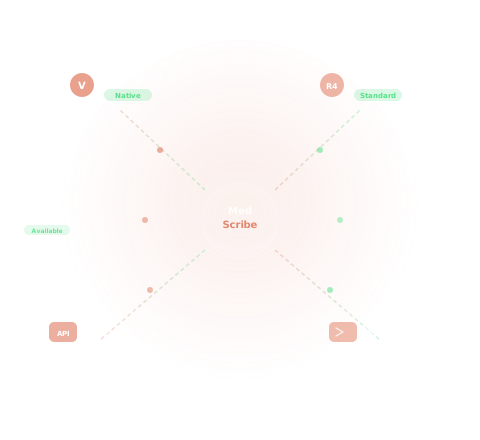
For coding-related workflows, the platform can suggest ICD-10 and CPT-aligned options based on the documented encounter, giving teams a starting point for review rather than forcing manual lookup every time. This can support cleaner downstream workflows for billing and reporting when used with clinician oversight. On-premise or private deployment options are available for organizations that prefer tighter control over infrastructure decisions and internal governance processes.
In practical terms, an AI medical scribe in India helps with three recurring needs: reducing after-hours documentation, improving note consistency across providers, and making records easier to review before sign-off. These are operational benefits that matter in both independent clinics and larger hospital departments.
How It Works
The workflow is designed to be simple for clinicians while keeping human review central to the final record.
- Capture the consultation conversation: During the adolescent medicine visit, the consultation audio is captured through the configured workflow. This may include discussion with the patient, parent, or guardian, along with counselling and follow-up planning. Speaker diarization helps separate participants in the transcript.
- Transcribe and structure the encounter: The system converts the conversation into text and organizes it into clinically relevant segments. Multilingual support helps when the visit includes mixed-language communication common in Indian OPD settings.
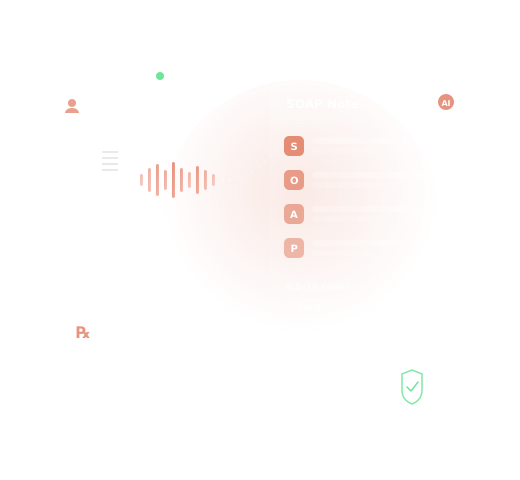
- Draft SOAP notes automatically: Based on the structured transcript, MedScribe generates a draft SOAP note that can include subjective history, objective findings, assessment themes, and plan elements. The draft is meant to save time, not replace clinician reasoning.
- Suggest coding support: The platform can surface ICD-10 and CPT suggestions linked to the documented encounter. These suggestions are review aids for the care team and should be checked before use in the final workflow.
- Review, edit, and sign off: The clinician reviews the draft note, makes corrections, adds missing details, and confirms the final documentation before record completion. This human checkpoint is essential for accuracy and clinical accountability.
- Choose deployment posture for operations: Organizations can evaluate on-premise or private deployment options based on internal IT, workflow, and governance preferences. This is a practical implementation choice for healthcare teams that want documentation support aligned with their operating environment.
Local context
Healthcare teams evaluating an AI medical scribe in India usually want a solution that fits real OPD conditions: variable consultation lengths, mixed-language communication, high patient volumes, and different documentation expectations across clinics and hospitals. Adolescent medicine adds another layer because visits may involve confidentiality-sensitive topics, family participation, and preventive counselling that does not always fit into short templated notes.
A practical documentation copilot should therefore support flexible workflows rather than force rigid templates. It should also complement existing operational pathways, whether the organization is standardizing notes across multiple doctors or trying to reduce documentation backlog in a single specialty unit. For Indian healthcare settings, deployment posture, review controls, and ease of adoption often matter as much as automation itself.
This is why many teams exploring AI medical scribe India healthcare use cases focus on implementation questions first: how quickly clinicians can review notes, whether multilingual conversations are handled well, and how the tool fits into existing documentation habits.
Use cases
In adolescent medicine, the product can support a range of routine and follow-up encounters. Common use cases include preventive health visits, menstrual and reproductive health consultations, obesity and nutrition counselling, acne and dermatology-related adolescent visits, asthma and allergy follow-up, diabetes education, mental wellbeing screening conversations, sports participation assessments, and chronic disease review appointments.
It can also help in multidisciplinary settings where adolescent physicians coordinate with psychologists, nutritionists, endocrinologists, or paediatric subspecialists. In these workflows, a structured draft note can make handoffs clearer and reduce the need to reconstruct the visit later from memory. For organizations scaling specialty OPD services, an AI medical scribe in India can support more standardized documentation without removing clinician control.
FAQ
Below are common implementation questions from clinics and hospitals considering this workflow.
Can this be used during sensitive adolescent consultations?
Yes, the tool is intended to support documentation workflows, but the clinician remains responsible for deciding when and how it is used, what gets reviewed, and what is finalized in the record.
Does it replace the doctor's note-writing responsibility?
No. It creates draft documentation and coding suggestions for review. The clinician edits, validates, and signs off before the record is finalized.
Is it useful for multilingual consultations?
Yes, multilingual support is relevant for Indian outpatient settings where English may be mixed with Hindi or regional languages during history taking and counselling.
Can hospitals choose different deployment models?
Yes, teams can evaluate on-premise or private deployment options based on internal workflow, IT, and governance preferences.
CTA
If your team is evaluating an AI medical scribe in India for adolescent medicine, start with the practical questions: how notes are drafted, how review happens, and how the workflow fits your OPD reality. Explore the core product pages for MedScribe, review detailed capabilities on features, and assess how documentation support can help your clinicians spend more time with patients and less time on repetitive charting.