Introduction
Anatomical pathology teams manage dense clinical information, specimen details, referral context, and reporting steps that can create documentation overhead across daily workflows. An AI medical scribe in India can help reduce manual note-taking by turning consultation and case discussion audio into structured drafts that clinicians can review, edit, and finalize. For pathology departments, the value is practical: clearer documentation support, faster first drafts, and more consistent capture of relevant details without changing how specialists make decisions.
MedScribe is designed as an AI documentation copilot for doctors, clinics, and hospitals that need usable clinical notes from real conversations. In anatomical pathology settings, this can support pre-analytic discussions, referral summaries, multidisciplinary case conversations, and internal documentation tasks where accurate context matters. Rather than replacing clinician judgment, the system supports workflows aligned with existing review and sign-off practices. This makes an AI medical scribe in India relevant for organisations looking to improve documentation quality while keeping the pathologist in control of the final record.
Department workflow
Anatomical pathology documentation often starts before a specimen is reviewed. Referral notes, clinical history, provisional diagnosis, prior imaging or lab context, and surgeon comments may all influence how a case is documented. During the workflow, teams may discuss grossing notes, specimen orientation, relevant findings, differential considerations, and report-ready summaries. In many hospitals, these details are spread across conversations, handwritten notes, LIS entries, and follow-up clarifications.
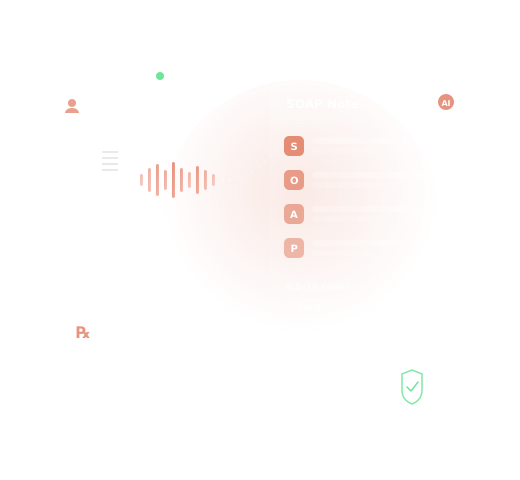
This is where an AI medical scribe in India can fit into the department workflow. Instead of relying only on manual recall after a discussion, the platform can capture the conversation, transcribe it, identify speakers, and structure the output into a draft note. That draft can then support SOAP-style documentation where appropriate, referral summaries, coding suggestions, or internal case notes before the clinician completes final review. For pathology teams in India, this is especially useful in high-volume OPD-linked and hospital-based environments where documentation consistency matters across multiple stakeholders.
Because anatomical pathology is detail-sensitive, the workflow must include checkpoints. Drafts should be reviewed by the responsible clinician, edited for terminology and case specifics, and signed off only after verification. The product is therefore best understood as documentation support for pathology workflows, not autonomous reporting.
Features mapped to workflow
Conversation capture: The platform supports the first step of documentation by capturing consultation or case discussion audio in a controlled workflow. This is useful when pathology teams discuss referral history, specimen context, or findings that need to be reflected in notes.
Multilingual transcription: In Indian healthcare settings, conversations may move between English and regional languages. Multilingual support helps teams document discussions more naturally while still producing usable drafts for review.
Speaker diarization: Pathology workflows often involve more than one participant, such as a pathologist, resident, surgeon, or technician. Speaker diarization helps separate who said what, improving traceability during review.
Automatic SOAP note generation: Where SOAP formatting is used for clinical documentation, the system can convert conversation content into a structured draft. This can help standardize first-pass notes and reduce repetitive typing.
ICD-10 and CPT suggestions: Coding support can help teams prepare documentation for downstream administrative workflows. Suggestions are intended to assist review, not replace coding validation by the clinician or billing team.
On-premise or private deployment options: Some hospitals prefer deployment choices that align with internal governance, IT controls, and data handling preferences. These options are workflow and infrastructure decisions that can support operational requirements.
How It Works
The product workflow is built around turning real clinical conversations into review-ready documentation for the clinician. In anatomical pathology, that means supporting the pathologist from discussion capture to final sign-off.
- Capture the conversation: A pathology consultation, referral review, or internal case discussion is recorded through the documentation workflow. The system is designed to capture spoken clinical context without requiring the clinician to type during the interaction.
- Transcribe and structure the discussion: The audio is transcribed with multilingual support where needed, and speaker diarization separates participants. The transcript is then organized into clinically useful sections so the raw conversation becomes easier to review.
- Draft the note automatically: Based on the structured transcript, the platform generates a SOAP-style note draft or another usable clinical summary. For anatomical pathology, this can help capture history, specimen-related context, assessment points, and next-step planning in a more consistent format.
- Add coding support: The system can surface ICD-10 and CPT suggestions linked to the documented encounter. These suggestions are meant to support downstream workflows and should be checked by the clinician or coding team before use.
- Review, edit, and approve: The clinician reviews the draft, corrects terminology, adds missing pathology-specific details, and confirms that the note reflects the case accurately. Human review is a required checkpoint before any record is finalized.
- Finalize within the chosen deployment model: Once approved, the note can move into the organisation's documentation workflow. Teams can choose on-premise or private deployment approaches based on operational preferences, IT architecture, and governance needs.
Local context
In India, pathology departments often work across mixed documentation environments that include hospital systems, standalone lab processes, referral paperwork, and clinician-driven summaries. An AI medical scribe in India is most useful when it adapts to these realities rather than forcing a rigid workflow. Practical value comes from helping clinicians document faster while preserving review control and fitting into existing operational patterns.
For hospitals and clinics evaluating an AI medical scribe in India, common considerations include multilingual usage, variable infrastructure maturity, and the need for deployment flexibility. Some organisations may prefer private or on-premise setups to align with internal IT and governance expectations. Others may focus first on reducing documentation burden in OPD-linked specialty workflows. In either case, the goal is to support pathology teams with better draft generation and clearer documentation pathways.
Use cases
Referral history capture: Convert clinician-pathologist discussions into structured summaries that preserve relevant history for case documentation.
Multidisciplinary case notes: Support documentation from tumour board or cross-specialty discussions where multiple speakers contribute findings and recommendations.
Specimen and findings discussions: Create draft notes from internal conversations around specimen context, observations, and reporting considerations.
Administrative coding support: Surface ICD-10 and CPT suggestions to help teams prepare for downstream coding review.
High-volume documentation support: Help pathology departments reduce repetitive typing and create more consistent first drafts during busy schedules.
FAQ
Can this replace a pathologist's final report?
No. The platform is designed to create draft documentation from conversations. A clinician should review, edit, and approve the final record before it is used.
Is it useful only for OPD consultations?
No. It can also support referral reviews, internal case discussions, multidisciplinary meetings, and other documentation-heavy workflows relevant to anatomical pathology.
How does it help in multilingual settings?
The product includes multilingual support so teams can document conversations that may include English and regional language usage, then review the generated draft in a structured format.
Does it support coding workflows?
Yes. It can provide ICD-10 and CPT suggestions as documentation support, with clinician or coding-team review before final use.
CTA
If your organisation is evaluating an AI medical scribe in India for anatomical pathology, focus on workflow fit: conversation capture, structured drafting, coding support, clinician review, and deployment choice. MedScribe is built to support practical documentation workflows for clinics and hospitals in India without removing human oversight. Explore how an AI medical scribe in India can help your pathology team create clearer drafts, reduce repetitive documentation work, and maintain final sign-off control.