Introduction
An AI medical scribe in India can help andrology clinics and hospital departments reduce documentation burden during busy OPD sessions. In andrology, consultations often involve sensitive history taking, fertility concerns, sexual health discussions, medication review, follow-up planning, and careful documentation of symptoms over time. That makes note quality important, but it also makes manual charting time-consuming. An AI medical documentation copilot supports clinicians by turning consultation conversations into structured draft notes that can be reviewed, edited, and finalized by the doctor.
This page focuses on practical use of an AI medical scribe for andrology settings in India. The goal is not to replace clinical judgment. Instead, it is to support everyday workflows with conversation capture, transcription structuring, SOAP note drafting, coding suggestions, speaker diarization, multilingual support, and deployment options such as on-premise or private environments. For clinics evaluating an AI medical scribe in India, the most useful question is simple: can it fit naturally into the way your team already works while keeping the clinician in control of the final record?
For andrology teams, that usually means faster first drafts, more consistent documentation, and less after-hours typing. It also means a workflow designed to align with existing record-keeping practices rather than forcing doctors to change how they consult.
Department workflow
Andrology consultations often follow a detailed but variable pattern. A patient may present with infertility concerns, erectile dysfunction, ejaculatory issues, hormonal symptoms, post-surgical follow-up, or chronic symptom review. The clinician typically gathers a sensitive history, reviews prior investigations, discusses lifestyle factors, notes medication use, and documents assessment and next steps. In many clinics, this happens across high-volume OPD blocks where time pressure can affect note completeness.
An AI medical scribe India healthcare workflow is useful here because the documentation burden is not limited to one part of the visit. It spans history of present illness, relevant sexual and reproductive history, prior treatment response, examination findings, counselling points, and follow-up instructions. When these details are captured from the consultation and converted into a structured draft, the doctor can focus more on the patient interaction and less on typing every line manually.
In hospital settings, the same need extends to follow-up visits, procedure counselling, referral summaries, and continuity across multiple clinicians. For smaller clinics, the value is often operational: fewer incomplete notes, easier review before sign-off, and better consistency in documentation style across providers.
Features mapped to workflow
The product value of an AI medical scribe in India becomes clearer when mapped to actual andrology workflows:
- Conversation capture: Supports the start of the consultation by capturing doctor-patient dialogue for documentation use.
- Speaker diarization: Helps distinguish clinician and patient speech, which is useful in counselling-heavy andrology visits.
- Multilingual support: Useful when consultations move between English and Indian languages during history taking or explanation.
- Structured transcription: Converts raw conversation into organized clinical content rather than leaving staff with a long transcript to clean up.
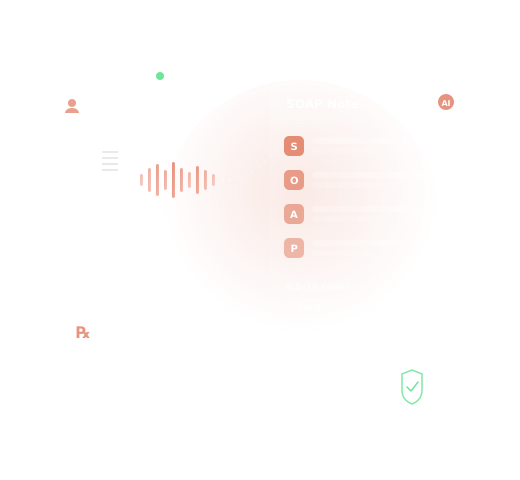
- Automatic SOAP note generation: Drafts subjective, objective, assessment, and plan sections for clinician review.
- ICD-10 and CPT suggestions: Provides coding support as a starting point, helping teams review likely codes alongside the note.
- Human review and edits: Keeps the clinician in charge before any record is finalized.
- On-premise deployment options: Supports workflows aligned with internal governance preferences for clinics and hospitals that want tighter infrastructure control.
These capabilities are broadly reusable across specialties, but they are especially relevant in andrology because consultations are often detailed, sensitive, and longitudinal. The result is a documentation process that supports the visit without trying to automate away clinical responsibility.
How It Works
Below is a practical end-to-end view of how the product fits into daily andrology documentation:
- Capture the consultation conversation: During the OPD visit, the system records the doctor-patient interaction through the configured workflow. This may include multilingual dialogue and counselling-heavy exchanges common in andrology. Speaker diarization separates who said what, creating a cleaner base for documentation.
- Convert speech into structured clinical text: The captured conversation is transcribed and organized into clinically relevant segments. Instead of leaving the team with a raw transcript, the system structures the content so important history, symptoms, and follow-up details are easier to review.
- Draft a SOAP note automatically: Using the structured conversation, the product generates a draft SOAP note. For andrology visits, this can help organize symptom history, prior treatment context, examination references, assessment themes, and plan items into a usable first draft.
- Suggest coding support: The workflow can surface ICD-10 and CPT suggestions based on the drafted note. These suggestions are intended to support review, not replace coder or clinician judgment. Teams can use them as a starting point before finalizing documentation.
- Review, edit, and sign off: The clinician checks the draft note, makes edits, confirms accuracy, and approves the final version. This human review checkpoint is essential. The record should only be finalized after the doctor verifies that the note reflects the actual consultation.
- Choose deployment posture for operations: Depending on clinic or hospital needs, teams may evaluate standard, private, or on-premise deployment approaches. This is best treated as a workflow and governance decision based on infrastructure, access control, and operational preferences.
Local context
For clinics and hospitals evaluating an AI medical scribe in India, local practicality matters more than generic automation claims. Many andrology consultations involve mixed-language communication, variable visit lengths, and documentation styles that differ by institution. A useful system should support these realities without adding friction for doctors or front-desk teams.
In India, OPD efficiency is often a major operational concern. Doctors may need to balance patient volume with detailed counselling and careful note quality. An AI medical scribe in India can support this by reducing repetitive typing and helping standardize draft documentation across providers. For larger organizations, deployment posture may also matter, especially when internal IT teams prefer private or on-premise options to align with existing governance processes.
The key is to treat the tool as a documentation copilot for India healthcare workflows, not as a black-box replacement for clinical reasoning. That approach is usually more practical for adoption and training.
Use cases
- New andrology consultations: Capture detailed history and generate a structured first draft for review.
- Follow-up visits: Document symptom progression, treatment response, medication changes, and next steps more consistently.
- Fertility-related counselling: Support note creation during longer discussions that include prior reports, lifestyle advice, and planning.
- Hospital outpatient departments: Help clinicians manage documentation load during high-volume sessions.
- Multi-doctor clinics: Improve consistency in note structure while preserving each clinician's final review and sign-off.
- Teams seeking infrastructure control: Evaluate private or on-premise deployment options as part of operational planning.
These use cases show why an AI medical scribe in India is relevant beyond simple transcription. The value comes from turning conversation into usable clinical documentation that still passes through clinician review before finalization.
FAQ
Can this replace the doctor's documentation responsibility?
No. The system helps create draft notes and coding suggestions, but the clinician should review, edit, and approve the final record.
Is it useful for sensitive andrology consultations?
Yes, because it is designed to support detailed history-taking and counselling workflows where manual note creation can be time-consuming. Final accuracy still depends on clinician review.
Does it support multilingual consultations?
The product includes multilingual support, which can help in clinics where consultations move between English and Indian languages.
Can hospitals consider private or on-premise deployment?
Yes. Deployment posture can be evaluated based on workflow, IT preferences, and governance needs. It should be treated as an operational decision rather than a blanket guarantee.
CTA
If your andrology clinic or hospital team is exploring a practical AI medical scribe in India, focus on workflow fit: how conversations are captured, how SOAP drafts are created, how coding support is presented, and how clinicians review before sign-off. A good implementation should reduce documentation friction while keeping doctors in control of the final note. Explore the core product, features, integrations, and pricing paths to assess whether the workflow matches your OPD and documentation needs.