Introduction
An AI medical scribe in India can help Ayurveda clinics and hospitals reduce time spent on repetitive documentation while keeping the clinician in control of the final record. For Ayush Ayurveda departments, consultations often include detailed history taking, prakriti discussion, symptom progression, lifestyle factors, and treatment planning. Capturing all of this consistently during a busy OPD can be difficult when doctors are balancing patient interaction, note writing, and follow-up instructions.
MedScribe is designed as an AI documentation copilot that converts consultation conversations into structured clinical notes and coding support suggestions. Instead of replacing clinical judgment, it supports the doctor with draft documentation that can be reviewed, edited, and signed off before the record is finalized. This makes it useful for clinics that want practical support for daily workflows, whether they run standalone Ayurveda practices, multispecialty hospitals with Ayush services, or growing chains that need more consistent documentation standards.
For teams evaluating an AI medical scribe in India, the main value is operational: less manual typing, more complete notes, and a smoother path from consultation to record completion. The product is built for real consultation flow, with multilingual support, speaker diarization, SOAP note drafting, and deployment options such as private or on-premise setups based on organizational preferences.
Department workflow
Ayurveda documentation has its own rhythm. A typical visit may include chief complaints, duration, ahara-vihara context, prior therapies, examination findings, assessment, and a treatment plan that may combine medicines, procedures, diet advice, and follow-up instructions. In many settings, the doctor must also maintain records that are understandable for internal teams, front-desk coordination, and future review.
In a busy OPD, this creates friction. Doctors may switch between listening, asking questions, and entering notes. Important details can remain in free text or be documented inconsistently across providers. Follow-up visits become harder when prior notes are brief or unstructured. An AI medical scribe in India is most useful when it fits this real workflow rather than forcing a new one.
For Ayurveda departments, the ideal documentation assistant should support conversation capture during consultation, organize the transcript into clinically usable sections, draft a SOAP-style note, and leave room for the clinician to refine terminology and treatment details. It should also support multilingual interactions common in Indian care settings, where patient conversations may move between English, Hindi, and regional languages.
Features mapped to workflow
Conversation capture: The product supports consultation audio capture so the doctor can focus more on the patient and less on typing. This is especially useful in Ayurveda visits where history and lifestyle discussion can be detailed.
Speaker diarization: By separating clinician and patient speech, the system helps structure the encounter more clearly. This is valuable when extracting symptoms, history, and recommendations from a natural conversation.
Multilingual support: Indian clinical environments often involve mixed-language consultations. Multilingual capability supports more practical use in Ayurveda OPD settings where language flexibility matters.
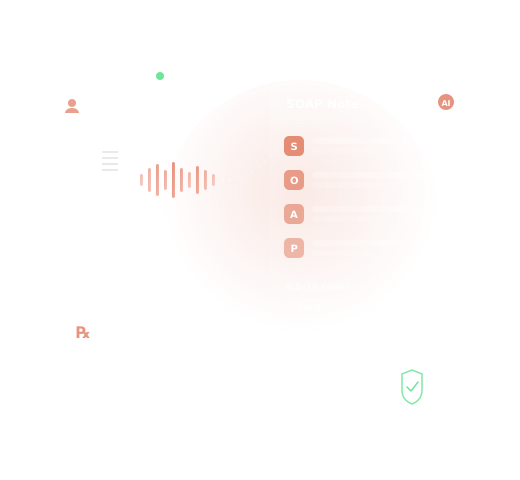
Automatic SOAP drafting: The system converts the consultation into a draft SOAP note, giving the clinician a usable starting point instead of a blank screen. This can improve consistency across providers and shifts.
Coding suggestions: ICD-10 and CPT suggestions can support downstream documentation workflows where coding references are needed. These remain suggestions for clinician or administrative review, not automatic final coding decisions.
Private deployment options: Some organizations prefer on-premise or private deployment models as part of their governance and IT approach. The platform is designed to support workflows aligned with those operational preferences.
Together, these capabilities make AI medical scribe India healthcare adoption more practical for teams that want documentation support without disrupting the consultation experience.
How It Works
The workflow is designed around the real path from consultation to finalized record, with human review built in at the right checkpoints.
- Capture the consultation conversation: During the Ayurveda visit, the consultation audio is captured through the configured workflow. The system is designed to support multilingual conversations and identify different speakers so the interaction can be separated into patient and clinician contributions.
- Transcribe and structure the encounter: The captured conversation is converted into text and organized into a structured draft. This helps surface key elements such as presenting complaints, history, observations, and treatment discussion from a natural conversation.
- Generate a SOAP-style draft note: Based on the structured transcript, the platform creates a draft SOAP note that the clinician can use as a starting point. For Ayurveda teams, this can reduce manual note writing while still allowing the doctor to refine terminology, findings, and recommendations.
- Add coding support suggestions: The system can provide ICD-10 and CPT suggestions to support documentation and administrative workflows where coding references are relevant. These suggestions are intended for review and should be validated by the clinician or authorized team member.
- Review, edit, and sign off: Before any record is finalized, the clinician reviews the draft, makes edits, confirms accuracy, and completes final sign-off. This human review checkpoint is essential because the product is a documentation copilot, not an autonomous decision-maker.
- Choose the deployment posture that fits operations: Clinics and hospitals can evaluate whether a private or on-premise approach better fits their IT and governance model. This is a workflow and infrastructure decision that supports internal preferences for data handling and system integration.
Local context
In India, Ayurveda services are delivered across independent clinics, Ayush centers, and hospital-based departments. Documentation needs vary widely: some teams want faster OPD note completion, some want more standardized records across doctors, and others want better continuity for repeat visits. An AI medical scribe in India should therefore be practical, flexible, and easy to fit into existing routines.
Language diversity is a major consideration. Consultations may include English medical terms, Hindi explanations, and regional language patient responses in the same encounter. Another common need is balancing detailed consultation style with limited time per patient. For these reasons, clinics often look for tools that support multilingual capture, structured note drafting, and clinician-led review rather than rigid templates alone.
For organizations comparing options, the best fit is usually the one that supports day-to-day OPD efficiency, complements existing documentation habits, and can scale from a single doctor workflow to a larger department model.
Use cases
High-volume Ayurveda OPD: Reduce after-hours documentation by generating draft notes from consultations and letting doctors review them quickly before finalization.
Follow-up heavy practice: Create more consistent records so repeat visits are easier to review and treatment progression is clearer over time.
Multilingual patient base: Support consultations where patient and clinician switch between languages, helping preserve more of the original encounter context.
Hospital Ayush department: Standardize note structure across multiple providers while keeping final clinical control with the treating doctor.
Private governance preference: Evaluate on-premise or private deployment options when the organization wants infrastructure choices aligned with internal IT workflows.
FAQ
Below are common questions from clinics and hospitals evaluating an AI medical scribe in India for Ayurveda workflows.
Can this be used in Ayurveda consultations?
Yes. The workflow is suitable for consultation-based documentation where detailed history, symptoms, assessment, and treatment planning need to be captured and converted into structured notes for clinician review.
Does it replace the doctor's documentation responsibility?
No. The system creates draft notes and coding support suggestions, but the clinician reviews, edits, and signs off before the record is finalized.
Can it support multilingual consultations in India?
The product is designed with multilingual support, which is useful for Indian care settings where consultations may include English, Hindi, and regional languages.
Does it offer deployment flexibility?
Yes. Organizations can evaluate private or on-premise deployment options based on workflow, IT, and governance preferences.
CTA
If your Ayurveda clinic or hospital wants a more efficient way to document consultations, MedScribe offers a practical path from conversation capture to reviewed clinical notes. Explore how an AI medical scribe in India can support your OPD workflow, improve note consistency, and reduce manual documentation burden while keeping the clinician in control. Review the core product pages for more detail on capabilities, features, integrations, and pricing, then assess the workflow fit for your team.