Introduction
Ayush Homeopathy consultations often involve detailed case-taking, symptom narratives, follow-up comparisons, and careful documentation of patient history over time. An AI medical scribe in India can help clinics and hospitals reduce manual note-writing during or after consultations by turning doctor-patient conversations into structured draft records. For homeopathy teams, this is useful when the consultation includes long descriptions of modalities, constitutional observations, past treatment history, and recurring follow-up notes.
MedScribe is designed as an AI documentation copilot for practical OPD use. It supports conversation capture, transcription, structured note drafting, and coding assistance while keeping the clinician in control of edits and final sign-off. Instead of replacing clinical judgment, it helps reduce repetitive documentation work so practitioners can focus more on listening, assessment, and patient communication. For organisations evaluating an AI medical scribe in India, the key value is not just speed, but a more consistent documentation workflow that can fit daily outpatient operations.
Department workflow
In Ayush Homeopathy settings, documentation usually starts with a detailed intake. The practitioner may record presenting complaints, onset, duration, aggravating and relieving factors, sleep, appetite, thermal preferences, emotional state, and prior remedies. Follow-up visits then require comparison against earlier notes, response tracking, and updates to the treatment plan. This creates a workflow where documentation is clinically important but time-consuming.
A practical scribe workflow for this department supports first consultations, repeat visits, and mixed OPD schedules. During the encounter, the system captures the conversation and separates speakers so the doctor and patient dialogue can be interpreted more clearly. After transcription, the content is organised into a draft note format that the clinician can review, edit, and approve. In larger hospitals, this can support standardisation across practitioners; in smaller clinics, it can reduce after-hours charting. This is where an AI medical scribe in India becomes useful for both solo and multi-doctor setups.
Features mapped to workflow
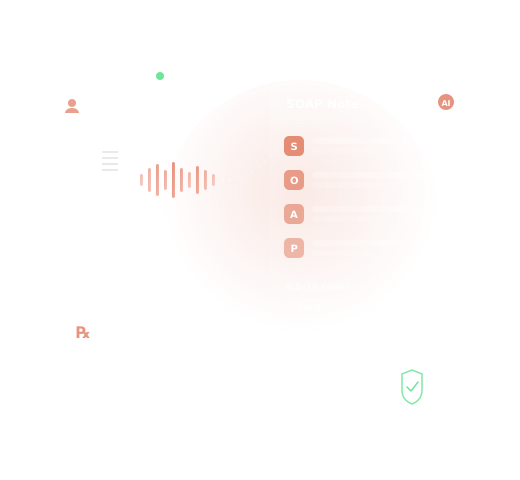
Automatic SOAP note drafting: Consultation conversations can be converted into structured draft notes, helping clinicians move from free-flowing dialogue to a usable clinical record. This is especially helpful when homeopathy consultations are long and descriptive.
Speaker diarization: By distinguishing between doctor and patient speech, the system supports cleaner transcripts and more reliable note drafting. This matters in OPD environments where family members or attendants may also speak during the visit.
Multilingual support: Many Indian clinics work across English, Hindi, and regional language conversations. Multilingual capability helps teams document more naturally without forcing a single-language consultation style.
ICD-10 and CPT suggestions: Where organisations need coding support for broader documentation or billing workflows, the platform can surface suggestions for clinician review. These are support tools, not final coding decisions.
On-premise or private deployment options: Some hospitals and enterprise groups prefer deployment choices that support internal governance and infrastructure preferences. These options are workflow and data-management decisions that can be aligned with organisational requirements.
Review before finalisation: Draft notes are not the final record until the clinician reviews, edits, and signs off. This checkpoint is important for quality, accuracy, and practical adoption.
How It Works
The product workflow is built around real consultation documentation rather than generic voice transcription. For teams considering an AI medical scribe in India, the process is designed to fit routine OPD use with clear review checkpoints.
- Capture the consultation conversation: The doctor starts the encounter as usual while the system records the consultation audio in the background or through the configured workflow. The goal is to capture the natural interaction without forcing a rigid template at the point of care.
- Transcribe and separate speakers: The audio is converted into text, and speaker diarization helps distinguish the clinician from the patient. This creates a cleaner base for documentation, especially in detailed homeopathy case-taking where symptom descriptions can be lengthy.
- Structure the transcript into a clinical draft: The system organises the conversation into a draft SOAP-style note. Relevant details from the history, symptoms, observations, and follow-up discussion are grouped into a more usable format for the clinician.
- Add coding support where needed: If the organisation uses coding workflows, the platform can provide ICD-10 or CPT suggestions based on the documented encounter. These suggestions are meant to support review, not replace clinician or coding team judgment.
- Review, edit, and approve: The clinician checks the draft note, corrects wording, adds missing context, and confirms the final version. Human review is the operational checkpoint before the record is finalised.
- Choose the right deployment posture: Depending on clinic or hospital needs, teams can evaluate private or on-premise deployment options. This supports workflows aligned with internal governance, IT preferences, and record-management practices.
Local context
Healthcare teams in India often work with high outpatient volumes, mixed digital maturity, and multilingual patient interactions. In Ayush Homeopathy, consultations may be longer than standard symptom-based visits because the practitioner is building a broader case profile. That makes documentation support particularly relevant. An AI medical scribe in India should therefore be practical, adaptable to different clinic sizes, and usable in both independent practices and hospital-based departments.
Another local consideration is infrastructure preference. Some organisations want cloud-based convenience, while others evaluate private or on-premise deployment for operational reasons. A useful AI medical scribe India healthcare solution should support these choices without making unrealistic promises. The focus should remain on helping clinicians document more consistently while preserving review control and fitting existing workflows.
Use cases
Detailed first consultations: Capture long-form patient narratives and convert them into structured draft notes for faster completion after the visit.
Follow-up comparison visits: Reduce repetitive typing when documenting symptom changes, response to remedies, and updated observations.
Busy OPD sessions: Support clinicians who need to maintain documentation quality while seeing multiple patients in a limited time window.
Multi-doctor departments: Encourage more consistent note structure across practitioners while still allowing individual clinical judgment and edits.
Hospitals evaluating documentation workflows: Use the platform as a practical layer between consultation conversations and final record creation, with human review built in.
FAQ
Can this be used for long homeopathy case-taking?
Yes. The workflow is suited to consultations where patients provide detailed histories and symptom descriptions. The output is a draft that the clinician reviews and refines.
Does the system replace the doctor's documentation judgment?
No. It assists with transcription, structuring, and drafting, but the clinician remains responsible for edits, validation, and final sign-off.
Can it support multilingual consultations in India?
Yes. Multilingual support is useful for clinics where consultations move between English, Hindi, or regional languages during the same visit.
Are coding suggestions automatic final codes?
No. ICD-10 and CPT suggestions are support features for review. Final coding decisions should be confirmed by the clinician or authorised team.
Is deployment flexible for different organisations?
Yes. Teams can evaluate private or on-premise deployment options based on workflow, infrastructure, and governance preferences.
CTA
If your Ayush Homeopathy clinic or hospital wants to reduce manual charting and improve documentation consistency, explore how an AI medical scribe in India can fit your OPD workflow. Review the core product at /medscribe, compare capabilities on /medscribe/features, and assess how conversation capture, SOAP drafting, coding support, and clinician review can work together in daily practice.