Introduction
Ayush Siddha consultations often involve detailed symptom narratives, lifestyle context, follow-up advice, and longitudinal observation. That makes documentation important, but also time-consuming in busy OPD settings. An AI medical scribe in India can help clinicians and care teams convert consultation conversations into structured draft notes that are easier to review, edit, and finalize. For Siddha departments in clinics and hospitals, the goal is practical: reduce repetitive typing, support clearer records, and help doctors stay focused on the patient interaction.
MedScribe is designed as an AI documentation copilot for real clinical workflows. It captures the consultation conversation, structures the transcript, drafts SOAP-style notes, and provides coding suggestions for clinician review. Rather than replacing clinical judgment, it supports the doctor with a faster first draft and a more consistent documentation process. For organizations evaluating an AI medical scribe in India, the value is usually strongest where consultation volume is high, note quality needs to be standardized, and teams want flexibility such as multilingual support or private deployment options.
In Siddha practice, where patient history and individualized treatment context matter, documentation tools should remain adaptable. This page explains how an AI medical scribe can fit into Ayush Siddha workflows in India without overcomplicating daily operations.
Department workflow
Siddha departments typically manage a mix of first visits, follow-ups, chronic condition reviews, symptom-based consultations, and treatment counseling. Documentation may include presenting complaints, history, examination findings, assessment, treatment plan, advice, and follow-up instructions. In many settings, doctors or assistants enter notes after the consultation, which can create delays, incomplete records, or variation in note quality.
An AI medical scribe in India is useful when the workflow needs to stay clinician-led but documentation support needs to become more efficient. During the consultation, the system can capture the conversation and separate speakers. After that, it can organize the content into a structured draft note for review. This is especially relevant in Siddha OPDs where doctors may switch between languages, explain treatment plans in patient-friendly terms, and revisit prior symptoms over multiple visits.
For hospitals and multi-specialty centers with Ayush services, the workflow benefit is not only speed. It is also about making records more readable, easier to audit internally, and more consistent across clinicians. Teams can use the tool to support note creation while keeping final sign-off with the treating doctor.
Features mapped to workflow
Conversation capture and transcription: The product records the consultation conversation and converts it into text, helping reduce manual note-taking during or after the visit.
Speaker diarization: It distinguishes between clinician and patient speech, which helps create cleaner drafts and reduces confusion in long consultations.
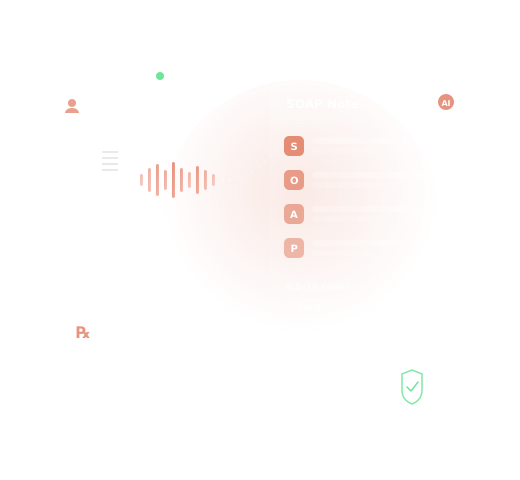
SOAP note generation: The system drafts structured SOAP notes from the conversation, giving clinicians a usable starting point instead of a blank screen.
ICD-10 and CPT suggestions: Coding support can help administrative and billing workflows where relevant, while still requiring clinician or authorized staff review before final use.
Multilingual support: In Indian care settings, consultations may move between English and regional languages. Multilingual capability supports more natural documentation workflows.
On-premise or private deployment options: Organizations with stricter governance preferences can evaluate deployment choices that support workflows aligned with internal IT and data handling requirements.
Clinician review and edit controls: Drafts are meant to be reviewed, corrected, and approved by the clinician before record finalization, which is essential for safe adoption.
How It Works
The workflow for this product is designed around the real sequence of a consultation, from conversation capture to final note approval.
- Capture the consultation conversation: During the Siddha consultation, the system records the interaction through the configured setup. It is built to support multilingual conversations and uses speaker diarization to separate patient and clinician speech for cleaner downstream processing.
- Transcribe and structure the dialogue: The audio is converted into a structured transcript. Instead of leaving teams with raw text, the system organizes the conversation into clinically relevant segments that can be used for documentation.
- Draft a SOAP note automatically: Based on the transcript, MedScribe generates a draft SOAP note. This gives the doctor a practical first version covering subjective inputs, observed findings, assessment context, and plan elements discussed during the visit.
- Add coding support for review: The system can surface ICD-10 and CPT suggestions where appropriate. These are intended as workflow aids for review, not automatic final coding decisions, and should be checked by the clinician or authorized staff.
- Review, edit, and sign off: The clinician reviews the draft note, makes corrections, adds missing clinical nuance, and approves the final version before it becomes part of the record. This human checkpoint is central to safe and reliable use.
- Choose deployment posture based on operations: Clinics and hospitals can evaluate on-premise or private deployment approaches as governance and workflow decisions. This helps teams align implementation with internal infrastructure preferences and documentation processes.
Local context
In India, Siddha departments often balance traditional care approaches with modern documentation expectations inside clinics, hospitals, and integrated Ayush settings. Teams may work across mixed digital maturity levels, from basic desktop documentation to broader hospital systems. That is why an AI medical scribe in India should be practical first: easy to fit into OPD routines, supportive of multilingual consultations, and flexible enough for different infrastructure environments.
The local need is not just faster notes. It is also better continuity across follow-ups, clearer records for internal coordination, and less after-hours documentation burden for clinicians. For organizations comparing options, AI medical scribe India healthcare use cases are strongest where patient volume, documentation consistency, and clinician time pressure intersect. Siddha teams can benefit when the tool supports their existing consultation style rather than forcing a rigid template.
Use cases
Busy OPD consultations: Draft notes can be prepared from the conversation so doctors spend less time typing after each visit.
Follow-up visits for chronic complaints: Structured notes help track symptom progression, treatment response, and plan changes over time.
Multilingual patient interactions: Clinics serving diverse patient populations can use the system in workflows where language switching is common.
Hospital-based Ayush departments: Standardized draft documentation can support coordination between Siddha units and broader administrative teams.
Private clinics seeking cleaner records: An AI medical scribe in India can help solo and group practices improve note consistency without adding more manual work.
FAQ
Below are common implementation questions from Siddha clinics and hospitals evaluating documentation support tools.
Can this be used in Siddha consultations with long patient narratives?
Yes. The workflow is suited to consultations where patients describe symptoms, history, and lifestyle context in detail. The system helps convert that conversation into a structured draft note for clinician review.
Does the tool replace the doctor's documentation responsibility?
No. It is a documentation copilot. The clinician should review, edit, and approve the draft before final sign-off.
Can it support multilingual consultations in India?
Yes. Multilingual support is part of the product capability, which is useful in Indian OPD settings where consultations may include English and regional languages.
How does coding support work?
The system can provide ICD-10 and CPT suggestions based on the documented encounter. These suggestions should be reviewed before use in operational workflows.
Is private deployment possible?
Organizations can evaluate on-premise or private deployment options based on workflow, infrastructure, and governance preferences. These choices support workflows aligned with internal requirements.
CTA
If your Siddha clinic or hospital wants to reduce documentation burden without disrupting the consultation experience, MedScribe offers a practical path. Explore how an AI medical scribe in India can support SOAP drafting, coding assistance, multilingual documentation, and clinician-led review. For teams assessing AI medical scribe India healthcare workflows, the next step is to map the product to your OPD process, review needs, and deployment preferences.
See related product details on /medscribe, feature capabilities on /medscribe/features, integration considerations on /medscribe/integrations, and planning options on /medscribe/pricing.