Introduction
AI medical scribe in India is becoming a practical option for clinics and hospitals that want to reduce documentation load without disrupting the consultation experience. In Ayush Yoga Naturopathy settings, clinicians often balance detailed patient history, lifestyle assessment, therapy planning, follow-up instructions, and ongoing progress notes within busy OPD schedules. An AI medical documentation copilot can support this process by turning consultation conversations into structured draft notes that are easier to review, edit, and finalize.
For Ayush Yoga Naturopathy teams, documentation is often broader than symptom capture alone. It may include patient routines, sleep patterns, diet, stress factors, movement limitations, therapy recommendations, and longitudinal wellness observations. MedScribe is designed to help convert spoken interactions into usable clinical documentation, including SOAP-style drafts and coding support where relevant. Rather than replacing clinician judgment, it supports a workflow where the doctor remains in control of review and sign-off. This makes AI medical scribe in India relevant for practical, day-to-day care delivery across independent clinics, wellness centres attached to hospitals, and multidisciplinary AYUSH departments.
Department workflow
Ayush Yoga Naturopathy consultations usually involve a conversational and observational workflow. A patient may describe chronic concerns, lifestyle triggers, stress patterns, digestive issues, sleep quality, pain behaviour, or mobility restrictions. The clinician may then ask follow-up questions, assess functional status, discuss yoga-based or naturopathy-based interventions, and explain home-care routines. Documentation must capture both the clinical context and the care plan in a way that remains useful for future visits.
In many departments, this creates a repetitive burden: writing history notes, summarizing findings, documenting advice, and preparing follow-up records after each consultation. When patient volume rises, note quality can become inconsistent or delayed. An AI medical scribe in India can support Ayush Yoga Naturopathy workflows by helping clinicians document consultations faster while preserving the need for human review. This is especially useful in OPD environments where doctors move quickly between first visits, therapy reviews, and repeat consultations.
Typical workflow needs in this department include capturing detailed narratives, organizing information into a structured format, separating doctor and patient speech, supporting multilingual conversations, and preparing drafts that can be edited before finalization. For clinics that prefer tighter control over data handling, deployment choices such as private or on-premise setups can also be considered as operational decisions aligned with internal governance preferences.
Features mapped to workflow
MedScribe is built around the practical steps clinicians already follow. Conversation capture supports the start of the consultation without forcing the doctor to type continuously. Speaker diarization helps distinguish patient and clinician voices, which is useful when extracting history, recommendations, and follow-up instructions from a natural discussion. Multilingual support is relevant in India healthcare settings where consultations may shift between English, Hindi, and regional languages during the same visit.
Once the conversation is transcribed, the system structures the content into a draft note. Automatic SOAP note generation can help Ayush Yoga Naturopathy clinicians organize subjective complaints, observations, assessment summaries, and plan details into a more consistent format. Coding suggestions such as ICD-10 or CPT support can be useful where organizations maintain standardized documentation workflows, though the clinician should always confirm relevance before use.
For administrators and IT teams, deployment posture matters. Some organizations may prefer cloud-based workflows, while others may evaluate private or on-premise deployment for internal process reasons. The product is designed to support workflows aligned with these operational choices rather than forcing a single setup. This makes AI medical scribe India healthcare adoption more practical across different clinic sizes and hospital environments.
How It Works
The workflow is designed to fit routine consultations while keeping the clinician in control of the final record.
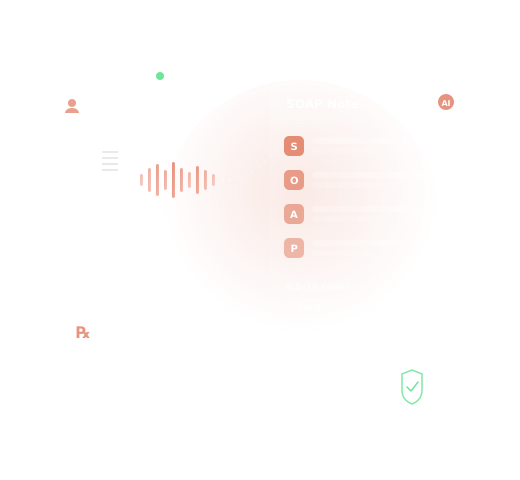
- Capture the consultation conversation: During the OPD visit, the doctor and patient speak naturally while the system records the interaction. This can be useful for detailed lifestyle and therapy discussions common in Ayush Yoga Naturopathy consultations.
- Transcribe and separate speakers: The audio is converted into text, and speaker diarization helps identify who said what. This reduces the effort needed to reconstruct history, advice, and follow-up instructions from memory after the visit.
- Structure the transcript into a clinical draft: The system organizes the conversation into a usable note format, including SOAP-style drafting where appropriate. This helps transform a free-flowing consultation into a structured record that is easier to review.
- Add coding support and workflow cues: Where needed, the draft can include ICD-10 or CPT suggestions to support standardized documentation workflows. These are prompts for clinician review, not automatic final coding decisions.
- Review, edit, and sign off: The clinician checks the draft, corrects wording, adds missing findings, and confirms the final note before it becomes part of the record. Human review is the operational checkpoint that keeps documentation clinically usable.
Deployment can also be matched to organizational needs. Clinics and hospitals may evaluate private or on-premise options when they want tighter control over infrastructure decisions. In that sense, AI medical scribe in India is not just a transcription tool; it is a documentation workflow layer that can be adapted to how the department already functions.
- Use the finalized note in downstream workflows: After sign-off, the note can support continuity of care, follow-up planning, internal documentation standards, and integration-oriented workflows depending on the organization’s setup.
Local context
In India, Ayush Yoga Naturopathy departments often work across varied care environments, from standalone centres to hospital-based OPDs and integrated wellness programs. Documentation needs can differ by organization, but common pressures remain the same: limited consultation time, multilingual patient interactions, and the need for clear follow-up records. An AI medical scribe in India can help address these operational realities by reducing manual note-taking effort and improving consistency in draft documentation.
Local relevance also comes from the nature of patient communication. Many consultations include mixed-language conversations, descriptive symptom narratives, and lifestyle counselling that are difficult to summarize quickly. A practical AI scribe should therefore support natural speech patterns rather than forcing rigid templates too early in the encounter. For Indian clinics and hospitals, this makes workflow fit more important than generic automation claims.
Use cases
Ayush Yoga Naturopathy teams can use MedScribe in several practical scenarios. In first consultations, it can help capture long-form patient history and convert it into a structured draft note. In follow-up visits, it can summarize progress, adherence to yoga or naturopathy recommendations, and changes in symptoms or routine. In multidisciplinary settings, it can help create clearer records that are easier to review when patients move between departments.
It can also support clinicians who want to spend more time maintaining eye contact and explaining care plans instead of typing throughout the visit. For administrators, it offers a way to standardize note structure across providers while still preserving clinician review. This is where AI medical scribe in India becomes useful as a workflow support tool rather than a one-size-fits-all automation layer.
FAQ
Below are common implementation questions from clinics and hospitals evaluating AI-assisted documentation for AYUSH workflows.
Can this work for conversational AYUSH consultations?
Yes. It is suited to consultations that include detailed history, lifestyle discussion, therapy explanation, and follow-up advice, then converts that conversation into a structured draft for review.
Does it replace clinician documentation judgment?
No. The draft note should be reviewed, edited, and approved by the clinician before finalization. Human sign-off remains an essential workflow step.
Is multilingual use relevant for India healthcare settings?
Yes. Multilingual support can help when consultations move between English, Hindi, and regional languages, which is common in many OPD environments.
Can organizations choose different deployment approaches?
Yes. Depending on internal workflow and governance preferences, teams may evaluate private or on-premise deployment options in addition to other setups.
CTA
If your Ayush Yoga Naturopathy department wants to reduce manual note-taking and create more consistent consultation records, MedScribe offers a practical starting point. Explore how an AI medical scribe in India can fit your OPD workflow, support SOAP-style drafting, and keep clinicians in control of final documentation. Review the product pathways for MedScribe, compare capabilities on features, and assess how the workflow may align with your clinic or hospital operations.