Introduction
An AI medical scribe in India can help clinics and hospitals reduce the manual effort involved in turning consultations into usable documentation for downstream billing and claims work. For billing teams, the challenge is rarely just note-taking. It is the gap between what happens during the consultation and what later needs to be reviewed, coded, checked, and submitted. When documentation is incomplete, delayed, or inconsistent, claims workflows slow down and staff spend more time clarifying records with clinicians.
MedScribe is designed as an AI documentation copilot that converts consultation conversations into structured clinical notes and coding suggestions. For organisations looking at an AI medical scribe India healthcare workflow, the practical value is in creating cleaner handoffs between doctors, front-desk staff, medical records teams, and billing claims operations. Instead of relying only on retrospective typing, teams can work from draft SOAP notes, speaker-separated transcripts, and suggested ICD-10 or CPT mappings that clinicians can review before final sign-off.
This page focuses on how an AI medical scribe in India supports billing claims departments while staying useful for daily OPD and hospital workflows. The goal is not to replace clinical judgment or billing review, but to reduce repetitive documentation work and improve the quality of information available for claims preparation.
Department workflow
In many Indian healthcare settings, billing claims teams depend on documentation created upstream by doctors and care staff. A typical workflow starts with patient registration and consultation, followed by note creation, diagnosis capture, procedure documentation, coding review, bill generation, and claims preparation where applicable. Delays often happen when the clinical note is written late, when diagnosis details are too brief, or when billing staff need to go back to the doctor for clarification.
An AI medical scribe in India fits into this workflow at the point of care. It captures the consultation conversation, structures the transcript, drafts a SOAP note, and surfaces coding suggestions for clinician review. Once the clinician edits and approves the note, billing and claims teams receive more usable documentation earlier in the process. This can support cleaner internal coordination for OPD visits, day-care procedures, specialty consultations, and hospital encounters where documentation quality affects coding readiness.
For billing claims departments, the operational benefit is straightforward: less time spent chasing missing details, better visibility into diagnosis and procedure context, and a more standardised starting point for coding and claim preparation. The system supports workflows aligned with internal documentation review rather than bypassing them.
Features mapped to workflow
Conversation capture and transcription: The product records or ingests consultation audio and converts it into text. This helps preserve the clinical discussion in a form that can be reviewed later by the doctor or documentation team.
Speaker diarization: By separating clinician and patient speech, the transcript becomes easier to interpret. This is useful when billing or records teams need to understand symptom history, advice given, or procedure-related discussion without reading an unstructured block of text.
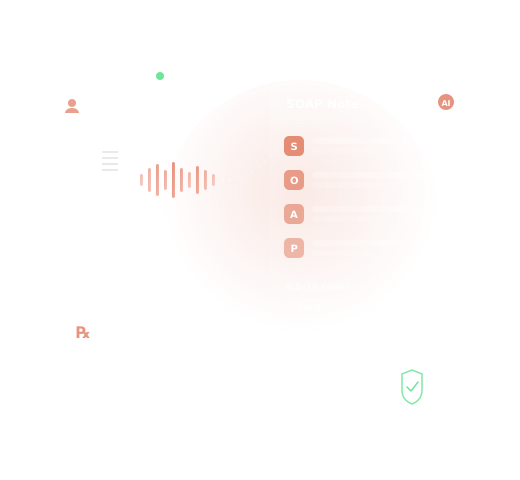
Automatic SOAP note generation: Draft Subjective, Objective, Assessment, and Plan notes help clinicians move faster from conversation to structured documentation. For billing claims teams, this creates a more consistent note format that is easier to review.
ICD-10 and CPT suggestions: Coding support can help surface likely diagnosis and procedure codes based on the documented encounter. These suggestions are not a substitute for professional review, but they can speed up coding preparation and reduce manual lookup effort.
Multilingual support: In India, consultations may shift between English and regional languages. Multilingual capability can help preserve context from real-world conversations and improve note completeness for mixed-language encounters.
On-premise or private deployment options: Organisations with stricter governance preferences may choose deployment models that fit their IT and operational requirements. This should be treated as a workflow and infrastructure decision, not as a blanket compliance claim.
How It Works
The workflow below shows how the product supports documentation and billing claims readiness from the consultation stage to final record review.
- Capture the consultation conversation: During or immediately after the encounter, the clinician or facility workflow initiates audio capture. The system processes the conversation and identifies speakers so the interaction is easier to follow in transcript form.
- Structure the transcript into clinical context: The raw conversation is converted into a structured transcript with medically relevant sections. This helps separate history, symptoms, findings, and care plan details that billing and records teams often need clarified later.
- Draft a SOAP note automatically: Based on the consultation, MedScribe generates a draft SOAP note. The clinician can review, edit, and refine the note so the final documentation reflects the actual encounter rather than an untouched machine draft.
- Surface coding suggestions for review: The system presents ICD-10 and CPT suggestions linked to the documented encounter. These suggestions support coding workflows, but the clinician and billing or coding team remain responsible for checking relevance before use.
- Complete human review and sign-off: Before the record is finalised, the clinician reviews the transcript, note, and suggested codes, makes edits where needed, and signs off. This checkpoint is important because billing claims workflows depend on approved documentation, not only generated output.
- Route approved documentation into operations: Once reviewed, the final note can support downstream records, billing preparation, and claims-related workflows. Organisations can choose deployment approaches such as on-premise or private environments based on internal governance and integration needs.
Local context
For providers evaluating an AI medical scribe in India, local practicality matters. OPD volumes can be high, consultations may be brief, and clinicians often switch between English and regional languages. Documentation tools need to fit this reality without adding friction. A useful deployment is one that supports the doctor during routine care while also helping non-clinical teams receive clearer records for billing and claims work.
Hospitals and clinics in India may also have different infrastructure preferences. Some may prefer cloud-based workflows for faster rollout, while others may evaluate private or on-premise deployment for internal governance reasons. In either case, the product should support workflows aligned with existing review processes, especially where billing claims teams depend on approved notes and coding checks.
An AI medical scribe in India is most effective when introduced as part of a practical documentation improvement plan: better note consistency, faster clinician review, and more reliable handoffs to administrative teams.
Use cases
Specialty OPD documentation: Specialists can use draft notes to reduce after-hours typing while giving billing teams more complete diagnosis context.
Day-care and procedure workflows: Procedure-related encounters often need clear documentation for coding support. Structured notes can help teams prepare records faster.
Multi-doctor clinics: Standardised SOAP drafts can reduce variation in note format across providers, making downstream review easier for billing staff.
Hospital outpatient departments: High-volume settings can benefit when consultation documentation is available sooner and coding suggestions are surfaced earlier.
Mixed-language consultations: Multilingual support can help preserve patient history and treatment discussion that might otherwise be lost in manual summarisation.
FAQ
Can billing claims teams use the output directly?
The output is best used as a reviewed starting point. Clinicians should edit and approve notes, and coding or billing teams should verify suggestions before final use.
Does the product replace medical coders?
No. It provides coding support through ICD-10 and CPT suggestions, but human review remains important for accurate documentation and billing workflows.
Is this suitable for clinics as well as hospitals?
Yes. The workflow can support individual doctors, multi-specialty clinics, and hospitals that want faster documentation handoffs to records and billing teams.
Can it work in multilingual consultation settings?
The product is designed with multilingual support, which can be useful in Indian healthcare environments where consultations may include more than one language.
CTA
If your organisation is exploring an AI medical scribe in India for better billing claims readiness, MedScribe offers a practical path from consultation capture to reviewed clinical documentation. Explore the product pages for workflow details, features, integrations, and pricing, then assess how the documentation flow can fit your OPD or hospital operations.