Introduction
AI medical scribe in India is becoming a practical option for hospitals and clinics that want to reduce documentation burden without disrupting day-to-day care delivery. For biomedical engineering teams, the value is not only in faster note creation but also in how documentation tools fit into device-enabled clinical environments, OPD workflows, and hospital IT architecture. MedScribe is designed as an AI documentation copilot that converts consultation conversations into structured clinical notes and coding suggestions, while keeping the clinician in control of review and sign-off.
In Indian healthcare settings, documentation needs often vary across specialties, consultation styles, and infrastructure maturity. Biomedical engineering stakeholders are frequently involved when hospitals evaluate microphone setups, workstation compatibility, deployment models, and integration readiness. That is why an AI medical scribe should be assessed not just as a transcription tool, but as part of a broader clinical workflow that supports usability, data handling choices, and operational reliability.
This page explains how an AI medical scribe in India can support practical documentation workflows for clinics and hospitals, with a focus on biomedical engineering considerations and implementation realities.
Department workflow
Biomedical engineering teams often sit at the intersection of clinical operations, medical devices, and hospital technology planning. When a documentation copilot is introduced, their role may include evaluating audio capture quality, device placement in consultation rooms, compatibility with existing systems, and support for multilingual environments. In OPD settings, the workflow usually starts with a clinician-patient conversation, followed by note preparation, coding support, review, and record finalization.
In many hospitals, biomedical engineering teams also help standardize room-level hardware and assess whether the solution should run in a cloud-connected model, private environment, or on-premise deployment. This matters because consultation rooms differ in acoustics, background noise, and device availability. A practical AI medical scribe should therefore support speaker separation, structured note drafting, and flexible deployment posture so the hospital can align implementation with its governance and infrastructure preferences.
For India-based providers, another workflow consideration is language diversity. Consultations may move between English and regional languages, or include mixed-language exchanges. A documentation tool that supports multilingual use can better fit real OPD conditions and reduce the need for manual rewriting after the visit.
Features mapped to workflow
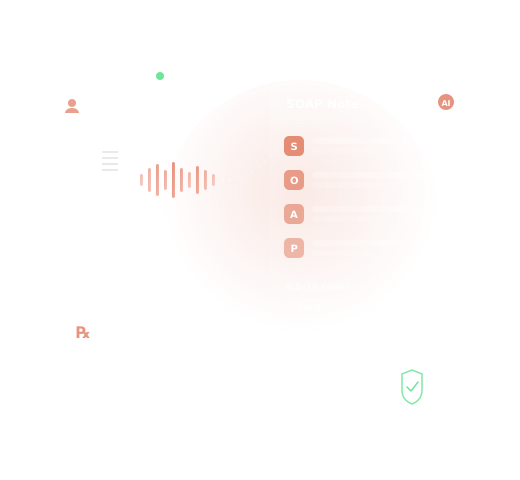
MedScribe is built around the core documentation sequence that clinicians already follow. First, it captures the consultation conversation. Next, it converts speech into text and organizes the content into clinically useful sections. It can then draft SOAP notes, suggest ICD-10 and CPT codes for review, and present the output for clinician editing before final sign-off.
For biomedical engineering and hospital operations teams, the feature set maps to workflow in a practical way:
- Automatic SOAP note generation: helps convert raw conversation into a familiar clinical structure that can be reviewed quickly.
- Speaker diarization: separates clinician and patient voices to improve readability and note organization.
- ICD-10/CPT suggestions: supports coding workflows by surfacing likely options for clinician or billing review rather than replacing human judgment.
- Multilingual support: useful for Indian consultations where language switching is common.
- On-premise deployment options: supports workflows aligned with internal governance, IT architecture, and data handling preferences.
These capabilities make AI medical scribe in India relevant not only to doctors but also to the teams responsible for implementation, room readiness, and operational continuity.
How It Works
The MedScribe workflow is designed to follow the real sequence of a consultation, from conversation capture to clinician-approved documentation.
- Capture the consultation audio: During the patient encounter, the system records the conversation through the configured device setup in the clinic or hospital. Biomedical engineering and IT teams can help determine whether the room uses standard microphones, workstation-connected audio, or a deployment model suited to the facility environment.
- Transcribe and structure the conversation: The audio is converted into text, with speaker diarization used to distinguish clinician and patient speech. The transcript is then organized into clinically meaningful segments so the raw conversation becomes easier to review.
- Draft SOAP notes automatically: Based on the structured transcript, MedScribe prepares a draft SOAP note. This gives the clinician a usable starting point rather than a blank screen, which can be especially helpful in high-volume OPD workflows.
- Surface coding suggestions: The system presents ICD-10 and CPT suggestions linked to the documented encounter. These are intended as support for review and downstream workflows, not as final coding decisions.
- Clinician review, edit, and sign-off: The doctor reviews the draft, makes corrections, confirms clinical accuracy, and finalizes the note. Human review is an operational checkpoint in the workflow, ensuring the record is validated before completion.
- Choose deployment posture for governance needs: Hospitals can evaluate whether a private or on-premise setup better supports internal workflow and governance decisions. This is a practical implementation choice shaped by infrastructure, access controls, and operational preferences.
Local context
In India, healthcare organizations often need technology that works across varied infrastructure conditions, mixed digital maturity, and multilingual patient interactions. An AI medical scribe in India should therefore be practical, adaptable, and easy to evaluate within existing OPD and hospital routines. For biomedical engineering teams, this means looking at room acoustics, hardware compatibility, uptime expectations, and how the tool fits with broader digitization plans.
Another local consideration is that many providers want flexibility in deployment and governance. Some may prefer centrally managed environments, while others may evaluate private or on-premise approaches. MedScribe is designed to support these workflow-aligned decisions without making compliance guarantees. The focus remains on helping hospitals and clinics build a documentation process that is usable for clinicians and manageable for operational teams.
The phrase AI medical scribe India healthcare often reflects a search for solutions that are not generic, but suited to Indian care delivery realities such as high patient throughput, variable consultation formats, and language diversity. In that context, the product value comes from reducing repetitive documentation effort while preserving clinician oversight.
Use cases
Biomedical engineering and hospital leadership teams may evaluate MedScribe for several practical scenarios:
- High-volume OPD clinics: where clinicians need faster draft notes after each consultation.
- Multi-specialty hospitals: where standardized documentation support can help across departments with different note styles.
- Facilities with multilingual consultations: where mixed-language interactions make manual note preparation slower.
- Hospitals assessing private deployment: where infrastructure and governance preferences influence implementation planning.
- Clinical environments with device planning needs: where biomedical engineering teams help optimize audio capture and workstation setup.
Across these scenarios, AI medical scribe in India is most useful when introduced as a workflow support layer rather than a replacement for clinical judgment. The strongest implementations usually combine good room setup, clear review steps, and clinician training on editing and sign-off.
FAQ
Below are common implementation questions from clinics, hospitals, and biomedical engineering stakeholders evaluating documentation automation.
Can this replace clinician documentation entirely?
No. The system is designed to draft notes and suggest coding support, but the clinician should review, edit, and approve the final record.
Is it suitable for multilingual consultations in India?
Yes, multilingual support is part of the product design, which can help in consultations where English and regional languages are both used.
What is the role of biomedical engineering in deployment?
Biomedical engineering teams may help assess room audio setup, device compatibility, workstation readiness, and whether a private or on-premise deployment model fits the hospital environment.
Does it support coding workflows?
It can provide ICD-10 and CPT suggestions to support review workflows. These suggestions should be checked by the appropriate clinician or coding team before use.
CTA
If your clinic or hospital is evaluating AI medical scribe in India for practical documentation improvement, start with the workflow questions that matter most: how consultations are captured, how notes are reviewed, and what deployment model best fits your environment. MedScribe is designed to support daily OPD and hospital documentation with structured note drafting, coding support, multilingual capability, and implementation flexibility for Indian healthcare settings. Explore the product pathways through /medscribe and feature details at /medscribe/features to assess fit for your biomedical engineering and clinical operations teams.