Introduction
Cardiac ICU documentation is detailed, time-sensitive, and often fragmented across rounds, bedside updates, procedure notes, and handover summaries. An AI medical scribe in India can help hospitals and specialist units reduce manual note-taking burden by turning clinician-patient or clinician-team conversations into structured draft documentation. For Cardiac ICU environments, the value is not just faster note creation, but more consistent capture of assessment, interventions, and follow-up points that clinicians can review before final sign-off.
MedScribe is designed as an AI medical documentation copilot for doctors, clinics, and hospitals. It supports automatic SOAP note drafting, coding suggestions, speaker diarization, multilingual workflows, and deployment options such as private or on-premise setups. In a Cardiac ICU setting, this can support workflows aligned with internal documentation standards while keeping the clinician in control of edits, validation, and final record completion. For organisations evaluating an AI medical scribe in India, the practical question is how well the tool fits real bedside and unit workflows rather than how many features it lists in isolation.
Department workflow
Cardiac ICU teams manage high-acuity patients where documentation often spans admission summaries, daily progress notes, procedure-related updates, medication changes, escalation decisions, and discharge planning. Consultants, intensivists, residents, nurses, and allied teams may all contribute to the information flow. This creates a familiar challenge: clinically important details are discussed in real time, but formal note entry may happen later under time pressure.
In this environment, an AI documentation copilot can support the sequence of care by capturing spoken interactions during rounds or consultations, separating speakers, converting speech to text, and organising the output into a draft note. Instead of replacing clinical judgment, it reduces repetitive typing and helps clinicians start from a structured draft. For hospitals exploring AI medical scribe India healthcare solutions, Cardiac ICU is a strong use case because the department depends on timely, reviewable, and consistent documentation across shifts.
Typical Cardiac ICU workflow points where documentation support matters include initial case discussion, post-procedure review, daily rounds, family counselling summaries, transfer notes, and discharge preparation. The goal is to make these moments easier to document without interrupting care delivery.
Features mapped to workflow
Conversation capture and transcription: During bedside rounds or review discussions, the platform can capture the clinical conversation and convert it into text. This is useful when multiple participants contribute findings, plans, and clarifications.
Speaker diarization: In Cardiac ICU settings, more than one clinician may speak during a case review. Speaker separation helps preserve context and makes draft notes easier to verify.
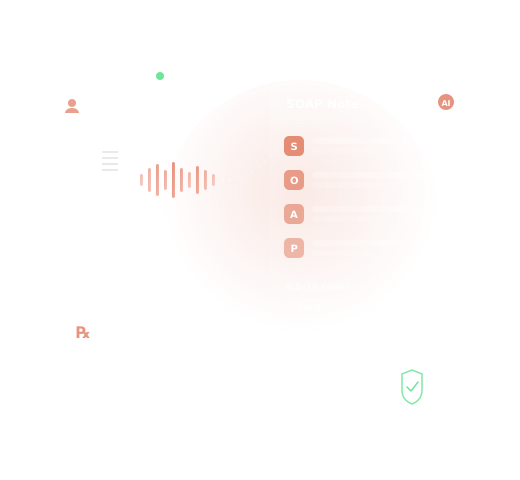
Automatic SOAP note generation: The system can organise captured information into a SOAP-style draft, helping clinicians move from raw conversation to usable documentation faster.
ICD-10 and CPT suggestions: Coding support can assist teams during documentation review, especially when preparing records for downstream billing or administrative workflows. Suggestions should always be checked by the clinician or coding team.
Multilingual support: Many Indian hospitals operate in multilingual environments where English mixes with regional languages in day-to-day communication. This can make an AI medical scribe in India more practical for real clinical use.
On-premise or private deployment options: For hospitals with specific governance preferences, deployment posture can be chosen as an operational decision. This supports workflows aligned with internal IT and data-handling requirements.
How It Works
The product workflow is built around turning clinical conversations into review-ready documentation while keeping the clinician responsible for final approval.
- Capture the interaction: A consultation, bedside review, or team discussion is recorded through the configured workflow. In Cardiac ICU, this may include patient status updates, hemodynamic observations, treatment changes, and next-step planning.
- Transcribe and structure the conversation: The system converts speech into text, applies speaker diarization, and organises the transcript into clinically relevant segments. This helps separate findings, assessment points, and care plans from general discussion.
- Draft a SOAP note automatically: Based on the structured transcript, the platform generates a draft SOAP note. For Cardiac ICU teams, this can help summarise subjective updates, objective observations, assessment, and planned interventions in a consistent format.
- Add coding support: The system surfaces ICD-10 and CPT suggestions linked to the documented encounter. These are intended as support for review, not as final coding decisions.
- Clinician review and edits: The doctor or authorised team member reviews the draft, corrects terminology, adds missing clinical nuance, and confirms that the note reflects the actual encounter. Human review is an operational checkpoint before any record is finalised.
- Final sign-off and record completion: After edits, the clinician signs off on the note and the organisation can route it into its preferred documentation workflow. Deployment can be configured in private or on-premise environments based on workflow and governance preferences.
Local context
Hospitals and specialty centres in India often balance high patient volumes, mixed digital maturity, and multilingual communication patterns. In Cardiac ICU units, documentation may need to support continuity across consultants, duty doctors, and nursing handovers. That is why an AI medical scribe in India should be evaluated for practical fit: how it handles mixed speakers, whether it supports structured note drafting, and how easily clinicians can review and correct outputs.
For Indian healthcare organisations, deployment flexibility also matters. Some teams may prefer private cloud workflows, while others may evaluate on-premise options to align with internal governance and IT preferences. The right approach depends on existing systems, documentation habits, and operational readiness. The focus should remain on making daily documentation easier without disrupting clinical care.
Use cases
Daily Cardiac ICU rounds: Convert bedside discussions into structured draft progress notes for faster review.
Post-procedure documentation: Support note creation after interventions where multiple findings and plan updates are discussed quickly.
Shift handover summaries: Help capture key changes in patient status, active concerns, and pending actions.
Family counselling documentation: Create a clearer starting point for documenting discussions on prognosis, treatment plans, and next steps.
Transfer and discharge preparation: Support more complete summaries when patients move from ICU to step-down care or discharge planning begins.
These use cases show why many providers exploring an AI medical scribe in India are looking for workflow support rather than generic transcription alone.
FAQ
Can this be used in a Cardiac ICU setting?
Yes. It is suited to documentation-heavy environments where clinicians need help converting spoken case discussions into structured draft notes for review.
Does the tool replace clinician documentation review?
No. The workflow is designed around human review, edits, and final sign-off before the record is completed.
Can it support multilingual conversations?
Yes. Multilingual support can help in Indian healthcare settings where English and regional languages may be used in the same workflow.
Does it provide coding support?
Yes. It can surface ICD-10 and CPT suggestions, which should be reviewed by the clinician or coding team before use.
Are there deployment options for hospitals with specific governance needs?
Yes. Private and on-premise deployment options can be considered as operational and governance decisions based on organisational requirements.
CTA
If your hospital or specialty unit is evaluating an AI medical scribe in India for Cardiac ICU documentation, focus on workflow fit: conversation capture, structured SOAP drafting, coding support, multilingual usability, and clinician-led review. Explore how MedScribe can support practical documentation workflows for Indian hospitals, and review related product details across the MedScribe overview, features, integrations, and pricing pages before planning implementation.