Introduction
Case management teams handle a high volume of coordination, follow-up, documentation, and communication across clinicians, patients, and administrative staff. An AI medical scribe in India can help reduce the time spent turning conversations into structured records, especially in busy OPD and hospital environments where every handoff matters. For case managers, physicians, and care coordinators, the goal is not just faster note creation. It is clearer documentation, more consistent summaries, and a smoother path from consultation to review and next action.
MedScribe is designed as an AI medical documentation copilot that converts consultation conversations into usable clinical notes and coding suggestions. In case management settings, this supports teams that need concise summaries, SOAP-style documentation, and a practical review process before records are finalized. Rather than replacing clinical judgment, the platform supports documentation workflows aligned with everyday care delivery in India healthcare settings.
This page focuses on how an AI medical scribe in India can fit into case management operations, where multiple stakeholders rely on timely notes, accurate follow-up context, and efficient clinician review.
Department workflow
Case management workflows often begin with a consultation, review call, bedside discussion, or follow-up interaction. Information may come from doctors, nurses, patients, family members, and coordinators. The challenge is that these details are often captured across fragmented notes, manual summaries, and delayed updates. That can slow down discharge planning, referral coordination, utilization review, and continuity of care.
An AI medical scribe in India is useful here because it supports a more structured documentation flow. Instead of relying only on manual typing after each interaction, teams can capture the conversation, generate a draft note, and route it for clinician review. This is especially relevant for case management teams that need to track history, current concerns, interventions, and next steps without creating extra administrative burden.
In practical terms, the workflow usually includes consultation capture, transcript creation, note structuring, coding support, review, edits, and final sign-off. For hospitals and clinics in India, this can help standardize documentation across departments while still allowing each clinician to make the final decision on what enters the medical record.
Features mapped to workflow
For case management, product value comes from how features map to daily tasks rather than from generic AI claims. MedScribe supports automatic SOAP note generation, which helps convert unstructured conversations into a familiar clinical format. This is useful when teams need a quick draft that can be reviewed and refined instead of written from scratch.
Speaker diarization helps separate who said what during a consultation or care discussion. In multidisciplinary settings, this can improve clarity when reviewing interactions involving clinicians and patients. Multilingual support is also relevant in India, where consultations may shift between English and regional languages. This helps teams preserve context from real conversations rather than forcing rigid documentation habits.
ICD-10 and CPT suggestions can support downstream coding workflows by surfacing likely options based on the documented encounter. These suggestions are not a substitute for professional review, but they can reduce repetitive lookup work and support more consistent documentation handoffs. On-premise deployment and private deployment options can be considered by organizations that want workflow and governance choices suited to their internal IT posture.
Together, these capabilities make AI medical scribe India healthcare adoption more practical for case management teams that need speed, structure, and clinician oversight.
How It Works
The workflow is designed to move from conversation capture to reviewed documentation with clear checkpoints for human validation.
- Capture the consultation or care discussion: The clinician or care team records the encounter audio during an OPD visit, inpatient review, follow-up call, or coordination discussion. The system is built to support real-world consultation flow rather than requiring rigid templates at the point of care.
- Transcribe and structure the conversation: MedScribe converts the audio into a transcript and applies speaker diarization to distinguish participants. It then organizes the content into clinically relevant sections so the team can quickly understand symptoms, history, assessment points, and care planning details.
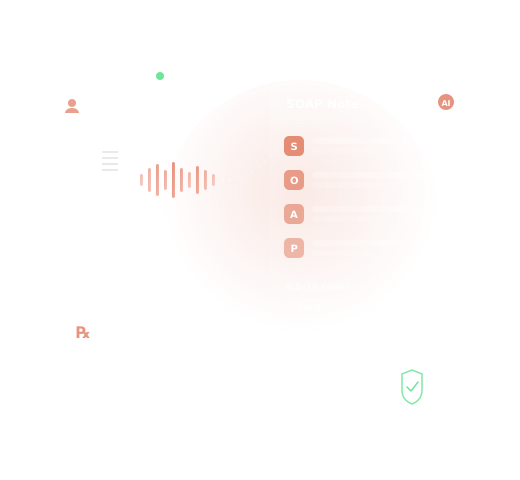
- Draft SOAP notes automatically: Based on the structured transcript, the platform generates a SOAP-style draft note. This gives case management and clinical teams a usable starting point for documentation, reducing the need to recreate the encounter manually after the visit.
- Surface coding suggestions: The system can provide ICD-10 and CPT suggestions linked to the documented encounter. These are intended as workflow support for review and refinement, helping teams move from narrative documentation toward more complete records.
- Review, edit, and sign off: The clinician reviews the draft, makes edits, confirms relevance, and finalizes the note before it becomes part of the record. This human review checkpoint is essential because the final clinical note should reflect clinician judgment, not automated output alone.
Deployment posture can also be chosen based on operational needs. Some organizations may prefer private or on-premise setups as part of their internal governance approach. This should be viewed as a workflow and infrastructure decision that supports how teams manage documentation environments.
Local context
In India, case management teams often work across mixed documentation environments that include hospital information systems, specialty software, and manual processes. This makes consistency difficult, especially when patient volumes are high and follow-up coordination depends on timely summaries. An AI medical scribe in India can help by creating a more repeatable documentation process without forcing every clinician to change how they conduct consultations.
Multilingual interactions are another practical consideration. Many consultations involve a mix of English and local language usage, and documentation tools need to support that reality. For clinics and hospitals evaluating an AI medical scribe in India, the key question is whether the tool fits the actual workflow: capture the encounter, generate a draft, support coding, and keep the clinician in control of final sign-off.
This is why AI medical scribe India healthcare adoption should be assessed in terms of operational fit, review controls, and ease of use for OPD and care coordination teams.
Use cases
Case management teams can use this workflow in several practical scenarios. During OPD consultations, clinicians can generate draft notes quickly and reduce after-hours documentation. In inpatient coordination, teams can summarize multidisciplinary discussions and prepare cleaner handoff notes. During follow-up calls, care coordinators can capture updates and convert them into structured records for review. For discharge planning, the platform can help organize assessment and next-step details into a format that is easier to validate and share internally.
An AI medical scribe in India may also support specialty clinics where repeat visits require concise longitudinal summaries. Instead of searching through fragmented notes, teams can work from structured drafts that are reviewed and finalized by the responsible clinician.
FAQ
Below are common implementation questions from clinics and hospitals evaluating AI medical scribe workflows for case management.
CTA
If your team is exploring a practical AI medical scribe in India for case management, focus on the workflow details that matter: conversation capture, structured transcription, SOAP drafting, coding support, clinician review, and deployment options that fit your environment. MedScribe is designed to support documentation workflows for clinics and hospitals that want more consistent notes without adding unnecessary complexity. Review the product pathways for core capabilities, features, integrations, and pricing to assess fit for your OPD and care coordination operations.