Introduction
Child and adolescent psychiatry consultations often involve nuanced conversations, parent inputs, developmental history, school context, behavioural observations, and careful follow-up planning. That makes documentation important, but also time-consuming. An AI medical scribe in India can help psychiatry clinics and hospitals reduce manual note-taking by turning consultation conversations into structured draft notes that clinicians can review and finalize. For teams managing OPD volume, follow-ups, and multidisciplinary coordination, the goal is not to replace clinical judgment. It is to support clearer documentation, more consistent note structure, and a smoother path from conversation to record completion.
MedScribe is designed as an AI documentation copilot for everyday care delivery. It converts consultation audio into transcript-backed clinical drafts, supports SOAP note generation, identifies speakers, and suggests coding support for clinician review. In child and adolescent psychiatry, this can be useful when visits include both caregiver and patient voices, longitudinal symptom tracking, and detailed assessment summaries. The result is a practical workflow for clinics seeking an AI medical scribe in India that fits routine documentation needs without adding unnecessary complexity.
Department workflow
Documentation in child and adolescent psychiatry usually extends beyond a short symptom summary. A typical visit may include presenting concerns, developmental milestones, family dynamics, school performance, sleep and appetite patterns, medication review, risk observations, and counselling points. In many settings, the psychiatrist also needs to capture caregiver concerns separately from the child or adolescent narrative. This creates a workflow where note quality matters as much as speed.
In OPD practice, clinicians often move quickly between new evaluations, therapy-linked reviews, medication follow-ups, and coordination with psychologists, counsellors, or paediatric teams. Manual note entry after each visit can delay record completion and increase after-hours documentation. An AI medical scribe in India can support this workflow by organizing the consultation into a usable draft, helping the clinician focus on the interaction first and the final edit second. For hospitals and specialty clinics, this is especially relevant when teams want more standardized notes across providers while still preserving individual clinical style.
Features mapped to workflow
Conversation capture and transcription: The platform captures the consultation discussion and converts it into structured text. This is useful for long psychiatric interviews where details can be missed during manual note-taking.
Speaker diarization: In child and adolescent psychiatry, multiple speakers are common. Speaker separation helps distinguish clinician, parent, and patient contributions, making draft notes easier to review.
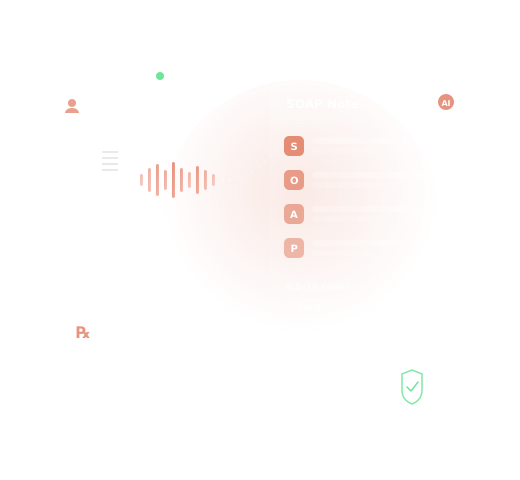
Automatic SOAP drafting: The system generates draft SOAP notes from the consultation, giving clinicians a starting point for subjective history, observations, assessment, and plan.
Coding suggestions: ICD-10 and CPT suggestions can support downstream documentation workflows. These are prompts for clinician review rather than automatic final coding decisions.
Multilingual support: Many Indian care settings involve mixed-language conversations. Multilingual support can help teams using English alongside regional language interactions during consultations.
Deployment posture options: For organizations with specific governance preferences, on-premise or private deployment options can support workflows aligned with internal IT and data handling requirements.
These capabilities make an AI medical scribe in India relevant not only for note creation, but also for improving consistency across intake, follow-up, and review visits in psychiatry practice.
How It Works
The workflow is designed to move from live conversation to clinician-approved documentation in a controlled, review-first process.
- Capture the consultation conversation: During the visit, the discussion is recorded through the configured workflow. In child and adolescent psychiatry, this may include the psychiatrist, the young patient, and a parent or guardian. The system prepares the audio for transcription while preserving speaker separation where possible.
- Transcribe and structure the interaction: MedScribe converts the conversation into text and applies speaker diarization to distinguish who said what. This is especially useful when caregiver observations and patient responses both influence the clinical picture.
- Generate a draft SOAP note: The transcript is organized into a structured clinical draft. Relevant details such as presenting concerns, behavioural observations, medication discussion, and follow-up planning can be mapped into SOAP-style sections for easier review.
- Surface coding support: Based on the documented encounter, the system can suggest ICD-10 and CPT options as a support layer. These suggestions are intended to assist the clinician or documentation team, not replace professional judgment.
- Review, edit, and sign off: The clinician reviews the draft note, corrects wording, adds missing context, and confirms the final assessment and plan. Human review is the operational checkpoint before any record is finalized.
- Finalize within the chosen deployment model: Depending on organizational preference, teams can use deployment approaches such as on-premise or private environments. This is a workflow and governance choice that can support internal documentation processes and integration planning.
Local context
In India, psychiatry teams often work across varied practice settings, from independent clinics to multispecialty hospitals and academic centres. Child and adolescent psychiatry adds another layer of complexity because documentation may need to reflect family participation, school-related concerns, and longitudinal follow-up. An AI medical scribe in India should therefore be practical for busy OPD environments, adaptable to mixed-language consultations, and usable without forcing a rigid documentation style.
For healthcare organizations evaluating AI medical scribe India healthcare solutions, the key questions are usually operational: how quickly clinicians can review drafts, whether the output is usable for routine records, and how the deployment model fits internal governance preferences. A practical implementation should support existing workflows, complement broader documentation systems, and keep the clinician in control of final sign-off.
Use cases
New patient psychiatric evaluations: Capture detailed history from both caregiver and patient, then convert it into a structured draft for clinician refinement.
Medication follow-up visits: Summarize symptom changes, side effects, adherence discussion, and plan updates in a consistent format.
Behavioural and school-related reviews: Organize inputs about classroom functioning, social interaction, and home behaviour into clearer documentation.
Multidisciplinary coordination: Support cleaner records that can be referenced by psychologists, counsellors, paediatricians, or care coordinators as needed.
High-volume OPD workflows: Reduce the burden of typing long notes after clinic hours by starting from a draft generated during or after the consultation.
FAQ
Can this be used for consultations involving both parents and children?
Yes. Speaker diarization is designed to help separate multiple voices in the conversation, which can be useful in child and adolescent psychiatry where caregiver input is common.
Does the system create final notes automatically?
No. It creates draft documentation that the clinician reviews, edits, and approves before final sign-off. Human review remains an essential step.
Is it useful for multilingual consultations in India?
It can be helpful in settings where consultations include English and regional language usage, because multilingual support is part of the product capability set.
Can hospitals choose how the solution is deployed?
Yes. Deployment posture options such as on-premise or private environments can be considered based on workflow, IT, and governance preferences.
CTA
If your psychiatry clinic or hospital is exploring a more efficient way to document complex consultations, MedScribe offers a practical path from conversation capture to clinician-reviewed notes. For teams comparing options for an AI medical scribe in India, the focus should be on usability in daily OPD care, support for structured notes, and a review workflow that keeps clinicians in control. Explore the product, feature set, and integration approach to see how it can fit child and adolescent psychiatry documentation in India.