Introduction
Clinical Immunology consultations often involve long histories, medication reviews, prior lab discussions, symptom timelines, and follow-up planning. That makes documentation time-consuming for specialists, fellows, and clinic teams. An AI medical scribe in India can help reduce manual note-taking by turning consultation conversations into structured draft documentation that clinicians can review and finalize. For hospitals and specialty clinics, the goal is practical: support faster note completion, improve consistency across encounters, and reduce after-hours charting without changing how doctors think clinically.
MedScribe is designed as an AI documentation copilot for daily OPD and specialty workflows. It converts doctor-patient conversations into draft SOAP notes, supports speaker separation, and provides coding suggestions that can be reviewed before final record completion. For Clinical Immunology teams in India, this is useful when visits include recurrent infection history, autoimmune symptom review, biologic therapy monitoring, adverse event discussion, and longitudinal follow-up. The product is designed to align with real clinical workflows rather than force a rigid template.
Department workflow
Clinical Immunology documentation usually starts before the patient enters the room. Teams may review referral notes, previous diagnoses, medication exposure, immunization history, allergy details, and relevant investigations. During the consultation, the clinician gathers a detailed history, clarifies symptom patterns, discusses triggers, reviews treatment response, and explains next steps. After the visit, the same information must be converted into a usable note, often with assessment logic, plan details, and coding support.
In many Indian clinics and hospitals, this process is still heavily manual. Doctors may type during the visit, dictate after the visit, or complete notes later in the day. That can affect eye contact, consultation flow, and turnaround time. An AI medical scribe in India is most valuable when it fits into this existing pattern: capture the conversation, organize it into a structured draft, and leave the clinician in control of edits and sign-off. For Clinical Immunology, that means supporting nuanced histories, medication lists, follow-up plans, and repeat visits where continuity matters.
Features mapped to workflow
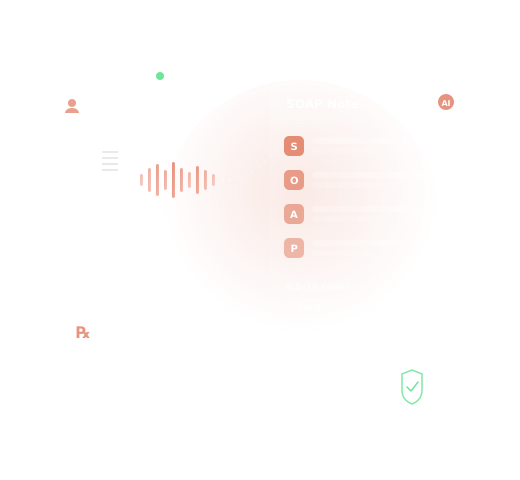
Automatic SOAP note drafting: Consultation audio can be transformed into a draft subjective, objective, assessment, and plan structure. This helps clinicians move from raw conversation to a usable note faster, especially in complex specialty visits.
Speaker diarization: The system separates speakers so the doctor and patient portions of the conversation are easier to interpret. In immunology visits with detailed symptom narratives and counseling, this improves note clarity.
Multilingual support: Many consultations in India shift between English and regional languages. Multilingual support helps teams document naturally without forcing a single-language interaction style.
ICD-10 and CPT suggestions: Coding suggestions can support downstream billing and record workflows, while still requiring clinician review. This is useful when specialty encounters need structured documentation plus coding assistance.
On-premise or private deployment options: Some organizations prefer deployment choices that support internal governance, infrastructure preferences, and workflow control. These decisions are operational and should match the institution's documentation processes.
Review-first workflow: Drafts are not the final record by default. Clinicians review, edit, and approve the note before it is finalized, which is important for specialty accuracy and accountability.
How It Works
The product workflow is built around the real sequence of a consultation, from conversation capture to clinician-approved documentation.
- Capture the consultation conversation: During the OPD or follow-up visit, the conversation is recorded through the configured workflow. This may include history taking, symptom review, medication discussion, and treatment planning relevant to Clinical Immunology.
- Transcribe and structure the encounter: The system converts speech into text and applies speaker diarization to distinguish clinician and patient contributions. It then organizes the transcript into clinically useful sections rather than leaving teams with a raw transcript.
- Draft a SOAP note automatically: Based on the structured conversation, MedScribe generates a draft SOAP note. For immunology visits, this can help summarize symptom chronology, prior treatment response, current concerns, and the planned next steps in a format clinicians can quickly review.
- Suggest coding support: The workflow can surface ICD-10 and CPT suggestions linked to the documented encounter. These are intended as support for the clinician or billing workflow, not as an automatic final coding decision.
- Review, edit, and sign off: The clinician checks the draft note, makes corrections, adds missing clinical nuance, and approves the final version before record completion. Human review is the operational checkpoint that keeps the final chart aligned with the clinician's judgment.
- Choose the right deployment posture: Organizations can evaluate on-premise or private deployment options based on internal workflow, IT preferences, and governance needs. This supports workflows aligned with institutional documentation practices rather than a one-size-fits-all setup.
Local context
For providers evaluating an AI medical scribe in India, the practical questions are usually about OPD speed, multilingual consultations, specialty complexity, and documentation consistency across clinicians. Clinical Immunology is a strong fit because visits often involve detailed histories and repeated follow-ups. In this setting, AI assistance is less about replacing clinical thinking and more about reducing repetitive documentation effort.
Hospitals, day-care centers, and specialty clinics may also have different infrastructure preferences. Some teams want a cloud-based workflow, while others evaluate private or on-premise deployment based on internal governance and operational needs. An AI medical scribe in India should therefore be assessed not only for note quality, but also for how well it fits scheduling patterns, consultation styles, and review processes already used by the department.
Use cases
New patient immunology evaluations: Capture long symptom histories, prior investigations, family history, and treatment exposure into a structured first-visit note.
Follow-up visits for chronic immune conditions: Summarize interval changes, medication tolerance, response to therapy, and next review plans with less manual typing.
Biologic therapy monitoring: Document counseling, adverse event review, symptom progression, and plan updates in a consistent format.
Multidisciplinary specialty clinics: Support documentation when consultations involve mixed language use, detailed counseling, and multiple decision points.
High-volume OPD sessions: Help clinicians complete draft notes faster so they can focus more on patient interaction and less on after-hours charting.
FAQ
Can this be used for complex specialty consultations?
Yes. The workflow is suited to consultations where history, assessment, and plan details are extensive, provided the clinician reviews and finalizes the draft note.
Does it replace clinician documentation review?
No. The system creates draft documentation and coding support, but the clinician remains responsible for edits, validation, and final sign-off.
Is multilingual consultation support relevant in India?
Yes. Many clinics switch between English and regional languages during visits, so multilingual support can make documentation more practical for real OPD use.
Can hospitals choose different deployment models?
Yes. Teams can evaluate on-premise or private deployment options based on workflow, IT, and governance preferences.
CTA
If your Clinical Immunology team is exploring an AI medical scribe in India, focus on workflow fit: how conversations are captured, how SOAP drafts are created, how coding support is surfaced, and how clinicians review the final note. MedScribe is built to support practical documentation workflows for clinics and hospitals that want more consistent notes with less manual effort. Explore the product overview at /medscribe, review capabilities at /medscribe/features, and assess how the workflow can fit your specialty OPD model.