Introduction
Clinical pathology teams handle a steady flow of diagnostic discussions, test interpretations, follow-up recommendations, and clinician communication. An AI medical scribe in India can help reduce the time spent turning these interactions into structured documentation. For pathology-led workflows, the goal is not to replace clinical judgment. It is to support faster note creation, clearer summaries, and more consistent documentation that clinicians can review before final sign-off.
MedScribe is designed as an AI documentation copilot for hospitals, diagnostic centres, and specialist clinics that want practical support for daily OPD and reporting workflows. It converts consultation or discussion audio into structured drafts such as SOAP-style notes, supports speaker diarization, and can suggest ICD-10 or CPT codes for clinician review. For organisations evaluating an AI medical scribe in India, the value is often operational: less manual typing, better continuity across encounters, and easier handoff between teams.
In clinical pathology, documentation may involve patient-facing consultations, clinician-to-clinician discussions, interpretation notes, and follow-up planning. A usable system should fit these realities, support multilingual environments, and allow deployment choices such as private or on-premise setups based on internal governance preferences.
Department workflow
Clinical pathology workflows often combine diagnostic interpretation with communication across departments. A patient may arrive with prior reports, referral notes, and a need for explanation of findings. In other cases, a pathologist or pathology-linked clinician may discuss test relevance, sample status, repeat testing, or next diagnostic steps with the treating team. Each interaction creates documentation work.
Typical workflow stages include patient or clinician conversation capture, transcription of the interaction, extraction of medically relevant details, drafting of structured notes, coding support where needed, and final review by the responsible clinician. In busy settings, this process can become fragmented when notes are written later from memory or spread across multiple systems.
An AI medical scribe in India is most useful when it supports the existing department rhythm rather than forcing a new one. That means helping with multilingual conversations, separating speakers clearly, preserving the clinical sequence of the encounter, and producing drafts that are easy to edit. For pathology teams, the emphasis is often on clarity, traceability, and efficient review rather than generic voice-to-text alone.
Features mapped to workflow
Conversation capture and transcription: MedScribe supports the first step by converting spoken interactions into text that can be used for documentation. This is useful for pathology consultations, report explanation visits, and internal case discussions where details matter.
Speaker diarization: In multi-person conversations, speaker separation helps distinguish clinician comments, patient responses, and caregiver inputs. This can improve readability during review and reduce confusion in draft notes.
Automatic SOAP note generation: Instead of leaving teams with raw transcripts, the system structures content into clinically usable drafts. For pathology-related encounters, this can help organise symptoms, relevant history, assessment context, and next-step planning.
ICD-10 and CPT suggestions: Coding suggestions are provided as decision support for clinician review, not as automatic final coding. This can help streamline downstream documentation tasks where coding alignment is part of the workflow.
Multilingual support: Many Indian healthcare settings involve mixed-language consultations. A practical AI medical scribe India healthcare solution should support this reality so documentation remains useful across diverse patient populations and care teams.
On-premise or private deployment options: Some hospitals and larger diagnostic networks prefer deployment models aligned with internal IT and governance requirements. MedScribe supports workflow choices such as on-premise or private environments without presenting them as blanket guarantees.
How It Works
- Capture the clinical conversation: During a pathology consultation, report discussion, or clinician handoff, the interaction is recorded through the configured workflow. The system is designed to capture spoken content in a way that supports later structuring, including multilingual exchanges where relevant.
- Transcribe and separate speakers: MedScribe converts the audio into text and applies speaker diarization so the draft reflects who said what. This is especially useful when a patient, caregiver, and clinician all contribute to the encounter or when pathology findings are discussed with another doctor.
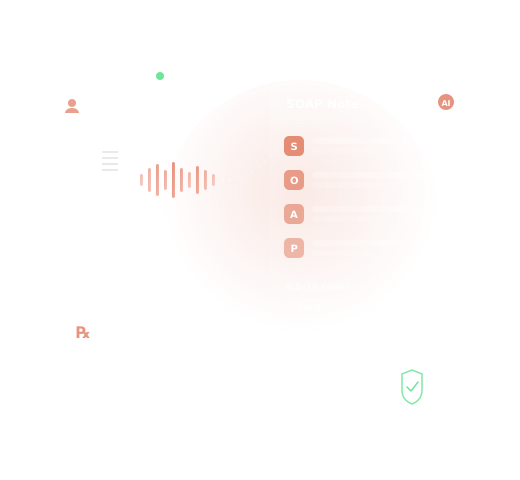
- Structure the transcript into a SOAP draft: The transcribed conversation is organised into a usable clinical note draft rather than remaining a raw transcript. Key details are arranged into a SOAP-style format to support faster review and editing by the clinician.
- Surface coding suggestions for review: Based on the documented encounter, the system can suggest ICD-10 and CPT codes as a support layer. These suggestions are intended to assist the clinician or coding team and should be reviewed before use.
- Review, edit, and sign off: The clinician checks the draft note, makes corrections, adds missing context, and confirms the final version before it becomes part of the record. Human review is a core checkpoint in the workflow and helps keep documentation clinically appropriate.
- Choose the deployment posture that fits operations: Depending on organisational needs, teams can evaluate private or on-premise deployment approaches as governance and workflow decisions. This helps align the documentation process with internal infrastructure preferences.
Local context
Healthcare organisations evaluating an AI medical scribe in India often need a solution that fits high-volume outpatient environments, mixed digital maturity, and multilingual communication. In pathology-linked settings, documentation may need to support both patient communication and coordination with referring clinicians. That makes practical usability more important than broad marketing claims.
For Indian clinics and hospitals, the right approach is usually one that can adapt to existing workflows instead of requiring a complete process redesign. Teams may want to start with selected departments, define review checkpoints, and decide whether cloud, private, or on-premise deployment is more suitable for their operating model. An AI medical scribe in India should support these decisions with flexibility and clear workflow boundaries.
Use cases
Pathology consultation notes: Draft structured notes from discussions about test findings, interpretation, and next steps.
Report explanation visits: Help clinicians document patient-facing conversations where results are explained and follow-up plans are discussed.
Referral and handoff summaries: Support clearer documentation when pathology findings are communicated to another specialist or treating physician.
Follow-up planning: Capture recommendations for repeat testing, additional investigations, or monitoring.
Coding support workflows: Provide ICD-10 and CPT suggestions for review where coding assistance is part of the documentation process.
These use cases show why an AI medical scribe in India can be relevant beyond general practice. In clinical pathology, the documentation burden often sits at the intersection of diagnostics, communication, and continuity of care. A practical AI medical scribe India healthcare deployment should help teams move from conversation to review-ready notes with less manual effort while keeping clinicians in control.
FAQ
Can this be used for pathology consultations and report discussions?
Yes. It is suited to workflows where clinicians need to document interpretation discussions, follow-up recommendations, and related clinical context.
Does the system create final notes automatically?
No. It creates draft documentation that clinicians review, edit, and approve before final sign-off.
Can it handle multilingual conversations?
The product supports multilingual use cases, which can be helpful in Indian healthcare settings where consultations may shift between languages.
Are coding outputs automatic?
No. ICD-10 and CPT outputs are suggestions intended to support review, not replace clinician or coding team judgment.
Is deployment limited to one model?
No. Teams can evaluate private or on-premise approaches based on workflow and governance needs.
CTA
If your organisation is assessing an AI medical scribe in India for clinical pathology workflows, focus on practical fit: how conversations are captured, how drafts are structured, how review happens, and how deployment aligns with your operating model. Explore the product pathways through /medscribe and feature details at /medscribe/features to evaluate whether the workflow matches your clinic or hospital documentation needs.