Introduction
Clinical Pharmacology teams manage detailed consultations, medication histories, adverse event discussions, dose adjustments, follow-up plans, and documentation that must remain clear for downstream care. An AI medical scribe in India can help reduce manual note-taking during OPD and specialist review workflows by turning clinician-patient conversations into structured draft documentation. For hospitals, specialty clinics, and academic departments, the goal is practical: save time on repetitive documentation tasks while keeping the clinician in control of the final record.
MedScribe is designed as an AI documentation copilot for day-to-day care settings. It supports automatic SOAP note drafting, speaker diarization, multilingual conversations, and coding suggestions that can assist teams handling medication reviews, therapeutic monitoring, and pharmacology consults. Rather than changing how doctors practice, it fits into existing documentation habits and supports workflows aligned with local operational needs in India.
Department workflow
In Clinical Pharmacology, documentation often starts before the consultation begins. The clinician may review referral notes, prior prescriptions, lab trends, and medication response history. During the encounter, the discussion can include current symptoms, indication review, dose timing, adherence, adverse drug reactions, interactions, contraindications, and treatment alternatives. After the consultation, the doctor or assistant usually prepares a structured note, updates the medication plan, and records diagnosis or procedure codes where needed.
This workflow creates several documentation pressure points. Important details may be missed when the clinician is typing while listening. Follow-up instructions can become inconsistent across providers. Coding support may require a second pass after the visit. In busy OPD settings, these small delays add up. An AI medical scribe in India is useful here because it can capture the consultation flow, organize the conversation into a clinical structure, and present a draft that the clinician can quickly review and edit before sign-off.
For Clinical Pharmacology specifically, the value is not only speed. It is also consistency in documenting medication-related reasoning, adverse event narratives, and monitoring plans. This helps teams create clearer records for continuity of care, internal review, and communication with referring physicians.
Features mapped to workflow
Conversation capture and transcription: The product listens to the consultation and converts speech into text, helping reduce manual note-taking during the visit. This is useful for medication counselling, dose titration discussions, and adverse reaction reviews where details matter.
Speaker diarization: By separating clinician and patient speech, the draft note becomes easier to interpret and structure. In specialty consultations where family members or caregivers may also speak, this supports cleaner documentation review.
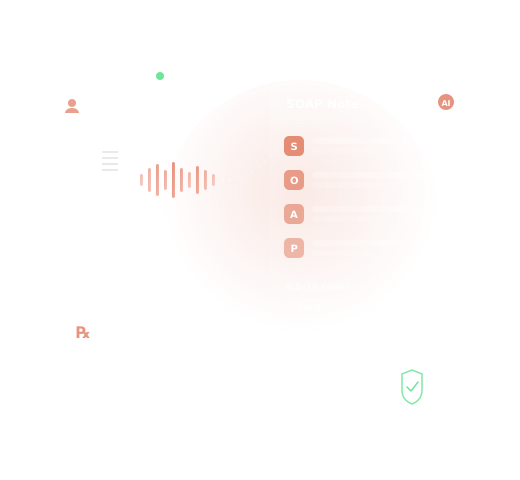
Automatic SOAP note generation: The system organizes the encounter into a familiar clinical format. For Clinical Pharmacology, this can help structure subjective symptoms, objective findings, assessment of medication response or risk, and the treatment or monitoring plan.
ICD-10 and CPT suggestions: Coding support can help teams prepare draft coding references alongside the note. These suggestions are intended to support clinician workflows, with final selection remaining a human decision.
Multilingual support: Many consultations in India move between English and regional languages. Multilingual capability can support more natural conversations while still producing usable draft documentation.
On-premise or private deployment options: Hospitals and larger groups may prefer deployment choices based on internal governance, IT architecture, and data handling preferences. These options are workflow and infrastructure decisions that can support workflows aligned with institutional requirements.
How It Works
The product flow is designed for real outpatient and specialist documentation, with clear checkpoints for clinician review before the record is finalized.
- Capture the consultation conversation: At the start of the visit, the clinician or care team initiates the documentation session. The system captures the consultation audio during medication review, symptom discussion, counselling, and treatment planning. It is built to support practical OPD use, including multilingual interactions common in India.
- Transcribe and separate speakers: The audio is converted into text and organized using speaker diarization so the clinician can distinguish patient statements from provider guidance. This is especially helpful in Clinical Pharmacology visits where history, adverse effects, and counselling points need to be clearly attributed.
- Draft a structured SOAP note: The transcript is then transformed into a draft clinical note with SOAP formatting. Relevant details such as medication history, current concerns, assessment points, and follow-up instructions are arranged into a usable structure instead of a raw transcript.
- Add coding support and workflow cues: The system can surface ICD-10 and CPT suggestions based on the documented encounter. These are presented as support for the clinician or coding team, not as final coding decisions. The draft can also help teams identify missing details that may need clarification before closure.
- Review, edit, and sign off: The clinician reviews the draft note, makes edits, confirms medication details, and finalizes the assessment and plan. Human review is the operational checkpoint that matters most. The record should only be finalized after clinician approval and sign-off.
For organizations evaluating deployment posture, the same workflow can be considered alongside private or on-premise setups depending on internal governance preferences. The key point is that deployment choice should support operational fit, review controls, and documentation workflows.
Local context
Healthcare teams in India often work across high patient volumes, mixed digital maturity, and multilingual consultations. In this environment, an AI medical scribe in India should be practical rather than theoretical. It should help doctors complete notes faster, support clearer records for follow-up, and fit into existing OPD routines without adding complexity.
Clinical Pharmacology departments may also support referrals from multiple specialties, which means documentation quality affects communication across the care pathway. A tool built for AI medical scribe India healthcare use should therefore focus on note usability, review controls, and deployment flexibility. For hospitals and larger groups, this can include evaluating whether private or on-premise deployment is a better fit for internal IT and governance expectations.
Use cases
Medication therapy review: Draft structured notes from detailed discussions on current medicines, adherence, side effects, and treatment response.
Adverse drug reaction documentation: Capture symptom chronology, suspected causality discussion, and follow-up recommendations in a more organized format.
Dose adjustment and monitoring visits: Support documentation for titration decisions, counselling, and planned monitoring.
Referral consults: Create clearer summaries for referring physicians when Clinical Pharmacology input is requested for complex medication management.
Busy OPD sessions: Reduce the burden of typing during consultations so clinicians can focus more on patient interaction and final review.
Across these scenarios, an AI medical scribe in India is most effective when used as a documentation assistant, not a replacement for clinical judgment. The clinician remains responsible for reviewing the draft, correcting inaccuracies, and approving the final note.
FAQ
Below are common implementation questions from clinics and hospitals evaluating an AI medical scribe in India for Clinical Pharmacology workflows.
Can it handle multilingual consultations?
Yes, the product supports multilingual use cases, which is helpful when consultations move between English and regional languages.
Does it replace clinician review?
No. The draft note should always be reviewed, edited where needed, and signed off by the clinician before finalization.
Can it support coding workflows?
It can provide ICD-10 and CPT suggestions to support documentation and coding review, while final coding decisions remain with the care team.
Is it suitable for hospitals with specific deployment preferences?
Yes, teams can evaluate private or on-premise deployment options based on workflow, infrastructure, and governance needs.
CTA
If your department wants to reduce documentation friction in medication-focused consultations, MedScribe offers a practical path to structured notes, coding support, and clinician-controlled review. Explore how an AI medical scribe in India can fit Clinical Pharmacology OPD workflows, specialist consults, and hospital documentation processes. Review the core product, features, integrations, and pricing paths to assess operational fit for your clinic or hospital.