Introduction
Clinical pharmacy teams manage medication histories, therapy reviews, counselling notes, intervention records, and coordination with prescribers across busy OPD and hospital settings. An AI medical scribe in India can help reduce the time spent turning conversations and review findings into structured documentation. Instead of relying only on manual typing after each interaction, clinicians and pharmacy teams can use AI-assisted drafting to capture key details from consultations and convert them into usable notes for review.
For Indian healthcare organisations, the value is practical: clearer records, faster note completion, and better continuity across doctors, pharmacists, and care teams. MedScribe is designed as an AI medical documentation copilot that converts consultation conversations into structured clinical notes and coding suggestions. For clinical pharmacy workflows, this means support for documenting medication reconciliation, adverse event discussions, adherence counselling, dose adjustments, and follow-up plans in a more consistent way. The goal is not to replace clinical judgment, but to support teams with faster first drafts that clinicians can review, edit, and sign off.
An AI medical scribe in India is especially useful where multilingual conversations, high patient volumes, and mixed digital maturity can make documentation uneven. With support for speaker diarization, SOAP note drafting, coding suggestions, and deployment choices such as on-premise or private setups, the product is designed to align with real-world healthcare workflows rather than idealised demos.
Department workflow
In clinical pharmacy, documentation often sits between direct patient interaction and broader care coordination. A typical workflow may begin with medication history collection, continue through therapy assessment, and end with counselling, intervention notes, and communication back to the treating clinician. In hospitals, pharmacists may also document antimicrobial stewardship recommendations, medication reconciliation at admission or discharge, and monitoring notes for high-risk medicines. In clinics, the focus may be on adherence, refill reviews, chronic disease medication education, and identifying potential interactions.
These workflows create repeated documentation tasks: capturing what the patient is taking, identifying what changed, noting why a recommendation was made, and recording the agreed plan. Manual note creation can slow down throughput and create variation in note quality. An AI medical scribe in India can support this department by turning spoken interactions into structured drafts that are easier to review and standardise. This is useful when pharmacists collaborate with physicians and need concise, clinically relevant summaries rather than long free-text notes.
For clinical pharmacy teams, the most important requirement is not generic transcription alone. It is the ability to organise information into a format that supports medication review, intervention tracking, and communication with the rest of the care team. That is where workflow-aware AI documentation becomes more useful than a basic dictation tool.
Features mapped to workflow
MedScribe maps well to clinical pharmacy documentation needs because its core capabilities align with common steps in the department workflow.
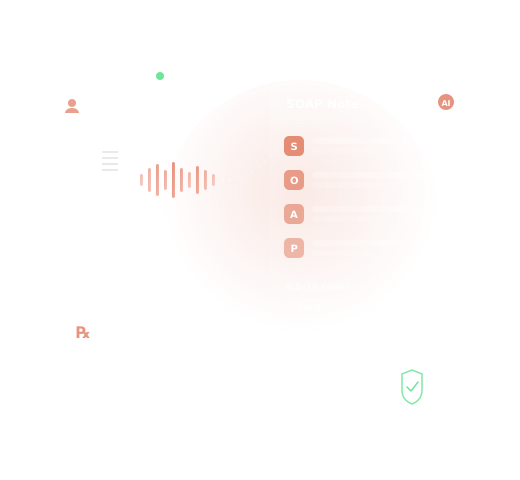
Automatic SOAP note generation: Helps convert consultation content into structured subjective, objective, assessment, and plan sections. This can support medication review notes, counselling summaries, and follow-up documentation.
Speaker diarization: Distinguishes between clinician and patient voices, which is helpful when documenting counselling sessions, medication history interviews, or multidisciplinary discussions.
Multilingual support: Useful in Indian care settings where patient conversations may move between English, Hindi, and regional languages during the same encounter.
ICD-10 and CPT suggestions: Supports coding workflows by surfacing relevant suggestions based on the documented encounter. These suggestions still require clinician review and should be treated as decision support.
On-premise deployment options: Supports organisations that prefer tighter control over infrastructure and governance decisions. This should be viewed as a workflow and IT posture choice, not a guarantee of compliance.
Human review before finalisation: Drafts are intended for pharmacist or clinician validation, helping teams maintain oversight before records are completed.
How It Works
The product workflow is designed around day-to-day consultation documentation rather than post-facto summarisation. For clinical pharmacy teams, the process can fit into OPD, inpatient review, and counselling workflows.
- Capture the consultation or medication review conversation: During a patient interaction, counselling session, or pharmacist-physician discussion, the system captures the spoken exchange. Speaker diarization helps separate who said what, which is useful when documenting patient-reported medication use versus clinician recommendations.
- Transcribe and structure the encounter: The audio is converted into text and organised into clinically relevant segments. Instead of leaving teams with a raw transcript, the system prepares information in a way that supports medication history, assessment points, and care planning.
- Draft a SOAP note automatically: Based on the conversation, MedScribe generates a SOAP-style draft. In clinical pharmacy, this can include symptoms affecting adherence, current medicines, observed issues, pharmacist assessment, and the proposed plan for counselling, escalation, or follow-up.
- Surface coding suggestions: The system can provide ICD-10 and CPT suggestions linked to the documented encounter. These are intended to support documentation workflows and should be checked by the responsible clinician or coding team before use.
- Review, edit, and sign off: The pharmacist or clinician reviews the draft, corrects details, adds missing context such as lab-linked medication decisions, and approves the final note. Human review is the operational checkpoint before the record is finalised.
- Choose deployment posture based on governance needs: Organisations can evaluate on-premise or private deployment approaches depending on internal IT, workflow, and data handling preferences. This supports workflows aligned with institutional governance requirements.
Local context
Healthcare teams in India often work across mixed documentation environments, from paper-heavy clinics to hospitals with established digital systems. Clinical pharmacy teams may also support diverse patient populations with varying health literacy and language preferences. In this setting, an AI medical scribe in India needs to be practical, not theoretical. It should help teams document faster without forcing major workflow changes.
This is where multilingual support and structured drafting matter. A pharmacist may counsel a patient in one language, discuss the case with a doctor in another, and still need a clear English clinical note for the record. An AI medical scribe in India can support this reality by helping convert complex spoken interactions into consistent documentation drafts. For hospitals and larger groups, deployment choices such as on-premise setups may also be relevant when evaluating internal governance and IT preferences.
Use cases
Medication reconciliation: Capture admission or discharge discussions and draft structured notes on current medicines, discrepancies, and recommended changes.
Adherence counselling: Document barriers, patient concerns, education provided, and the agreed follow-up plan.
Chronic disease medication reviews: Support repeat consultations for diabetes, hypertension, asthma, and other long-term conditions where medication optimisation is ongoing.
Adverse event and interaction review: Record patient-reported side effects, suspected interactions, and pharmacist recommendations for escalation or modification.
Collaborative care documentation: Summarise pharmacist interventions for physician review in OPD and inpatient settings.
High-volume outpatient workflows: Reduce after-hours note completion by generating a first draft during or soon after the encounter.
FAQ
Can this be used only by doctors?
No. While the product is built for clinical documentation, it can also support pharmacist-led interactions where structured notes and review workflows are needed.
Does it replace manual review?
No. Drafts and coding suggestions should always be reviewed, edited where needed, and approved by the responsible clinician before finalisation.
Is it useful for multilingual patient conversations?
Yes. Multilingual support can help in Indian care settings where consultations often include more than one language.
Can hospitals choose different deployment models?
Yes. On-premise or private deployment approaches may be considered based on workflow, IT, and governance preferences.
CTA
If your organisation is evaluating an AI medical scribe in India for clinical pharmacy workflows, focus on how well it supports real documentation tasks: medication review, counselling notes, coding support, and clinician sign-off. MedScribe is designed to help clinics and hospitals create structured drafts from consultation conversations while keeping human review at the centre. Explore the product pages for features, integrations, and pricing to assess fit for your pharmacy and care team workflows.