Introduction
Clinical psychology documentation often requires careful listening, structured note-taking, and clear summaries that reflect the patient conversation without disrupting rapport. An AI medical scribe in India can support this process by turning consultation audio into draft clinical documentation that psychologists and mental health teams can review, edit, and finalize. For clinics, hospitals, and multi-specialty centers, the goal is practical: reduce time spent on repetitive documentation while keeping the clinician in control of the final record.
MedScribe is designed as an AI documentation copilot for day-to-day OPD and therapy-adjacent workflows. It helps convert conversations into structured notes, supports SOAP formatting, identifies speakers, and provides coding suggestions where relevant to the documentation workflow. For clinical psychology teams in India, this can be useful in settings where consultations may involve mixed languages, variable visit lengths, and the need for consistent records across follow-up sessions. Rather than replacing clinical judgment, the system supports a more efficient documentation process aligned with routine care delivery.
Department workflow
In clinical psychology, documentation needs are different from many procedure-led specialties. Sessions may include intake interviews, symptom reviews, behavioral observations, treatment planning, psychoeducation, and follow-up assessments. Clinicians often need to capture subjective concerns, mental status observations, risk-related notes where appropriate, interventions discussed, and next-step plans. This creates a documentation burden, especially in busy outpatient departments and hospital-based mental health units.
An AI medical scribe in India can fit into this workflow by helping clinicians move from conversation to structured draft notes more quickly. Instead of writing from memory after the session, the clinician can review a generated draft that reflects the consultation flow. This is especially useful when multiple appointments are scheduled back-to-back, when teams need more standardized note structures, or when psychologists collaborate with psychiatrists, counselors, and hospital administrators who rely on clear records.
For Indian healthcare settings, practical workflow support matters more than generic automation. Teams may need multilingual conversation capture, speaker separation between clinician and patient, and deployment choices that suit internal governance preferences. In clinical psychology, where nuance matters, the documentation tool should support careful review rather than automatic finalization.
Features mapped to workflow
MedScribe maps its capabilities to the actual steps clinicians follow during and after a consultation:
- Conversation capture: Supports the intake of consultation audio for documentation workflows.
- Speaker diarization: Helps distinguish between clinician and patient speech, which is useful in dialogue-heavy psychology sessions.
- Structured transcription: Converts spoken interaction into organized text that is easier to review than raw transcripts.
- Automatic SOAP note drafting: Generates draft Subjective, Objective, Assessment, and Plan sections to reduce manual formatting effort.
- ICD-10 and CPT suggestions: Provides coding support as a reference layer for teams that need documentation-linked coding workflows.
- Multilingual support: Useful for Indian settings where consultations may shift between English and regional languages.
- On-premise or private deployment options: Supports workflows aligned with internal IT and governance preferences.
- Clinician review and sign-off: Keeps the final decision with the treating professional before the record is completed.
These features make an AI medical scribe in India relevant not only for independent psychology clinics but also for hospitals, mental health departments, and integrated care environments where documentation consistency matters.
How It Works
The workflow is designed to be straightforward and clinician-led, from consultation capture to final note approval:
- Capture the consultation conversation: During or immediately after the session, the consultation audio is captured through the configured workflow. This may be set up to suit in-clinic operations and internal preferences for private or on-premise deployment.
- Transcribe and structure the interaction: The system processes the conversation, applies speaker diarization, and creates a structured transcript that separates clinician and patient dialogue for easier review.
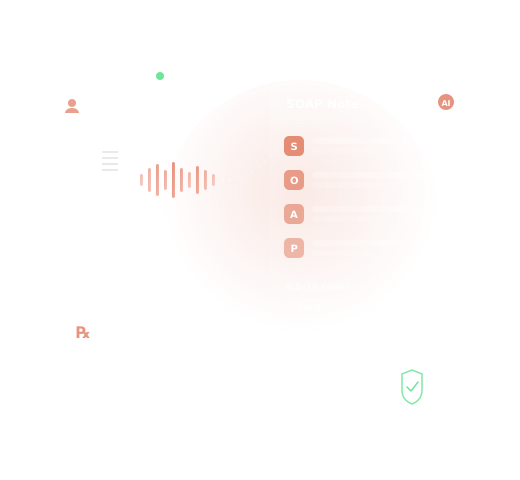
- Draft a SOAP note automatically: Based on the conversation, MedScribe generates a draft SOAP note. For clinical psychology, this can help organize presenting concerns, observations, assessment-related content, and follow-up planning into a usable format.
- Add coding support: The platform can surface ICD-10 and CPT suggestions as documentation support. These suggestions are intended to assist review workflows, not replace clinician judgment or billing validation.
- Review, edit, and finalize: The clinician checks the draft note, edits wording, removes anything unnecessary, and confirms that the record reflects the actual session. Human review is the operational checkpoint before final sign-off.
This review-first approach is important in mental health documentation, where context, phrasing, and clinical interpretation require professional oversight. The product is designed to support workflows aligned with internal documentation standards rather than force a one-size-fits-all process.
Local context
In India, clinical psychology teams often work across private clinics, hospital OPDs, rehabilitation settings, and multidisciplinary care models. Documentation needs can vary by organization, but common operational challenges include high patient volumes, mixed-language consultations, and the need to maintain continuity across repeat visits. An AI medical scribe in India is most useful when it adapts to these realities instead of adding another layer of administrative work.
For example, a hospital psychology department may want standardized note structures across clinicians, while an independent practice may prioritize faster post-session documentation. Some organizations may prefer private or on-premise deployment as a workflow and governance decision. Others may focus on multilingual support because patients and caregivers switch between English, Hindi, and regional languages during the same interaction. In each case, the value comes from practical documentation support that fits existing care delivery.
The broader AI medical scribe India healthcare landscape is also shaped by the need for tools that complement, not complicate, daily operations. That is why implementation should focus on note quality, review checkpoints, and ease of use for clinicians who already manage demanding schedules.
Use cases
- New patient intake: Generate a structured draft after a long first consultation so the clinician can focus on refining assessment details instead of writing from scratch.
- Follow-up sessions: Speed up repeat-visit documentation while maintaining continuity in plan and progress notes.
- Hospital OPD workflows: Support psychologists handling multiple appointments in a day with more consistent note formatting.
- Multidisciplinary coordination: Create clearer records that can be reviewed alongside psychiatry, counseling, or rehabilitation workflows.
- Mixed-language consultations: Help document sessions where patients and clinicians move between languages during discussion.
These scenarios show why an AI medical scribe in India can be valuable for clinical psychology teams that want to reduce documentation friction without losing control over the final record.
FAQ
Below are common implementation questions from clinics and hospitals evaluating documentation support for psychology workflows.
Can this replace clinician documentation entirely?
No. It is best used as a documentation copilot that creates draft notes for clinician review, editing, and final sign-off.
Is it suitable for psychology and mental health consultations?
It can support psychology workflows by structuring conversation-based documentation, especially where sessions are dialogue-heavy and require organized summaries.
Does it support coding workflows?
It can provide ICD-10 and CPT suggestions as a support layer. Teams should still validate coding decisions through their own review process.
Can organizations choose different deployment approaches?
Yes. Private or on-premise deployment options can support workflows aligned with internal IT and governance preferences.
CTA
If your clinical psychology team wants to reduce time spent on manual notes while keeping clinicians in control, MedScribe offers a practical path forward. Explore how an AI medical scribe in India can support consultation documentation, SOAP drafting, coding assistance, and review-led finalization for clinics and hospitals. Start by evaluating the workflow fit for your OPD, therapy-adjacent, or multidisciplinary mental health setting, then align deployment and review processes to your organization’s needs.