Introduction
An AI medical scribe in India can help Clinical Research Unit teams reduce documentation burden while keeping clinician review at the center of the workflow. In research-linked outpatient and hospital settings, teams often manage detailed visit notes, protocol-related observations, follow-up summaries, and coding support alongside routine patient care. That creates pressure on doctors, coordinators, and support staff to document consistently without slowing consultations.
MedScribe is designed as an AI documentation copilot that converts consultation conversations into structured clinical notes and coding suggestions. For Clinical Research Unit environments, the value is practical: faster first-draft documentation, clearer note structure, support for multilingual conversations, and a workflow that still depends on clinician edits and final sign-off. Rather than replacing judgment, the system supports teams that need usable drafts for daily OPD work, specialty consults, and research-adjacent documentation processes.
This page focuses on how an AI medical scribe in India can fit real hospital and clinic operations, especially where documentation quality, turnaround time, and review checkpoints matter. The goal is not to promise automatic compliance or one-click final records, but to support workflows aligned with internal governance and documentation standards.
Department workflow
Clinical Research Unit teams often work across routine care and structured documentation requirements. A typical workflow may include patient registration, consultation, history capture, assessment, treatment planning, follow-up instructions, and internal review of records where needed. In many Indian hospitals and specialty clinics, this happens in busy OPD schedules where doctors switch between languages, see repeat and new patients, and need notes that are both clinically useful and easy to finalize.
Documentation challenges usually appear at predictable points: capturing the full conversation accurately, organizing findings into a standard format, translating spoken details into concise notes, and preparing coding suggestions that can be reviewed before submission or record completion. For Clinical Research Unit settings, there may also be a need to maintain consistency across investigators, coordinators, and consulting clinicians.
An AI medical scribe in India is most useful when it fits this existing workflow instead of forcing a new one. That means supporting conversation capture during or after the visit, structuring the transcript into clinically relevant sections, drafting SOAP notes, surfacing ICD-10 or CPT suggestions for review, and allowing the clinician to edit and approve the final output.
Features mapped to workflow
Conversation capture and transcription: The platform supports consultation audio capture and converts speech into text for downstream note creation. This helps reduce manual typing during or after visits.
Speaker diarization: By separating clinician and patient speakers, the draft becomes easier to review and more useful for note generation, especially in longer consultations.
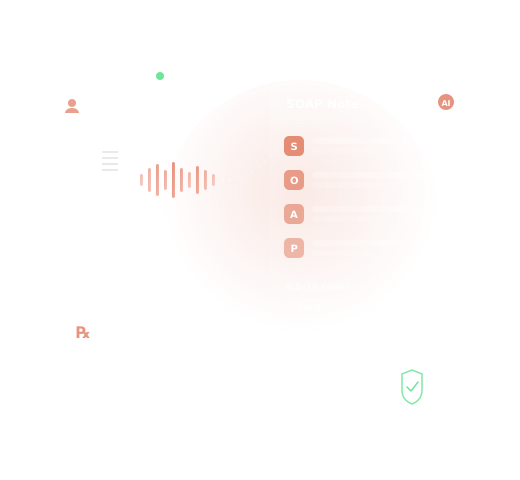
Automatic SOAP note generation: The system structures the encounter into Subjective, Objective, Assessment, and Plan sections, giving clinicians a usable first draft instead of a blank screen.
ICD-10 and CPT suggestions: Coding support is presented as suggestions for clinician review, helping teams move faster while keeping coding decisions under human control.
Multilingual support: In Indian care settings, consultations may shift between English and regional languages. Multilingual support helps teams document more naturally without forcing a single-language interaction.
On-premise or private deployment options: For organizations with stricter governance preferences, deployment posture can be chosen as an operational decision. This supports workflows aligned with internal IT and data handling practices.
Review and sign-off workflow: Drafts are not the endpoint. Clinicians can edit, validate, and finalize notes before they become part of the record.
How It Works
The workflow for this product is built around practical documentation support for real consultations.
- Capture the consultation conversation: During an OPD or follow-up visit, the consultation audio is recorded through the configured workflow. The system is designed to process doctor-patient conversations, including multilingual exchanges common in Indian healthcare settings.
- Transcribe and structure the interaction: The audio is converted into text, and speaker diarization separates who said what. This creates a clearer base record for review and reduces the effort needed to reconstruct the encounter from memory.
- Generate a SOAP draft automatically: The transcript is organized into a structured clinical note with SOAP sections. Instead of raw text alone, the clinician receives a draft that is closer to daily documentation needs in clinics and hospitals.
- Surface coding suggestions for review: Based on the documented encounter, the system presents ICD-10 and CPT suggestions. These are intended to support faster review, not replace coding judgment or internal approval processes.
- Clinician edits and validates the note: The doctor or authorized team member reviews the draft, corrects details, adds missing context, and confirms the assessment and plan. Human review is the operational checkpoint before any record is finalized.
- Finalize within the chosen deployment workflow: Once approved, the note can move into the organization’s documentation process. Teams may choose on-premise or private deployment models based on workflow, governance, and integration preferences.
Local context
For providers evaluating an AI medical scribe in India, the local context is important. Clinical teams often manage high patient volumes, mixed digital maturity, and multilingual communication in the same day. In Clinical Research Unit settings, documentation may also need to be consistent across investigators, departments, and support teams. That makes usability and review controls more important than generic automation claims.
An effective AI medical scribe in India should support practical realities: OPD speed, variable consultation lengths, specialty-specific note styles, and the need for doctors to retain final control over records. It should also fit different infrastructure preferences, including private or on-premise deployment where organizations want tighter operational control. For hospitals and clinics comparing options, the key question is whether the system helps teams document faster without disrupting established care workflows.
Use cases
Research-linked outpatient consultations: Create faster first-draft notes for investigator or specialist visits while preserving clinician review before finalization.
Follow-up visit documentation: Summarize interval history, treatment response, and next-step plans in a structured format that is easier to edit and sign off.
Multilingual specialty clinics: Support consultations where patient communication shifts between English and regional languages, reducing the need to manually reconstruct details later.
Coding-assisted documentation: Help teams review ICD-10 and CPT suggestions alongside the drafted note to improve documentation completeness.
Hospital documentation standardization: Support more consistent note structure across departments or units that want a common starting format for clinical records.
FAQ
Below are common implementation questions from clinics and hospitals considering an AI medical scribe India healthcare workflow.
Can this replace clinician documentation completely?
No. The product is designed to create draft notes and coding suggestions, but clinician review, edits, and final sign-off remain essential before record completion.
Does it support multilingual consultations?
Yes. Multilingual support is intended to help teams document consultations more naturally in settings where English and regional languages are both used.
How does it fit Clinical Research Unit workflows?
It supports structured note drafting, coding assistance, and review checkpoints that can be adapted to research-linked clinical operations without changing the need for human oversight.
Can organizations choose how it is deployed?
Yes. On-premise or private deployment options can be considered as workflow and governance decisions based on internal IT preferences.
CTA
If your team is evaluating an AI medical scribe in India for Clinical Research Unit documentation, focus on workflow fit: how conversations are captured, how drafts are structured, how coding suggestions are reviewed, and how clinicians retain final control. MedScribe is built to support practical documentation workflows for clinics and hospitals that want faster note creation without losing oversight.
Explore the product pathways that matter most to your evaluation, including core capabilities, workflow features, integration considerations, and pricing discussions. For organizations looking for an AI medical scribe in India, the best next step is a workflow review centered on your OPD process, documentation standards, and deployment preferences.