Introduction
Community dentistry teams often manage high patient volumes, preventive care visits, outreach-linked records, follow-ups, and treatment documentation across clinics and hospital dental units. An AI medical scribe in India can help reduce time spent on manual note-taking by turning consultation conversations into structured draft documentation that clinicians can review and finalize. For community dentistry, this is useful when providers need to document oral health findings, patient history, treatment advice, preventive counselling, and procedure planning without losing focus during the interaction.
MedScribe is designed as an AI documentation copilot for practical OPD use. It supports conversation capture, transcription, SOAP note drafting, coding suggestions, and clinician review before the record is finalized. Instead of replacing clinical judgment, it supports a more consistent documentation workflow for dentists, public health dental teams, and multispecialty facilities that want faster note completion with human oversight. For organizations evaluating an AI medical scribe in India, the value is usually operational: less repetitive typing, more complete drafts, and a clearer path from consultation to signed record.
Department workflow
In community dentistry, documentation usually starts with registration details, chief complaint, medical and dental history, and risk factors such as tobacco use, oral hygiene habits, diet, or prior treatment. The clinician then records examination findings, provisional diagnosis, treatment advice, preventive education, prescriptions, referrals, and follow-up instructions. In outreach or public-facing settings, the workflow may also include screening notes, recall planning, and coordination with general medicine or pediatrics.
An AI medical scribe in India fits into this workflow by helping convert spoken consultations into structured drafts that are easier to review than free-form transcripts. This is especially relevant when dental teams need to maintain note quality during busy OPD sessions. The system can support multilingual conversations, distinguish speakers, and organize content into clinically familiar sections so the provider can focus on patient communication and then complete edits efficiently.
Features mapped to workflow
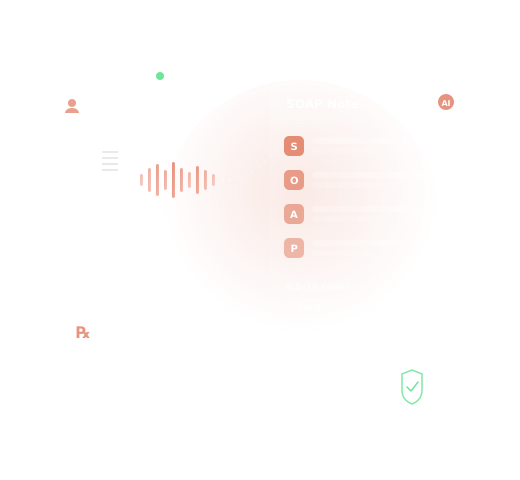
Automatic SOAP note generation: After a consultation, the platform drafts Subjective, Objective, Assessment, and Plan sections based on the captured interaction. For community dentistry, this can help organize symptoms, oral findings, treatment considerations, and preventive advice into a usable format.
Speaker diarization: Dental consultations often include back-and-forth clarification between clinician and patient. Speaker separation helps identify who said what, improving the quality of the draft note and reducing confusion during review.
Multilingual support: Many clinics in India work across English and regional languages. Multilingual capture can support more natural patient conversations while still producing structured documentation for the clinician to verify.
ICD-10 and CPT suggestions: Coding support can help teams prepare draft coding suggestions linked to the documented encounter. These suggestions still require clinician or billing review, but they can reduce manual lookup effort.
On-premise or private deployment options: Some hospitals and larger dental networks prefer deployment choices that support internal governance and IT preferences. These options are workflow and infrastructure decisions that can be aligned with organizational policies.
Review before finalization: The product is built around clinician review, edits, and sign-off. That matters in community dentistry, where preventive counselling, diagnosis wording, and treatment planning often need precise confirmation before the note becomes part of the record.
How It Works
The workflow below reflects how an AI medical scribe in India can be used in day-to-day community dentistry documentation.
- Capture the consultation conversation: During or immediately after the visit, the clinician or care team initiates audio capture for the consultation. The system records the interaction in a way that supports multilingual speech and speaker diarization, helping separate patient responses from clinician questions and explanations.
- Convert speech into structured transcript: The captured conversation is transcribed and organized into a readable clinical transcript. Instead of leaving the team with raw text alone, the platform structures the content around medically relevant details such as symptoms, history, examination findings, advice, and next steps.
- Draft a SOAP note automatically: Using the structured transcript, MedScribe generates a draft SOAP note. In community dentistry, this may include the presenting complaint, oral examination observations, assessment summary, preventive counselling, treatment recommendations, and follow-up plan.
- Add coding suggestions for review: The system can surface ICD-10 and CPT suggestions based on the documented encounter. These are intended as decision support for the clinician or billing team, not as final coding without review.
- Clinician edits and signs off: Before anything is finalized, the dentist reviews the draft note, corrects wording, adds missing findings, confirms coding relevance, and approves the final version. Human review is the operational checkpoint that keeps the record clinically usable.
- Choose deployment posture to match operations: Depending on the clinic or hospital setup, teams can evaluate on-premise or private deployment approaches to support internal governance, IT controls, and workflow preferences. This is best treated as an implementation decision rather than a blanket compliance claim.
Local context
Dental clinics and hospitals in India often balance preventive care, restorative consultations, patient education, and documentation across varied patient loads. In community dentistry, providers may also need to document screening outcomes, oral hygiene counselling, referral advice, and follow-up plans in a consistent way. An AI medical scribe in India is most useful when it adapts to practical OPD realities: mixed-language conversations, limited time per patient, and the need for clinician-reviewed notes rather than fully automated records.
For larger institutions, deployment choices may matter as much as note quality. Some teams may prefer private or on-premise setups to support workflows aligned with internal data handling practices. For smaller clinics, the priority may be faster note completion and easier review. In both cases, the goal is the same: support documentation quality without adding friction to the consultation.
Use cases
Busy dental OPD: Draft notes can be prepared quickly after routine consultations involving pain, swelling, caries review, periodontal complaints, or preventive counselling.
Community oral health programs: Screening interactions and counselling discussions can be converted into structured drafts for later review and record completion.
Hospital dental departments: Teams handling referrals, medically complex patients, or multidisciplinary care can use structured documentation support to improve consistency.
Multilingual patient interactions: Clinics serving diverse populations can benefit when the documentation workflow supports natural speech patterns and later clinician verification.
Coding-assisted documentation: Providers and billing teams can review draft ICD-10 and CPT suggestions alongside the note to streamline downstream administrative work.
FAQ
Can this replace the dentist's documentation responsibility?
No. The platform creates draft notes and coding suggestions, but the clinician remains responsible for review, edits, and final sign-off.
Is it useful for community dentistry and preventive visits?
Yes. It can help document counselling, oral health history, examination findings, treatment advice, and follow-up plans in a structured format.
Does it support multilingual consultations?
The product supports multilingual workflows, which can be helpful in Indian clinical settings where patients and providers may switch between languages during a visit.
Can hospitals consider private or on-premise deployment?
Yes. Deployment posture can be evaluated based on operational needs, IT preferences, and workflows aligned with internal governance requirements.
CTA
If your dental clinic or hospital is exploring a practical AI medical scribe in India, MedScribe can support community dentistry workflows from conversation capture to clinician-reviewed documentation. Explore the product overview, feature details, and integration pathways to assess fit for your OPD setup and documentation process.