Introduction
Community outreach screening programs often run in busy, time-bound settings where teams need to move quickly between registration, history taking, basic assessment, counselling, and referral documentation. An AI medical scribe in India can support these workflows by turning spoken interactions into structured clinical documentation that is easier to review, edit, and finalize. For hospitals, clinics, public health initiatives, and mobile screening units, the goal is not to replace clinical judgment. The goal is to reduce repetitive note-writing so doctors and outreach teams can focus more on patient interaction, triage, and follow-up planning.
MedScribe is designed as an AI documentation copilot for consultation and screening conversations. It helps convert speech into draft notes, supports SOAP-style documentation, and provides coding suggestions that clinicians can review before final sign-off. In community outreach screening, this is especially useful when teams must document high patient volumes while maintaining consistency across camps, school health drives, workplace screening events, and rural or peri-urban outreach visits. The result is a more practical documentation process for daily operations, with workflows aligned to clinician review rather than one-click automation.
For organizations evaluating an AI medical scribe in India, the most important question is whether the tool fits real field conditions: multilingual conversations, variable connectivity, mixed staffing models, and the need for clear handoff notes for referral centers. This page focuses on that practical fit for community outreach screening teams.
Department workflow
Community outreach screening usually involves a sequence of short but important interactions. A patient may first share demographic details and symptoms with a field worker or nurse, then speak with a doctor for focused history and assessment, and finally receive counselling, referral advice, or follow-up instructions. Documentation must capture enough detail for continuity of care without slowing down the camp.
Typical workflow steps include patient intake, symptom discussion, risk-factor capture, basic examination findings, provisional assessment, referral recommendation, and follow-up planning. In many outreach settings, notes are written later from memory or entered in fragmented formats across paper forms, spreadsheets, and hospital systems. That creates delays and inconsistency. An AI medical scribe in India can support a more standardized process by drafting structured notes during or immediately after the interaction, helping teams preserve key details while the encounter is still fresh.
For community outreach screening, the documentation need is often broader than a standard OPD note. Teams may need to record screening purpose, camp context, risk indicators, counselling provided, and whether the patient was referred to a higher center. A documentation copilot that supports structured note generation and multilingual speech capture can fit these operational realities more effectively than generic dictation alone.
Features mapped to workflow
Automatic SOAP note drafting: Outreach clinicians can use AI-generated draft notes to organize subjective complaints, objective observations, assessment, and plan in a familiar format. This helps standardize records across multiple doctors and screening locations.
Speaker diarization: In screening camps, more than one person may speak during the encounter, including the patient, clinician, nurse, or translator. Speaker separation helps make transcripts easier to review and supports cleaner note generation.
Multilingual support: Community outreach in India often involves mixed-language conversations. Multilingual capture is useful when patients describe symptoms in one language while clinicians summarize in another.
ICD-10 and CPT suggestions: Coding support can help teams prepare cleaner downstream documentation for billing, analytics, or referral workflows where applicable. Suggestions should always be reviewed by the clinician or authorized staff before use.
On-premise or private deployment options: Some organizations prefer deployment choices that support internal governance, network constraints, or data-handling preferences. These decisions are operational and IT-led, based on workflow and infrastructure needs.
Review-first workflow: Draft generation is only one part of the process. The stronger value comes from enabling clinicians to edit, validate, and sign off before the record is finalized.
How It Works
The workflow below reflects how an AI medical scribe supports community outreach screening from conversation capture to finalized documentation.
- Capture the screening conversation: During the patient interaction, the clinician or outreach team records the consultation audio through the configured workflow. This may include symptom history, risk factors, screening findings, counselling, and referral advice. The system is designed to identify speakers where possible, helping separate patient responses from clinician prompts.
- Transcribe and structure the encounter: The captured conversation is converted into text and organized into clinically useful sections. Instead of leaving teams with a raw transcript alone, the workflow prepares structured content that can be used for note drafting and downstream review.
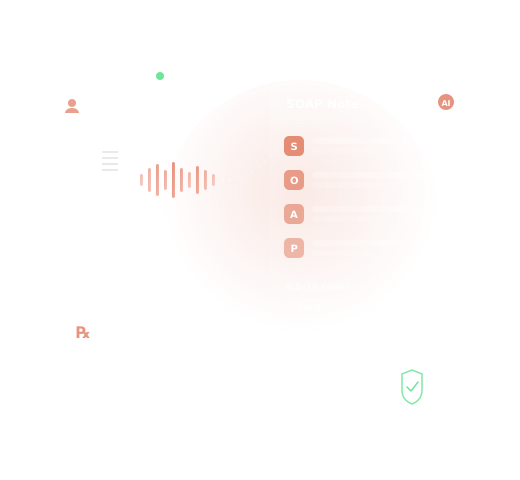
- Generate a SOAP-style draft note: Based on the conversation, the system creates a draft clinical note with subjective details, objective findings, assessment, and plan. In outreach screening, this can include screening context, observed findings, advice given, and referral recommendations where discussed.
- Suggest coding support for review: The platform can surface ICD-10 and CPT suggestions based on the documented encounter. These are support tools, not final coding decisions. Authorized staff should review relevance, specificity, and completeness before acceptance.
- Clinician reviews, edits, and signs off: The doctor or designated reviewer checks the draft note, corrects inaccuracies, adds missing context, and confirms the final version. This human review checkpoint is essential before the record is saved or shared with the next point of care.
- Finalize based on deployment and governance choices: Once approved, the note can move into the organization’s documentation workflow, depending on integration and deployment setup. Teams may choose private or on-premise deployment models to support internal workflow, infrastructure, and governance preferences.
Local context
In India, community outreach screening can span urban camps, semi-urban clinics, school programs, occupational health drives, and rural mobile units. Teams often work across different languages, staffing patterns, and documentation maturity levels. That is why an AI medical scribe in India should be evaluated for practical fit: can it support short encounters, mixed-language conversations, and clinician review without adding operational friction?
Hospitals and clinic networks may also need outreach documentation to connect back to central care teams. A structured note is more useful than a long transcript when a referred patient later arrives at an OPD or specialty clinic. For this reason, AI medical scribe India healthcare adoption is often strongest where organizations want better continuity between field screening and facility-based care. The value is not only speed, but also more consistent handoff documentation.
Because outreach settings vary widely, deployment posture matters too. Some organizations may prefer private environments or on-premise options to align with internal IT and data-handling workflows. These choices should be assessed as part of operational planning, integration needs, and governance design.
Use cases
Non-communicable disease screening camps: Draft notes for blood pressure, diabetes risk, symptom history, counselling, and referral recommendations.
School and adolescent health programs: Capture focused history, observations, parent or guardian concerns, and follow-up advice in a structured format.
Women’s health outreach: Support documentation for screening conversations, symptom review, counselling, and referral planning.
Occupational and workplace screening: Standardize short encounter notes across high-volume employee health checks.
Mobile clinic operations: Help clinicians document encounters consistently when moving between locations and patient groups.
Across these scenarios, an AI medical scribe in India is most useful when it supports fast documentation, multilingual interaction capture, and a clear clinician review step before finalization.
FAQ
Can this be used in short screening encounters?
Yes. The workflow is suited to brief, structured interactions where teams need draft documentation quickly and still want clinician review before finalizing the note.
Does it replace the doctor’s documentation responsibility?
No. It supports note creation and coding suggestions, but the clinician or authorized reviewer should verify, edit, and sign off on the final record.
Is multilingual use relevant for outreach programs?
Yes. Many outreach encounters in India involve mixed-language conversations. Multilingual support can help teams document these interactions more effectively.
Can organizations choose different deployment models?
Yes. Private or on-premise deployment options may be considered based on infrastructure, workflow, and governance preferences.
CTA
If your hospital, clinic network, or outreach program is exploring an AI medical scribe in India for community screening workflows, start with the operational questions that matter: encounter length, language mix, review process, coding needs, and deployment preferences. MedScribe is designed to support practical documentation workflows for outreach teams, from conversation capture to clinician-reviewed notes. Explore the product overview, features, integrations, and pricing paths to assess fit for your screening operations.
Explore MedScribe | View features | See integrations | Review pricing