Introduction
Cornea and refractive services often run on tightly scheduled OPD sessions, repeat measurements, counselling-heavy consultations, and detailed follow-up documentation. An AI medical scribe in India can help ophthalmologists, fellows, optometrists, and clinic coordinators reduce manual note-taking while keeping the clinician in control of the final record. For cornea refractive practices, the value is practical: capture the consultation, structure the discussion into usable notes, support coding suggestions, and make review easier before sign-off.
MedScribe is designed as an AI documentation copilot for clinics and hospitals that want faster clinical documentation without changing how doctors examine patients. It converts consultation conversations into draft notes such as SOAP summaries, supports speaker diarization, and can fit multilingual environments common in Indian healthcare settings. Rather than replacing clinical judgment, it supports workflows aligned with day-to-day documentation needs in refractive counselling, corneal evaluation, pre-op assessment, and post-op follow-up.
Department workflow
In cornea refractive care, documentation usually spans more than one interaction. A patient may first discuss symptoms such as blurred vision, contact lens intolerance, dryness, glare, or fluctuating vision. The visit may then move into refraction review, corneal history, prior surgery details, medication use, and counselling on LASIK, PRK, SMILE, keratoconus management, or ocular surface optimization. Each step creates documentation load.
An AI medical scribe in India is useful here because the workflow is conversation-rich and repetitive in structure. Doctors often explain candidacy, risks, expected recovery, alternatives, and follow-up plans multiple times a day. Instead of typing throughout the consultation, the clinician can focus on examination and patient communication while the system prepares a structured draft. This is especially relevant in busy eye hospitals and specialty clinics where OPD throughput matters but note quality still needs consistency.
For cornea refractive teams, the documentation burden may include history of present illness, prior spectacle or contact lens use, dry eye symptoms, surgical eligibility discussion, treatment planning, and postoperative instructions. A documentation copilot helps standardize these recurring elements while still allowing the doctor to edit findings, add measurements, and finalize the note according to the case.
Features mapped to workflow
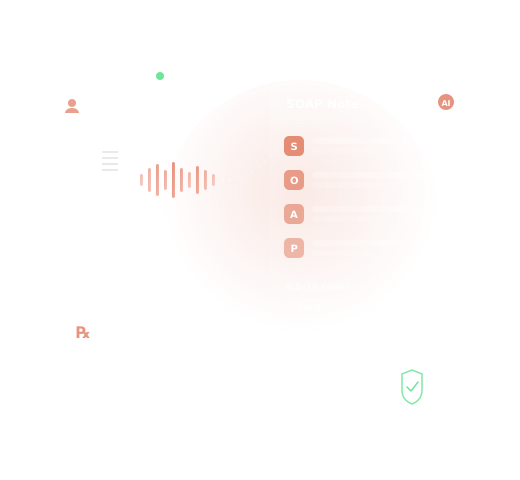
Automatic SOAP note drafting: Consultation audio can be converted into a structured draft with subjective history, objective findings placeholders, assessment framing, and plan summaries. This helps when the doctor wants a starting point instead of a blank screen.
Speaker diarization: In ophthalmology OPD, both doctor and patient speak extensively, and sometimes a counsellor or attendant joins the discussion. Speaker separation helps keep the note readable and reduces confusion in the draft.
ICD-10 and CPT suggestions: Coding support can assist administrative and billing workflows by surfacing likely coding options based on the documented encounter. The clinician or authorized staff should always review before use.
Multilingual support: Many clinics in India switch between English and regional languages during counselling. AI medical scribe India healthcare workflows benefit when the system can handle mixed-language conversations more naturally.
On-premise or private deployment options: Some hospitals prefer infrastructure choices based on internal governance, IT architecture, or data handling preferences. Deployment posture can be selected as an operational decision rather than a one-size-fits-all setup.
Review before finalization: The product is built around clinician review, edits, and sign-off. That matters in cornea refractive care, where subtle distinctions in candidacy, ocular surface status, and follow-up instructions should be confirmed by the treating doctor.
How It Works
The workflow below reflects how an AI medical scribe in India can support cornea refractive consultations from conversation capture to final note approval.
- Capture the consultation conversation: During the OPD visit, the doctor-patient discussion is captured through the configured workflow. This may include history taking, refractive surgery counselling, symptom review, and treatment planning. The goal is to document naturally without forcing the clinician to type continuously.
- Transcribe and structure the encounter: The system converts speech into text, separates speakers, and organizes the conversation into clinically relevant sections. In a cornea refractive setting, this can help distinguish patient-reported symptoms from clinician explanations and recommendations.
- Draft a SOAP-style note: Based on the structured transcript, MedScribe prepares a draft note with subjective and plan-oriented content, while leaving room for the clinician to add or refine objective findings from slit lamp exam, topography, pachymetry, tear film assessment, or postoperative review.
- Surface coding support: The system can suggest ICD-10 and CPT options linked to the documented encounter. These suggestions are intended to support workflow efficiency and should be checked by the clinician or authorized billing team before final use.
- Review, edit, and sign off: The clinician reviews the draft, corrects terminology, adds measurements or procedure details, and confirms the final assessment and plan. Human review is the operational checkpoint before the record is finalized.
- Choose deployment posture for governance needs: Depending on clinic or hospital requirements, teams may evaluate private or on-premise deployment options. This supports workflows aligned with internal IT and governance preferences without changing the core documentation process.
Local context
Eye care delivery in India often combines high patient volumes with multilingual communication and varied documentation habits across solo practices, day surgery centres, and hospital-based departments. An AI medical scribe in India should therefore be practical, flexible, and easy to fit into existing OPD routines. The need is not only speed, but also consistency across first consults, counselling visits, procedure discussions, and follow-ups.
For cornea refractive teams, local relevance also means supporting mixed workflows: some clinics may rely on digital records, some may be transitioning from partial paper documentation, and some may need deployment choices that align with internal infrastructure preferences. In this environment, AI medical scribe India healthcare adoption works best when the tool complements the doctor's process instead of forcing a new one.
Use cases
Refractive surgery screening: Capture candidacy discussions, prior lens use, visual expectations, and treatment options discussed during LASIK or SMILE evaluations.
Corneal disease follow-up: Support note drafting for keratoconus monitoring, corneal scar review, post-crosslinking visits, or ocular surface optimization plans.
Postoperative reviews: Reduce repetitive documentation during day 1, week 1, and later follow-ups where symptoms, medication adherence, and recovery counselling are discussed.
High-volume counselling clinics: Help standardize documentation when multiple clinicians explain benefits, limitations, and next steps for elective refractive procedures.
Multi-doctor eye hospitals: Improve note consistency across consultants, fellows, and support staff while preserving final clinician control over the record.
FAQ
Can this be used only for refractive surgery clinics?
No. While this page focuses on cornea refractive workflows, the documentation approach can also support broader ophthalmology consultations where conversation-to-note drafting is useful.
Does the system replace clinician documentation review?
No. The workflow is built around draft generation followed by clinician review, edits, and final sign-off before the record is completed.
Can it handle multilingual consultations common in India?
It is designed to support multilingual environments, which can be helpful when doctors and patients switch between English and regional languages during the same visit.
How does coding support work?
The product can surface ICD-10 and CPT suggestions based on the documented encounter. These are workflow aids and should be reviewed by the clinician or authorized staff.
Are there deployment options for hospitals with specific IT preferences?
Yes. Teams can evaluate private or on-premise deployment approaches based on operational and governance needs.
CTA
If your eye clinic or hospital wants to reduce documentation burden without disrupting cornea refractive consultations, MedScribe offers a practical starting point. Explore the product overview, features, integrations, and pricing to see how an AI medical scribe in India can support faster note preparation, coding assistance, and clinician-reviewed documentation for daily OPD workflows.
Explore MedScribe | View features | See integrations | Check pricing