Introduction
Corporate Relations teams in hospitals and clinic networks often sit at the intersection of doctors, administration, payer-facing communication, and operational reporting. While they may not document consultations themselves, they are closely affected by how quickly and accurately clinical notes are created, reviewed, and made available for downstream workflows. An AI medical scribe in India can support this chain by helping clinicians convert consultation conversations into structured notes that are easier to review, share internally, and use for coordinated care operations.
For healthcare organizations evaluating documentation technology, the practical question is not just whether AI can transcribe speech, but whether it can fit into daily OPD and hospital workflows without adding friction. MedScribe is designed as an AI medical documentation copilot that turns doctor-patient conversations into draft clinical notes, with support for SOAP formatting, coding suggestions, speaker diarization, multilingual use, and deployment options such as on-premise or private environments. For Corporate Relations stakeholders, this means a more consistent documentation process that can support smoother coordination between clinical, operational, and administrative teams.
This page focuses on how an AI medical scribe in India can be evaluated from a workflow and governance perspective for Indian healthcare organizations, especially where documentation quality, turnaround time, and internal coordination matter.
Department workflow
In many Indian hospitals, Corporate Relations teams help align internal departments around service delivery, reporting expectations, institutional partnerships, and patient experience goals. Documentation delays can affect several linked processes: clinician note completion, coding review, discharge or follow-up coordination, internal communication, and readiness for audits or management review. Even in OPD-heavy settings, incomplete or inconsistent notes can create avoidable back-and-forth between doctors, front office teams, and operations staff.
An AI medical documentation workflow can support this environment by reducing the time clinicians spend manually typing notes after consultations. Instead of relying only on memory or fragmented shorthand, the consultation conversation is captured, transcribed, structured, and converted into a draft note for clinician review. This can help standardize note quality across departments while preserving the doctor’s final authority over the record.
For Corporate Relations leaders, the value is operational: better note availability, more predictable documentation turnaround, and a clearer path from consultation to internal follow-up. This is especially relevant in multi-specialty hospitals, clinic chains, and enterprise care settings where documentation consistency affects coordination across teams.
Features mapped to workflow
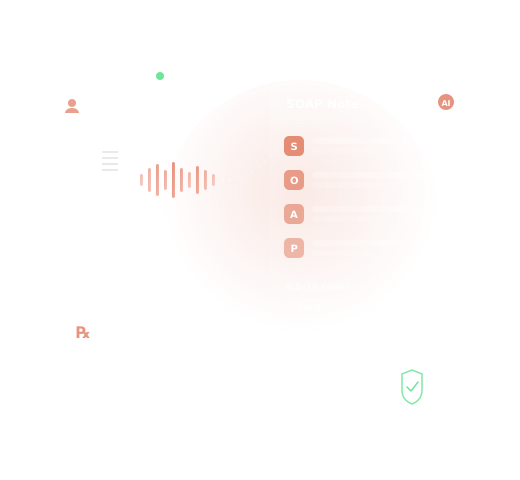
Automatic SOAP note generation: Consultation conversations can be converted into draft SOAP notes, helping clinicians move from raw dialogue to a usable clinical structure more quickly.
Speaker diarization: The system distinguishes between speakers in the consultation, which helps separate clinician and patient inputs during transcription and note drafting.
ICD-10 and CPT suggestions: Coding support can assist clinicians and downstream teams by surfacing likely coding options for review, without replacing human judgment.
Multilingual support: In India, consultations may shift between English and regional languages. Multilingual capability can make the tool more practical for real-world OPD interactions.
On-premise or private deployment options: Organizations with stricter internal governance preferences may choose deployment models designed to align with their infrastructure and workflow controls.
Clinician review before finalization: Draft notes are not the endpoint. Human review, edits, and sign-off remain central to record quality and workflow accountability.
For teams assessing AI medical scribe India healthcare solutions, these features matter most when they reduce documentation friction without disrupting existing care delivery patterns.
How It Works
The workflow below reflects how this product is intended to support day-to-day clinical documentation while keeping clinicians in control of the final record.
- Capture the consultation conversation: During or immediately around the patient encounter, the conversation is captured through the configured workflow. This creates the source input for documentation while fitting into routine OPD or clinic operations.
- Transcribe and structure the interaction: The audio is converted into text, with speaker diarization helping distinguish doctor and patient contributions. The transcript is then organized into clinically relevant sections rather than remaining as raw text.
- Draft a SOAP note automatically: Based on the structured conversation, the system generates a draft SOAP note that clinicians can use as a starting point. This helps reduce repetitive manual typing and supports more consistent note formatting.
- Surface coding suggestions for review: The workflow can present ICD-10 and CPT suggestions linked to the documented encounter. These are intended as review aids for clinicians or relevant teams, not as automatic final coding decisions.
- Clinician reviews, edits, and signs off: Before any record is finalized, the doctor reviews the draft, corrects details, adds clinical nuance, and approves the final version. This human checkpoint is essential for accuracy and accountability.
- Choose deployment posture based on governance needs: Depending on organizational preferences, teams may evaluate on-premise or private deployment approaches. This is a workflow and governance decision that can support internal data handling expectations and IT planning.
Local context
Healthcare delivery in India often involves high patient volumes, multilingual consultations, and a mix of standalone clinics, specialty centers, and large hospital groups. In this environment, documentation tools need to be practical rather than theoretical. An AI medical scribe in India should support fast-moving OPD workflows, variable consultation styles, and the need for clinician oversight at every stage.
For Corporate Relations teams, the local context also includes coordination across departments with different documentation maturity levels. Some organizations may prioritize faster note completion for operational visibility, while others may focus on standardization across multiple facilities. A practical AI medical scribe in India should therefore be evaluated on usability, review controls, multilingual performance, and deployment fit within the organization’s existing systems and governance approach.
Because many Indian providers are balancing growth with operational discipline, the most useful implementation approach is usually phased: start with a defined workflow, validate clinician adoption, review note quality, and then expand based on measurable process improvement.
Use cases
Multi-specialty hospitals: Support clinicians with faster draft note creation while helping operations and coordination teams access more standardized documentation.
Clinic chains: Improve consistency across locations where doctors may follow different note-taking habits but leadership wants more uniform workflows.
Enterprise OPD settings: Reduce after-hours documentation burden and support quicker internal handoffs after consultations.
Corporate care programs: Help streamline documentation processes where coordination between clinicians, administrators, and relationship teams is important.
Specialty practices with mixed-language consultations: Use multilingual support to better reflect real consultation patterns in India.
These use cases show why an AI medical scribe in India is relevant not only to doctors, but also to stakeholders responsible for operational alignment and service quality.
FAQ
Can this replace clinician judgment?
No. The product is designed to assist with documentation by generating drafts and coding suggestions. Clinician review and final sign-off remain necessary before records are finalized.
Is it suitable for Indian OPD workflows?
It is designed to support practical, high-volume consultation environments, including multilingual interactions and structured note drafting for everyday clinical use.
Does it support coding workflows?
Yes. It can provide ICD-10 and CPT suggestions as part of the documentation workflow, which can then be reviewed by the clinician or relevant team.
What deployment options are available?
Organizations can evaluate deployment approaches such as on-premise or private environments based on internal IT, workflow, and governance preferences.
CTA
If your hospital or clinic is exploring documentation improvement for faster coordination and more consistent clinical records, MedScribe offers a practical starting point. Review the core product at /medscribe, explore deeper capabilities at /medscribe/features, and assess whether this AI medical scribe in India fits your Corporate Relations and clinical workflow priorities. The right evaluation should focus on usability, review controls, deployment fit, and how well the tool supports real consultation-to-documentation processes in Indian healthcare settings.