Introduction
An AI medical scribe in India can help hospitals and clinics reduce the time clinicians spend turning conversations into structured documentation. While CSSD teams are not the primary authors of consultation notes, their work is closely connected to procedure readiness, instrument traceability, handoff clarity, and documentation quality across surgical and procedural care. In that environment, an AI medical documentation copilot can support cleaner records by converting doctor-patient or clinician-team conversations into draft notes, structured summaries, and coding suggestions that are ready for review.
For organisations looking at an AI medical scribe in India, the practical value is not just faster note creation. It is about improving consistency across OPD, procedure rooms, and perioperative workflows where CSSD coordination matters. MedScribe is designed to capture consultation dialogue, structure it into usable clinical documentation, suggest SOAP formatting, and support coding review while keeping the clinician in control of edits and final sign-off.
This page focuses on how the product fits into real hospital operations in India, especially where CSSD-linked workflows depend on accurate procedure documentation, scheduling context, and clear communication between clinicians and support teams.
Department workflow
CSSD operations sit behind many high-dependency clinical workflows. Sterile processing, tray preparation, instrument turnaround, and coordination with OT or procedure units all depend on timely and accurate information. Although CSSD staff may not document the consultation itself, the downstream workflow often relies on what is recorded during assessment, procedure planning, and post-procedure communication.
In many hospitals, documentation gaps create avoidable friction. A clinician may complete a consultation but delay note entry. A procedure may be discussed verbally, yet the final record may not clearly reflect the indication, planned intervention, or coding context. This can affect handoffs to nursing, OT scheduling, and support functions that depend on complete records. An AI medical scribe in India is useful here because it helps convert live conversations into structured drafts quickly, so the care team has a more usable record earlier in the workflow.
For CSSD-linked environments, the documentation priorities are usually practical: clear procedure intent, concise history, relevant findings, planned next steps, and a reviewable summary that supports coordination. The goal is not to replace clinical judgment. It is to reduce manual note burden and make documentation more available to the teams that depend on it.
Features mapped to workflow
MedScribe is built as an AI medical documentation copilot for day-to-day healthcare operations. Its capabilities map well to hospitals and clinics that need structured notes without adding more administrative work.
- Conversation capture and transcription: Records consultation dialogue and converts speech into text for draft creation.
- Speaker diarization: Distinguishes between speakers so the note reflects who said what more clearly during clinician-patient or clinician-attendant interactions.
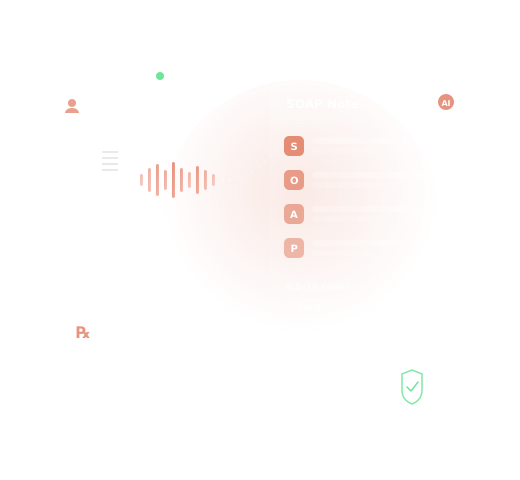
- Automatic SOAP note generation: Organises the encounter into a familiar clinical structure that can be reviewed and edited before finalisation.
- ICD-10 and CPT suggestions: Supports coding review by surfacing likely options based on the documented encounter, helping teams prepare cleaner records for downstream workflows.
- Multilingual support: Useful in Indian care settings where consultations may move between English, Hindi, and regional languages.
- On-premise or private deployment options: Supports workflow and governance choices for organisations that prefer tighter control over where systems run.
These features are relevant in CSSD-connected care pathways because better documentation upstream can improve clarity for procedure preparation, post-procedure summaries, and interdepartmental coordination.
How It Works
The product workflow is designed to follow the real sequence of a consultation and documentation cycle rather than forcing clinicians into a separate admin process.
- Capture the consultation conversation: During an OPD visit, pre-procedure assessment, or follow-up discussion, the clinician uses MedScribe to capture the conversation. The system processes speech input and prepares a transcript while preserving the flow of the encounter.
- Structure the transcript into clinical sections: The raw conversation is organised into meaningful components such as symptoms, history, findings, assessment points, and plan. Speaker diarization helps separate patient statements from clinician guidance, which is useful when the encounter includes attendants or multiple participants.
- Draft a SOAP note automatically: Based on the structured transcript, MedScribe generates a draft SOAP note. This gives the clinician a usable starting point instead of a blank screen and helps standardise documentation across OPD and procedure-linked workflows.
- Surface coding suggestions for review: The system can suggest ICD-10 and CPT codes aligned with the documented encounter. These are support prompts, not final coding decisions, and should be reviewed by the clinician or authorised team member before use.
- Review, edit, and sign off: The clinician checks the draft, corrects details, adds missing context, and approves the final note. Human review is a required operational checkpoint before the record is finalised or shared downstream.
- Choose deployment posture based on workflow needs: Hospitals can evaluate on-premise or private deployment approaches where internal governance, IT architecture, or data handling preferences require more controlled implementation. This supports workflows aligned with organisational policies without making blanket compliance claims.
Local context
Healthcare teams in India often work in high-volume settings where consultation time is limited and documentation still needs to be complete enough for continuity of care. This is one reason interest in an AI medical scribe in India continues to grow across clinics, day-care centres, and hospitals. In multilingual environments, clinicians may switch languages during the same encounter, and documentation tools need to adapt to that reality rather than assume a single-language workflow.
For hospitals with CSSD-linked procedural services, the local need is especially practical: faster note readiness, clearer procedure planning, and better handoff quality between clinicians and operational teams. An AI medical scribe India healthcare solution should therefore support everyday workflows, not just produce transcripts. It should help teams move from conversation to reviewable documentation with minimal disruption.
Because implementation needs vary, some organisations may prefer private or on-premise deployment models as part of their internal governance approach. The right choice depends on workflow design, IT maturity, and how the hospital wants to manage documentation operations.
Use cases
- OPD consultations before procedures: Generate draft notes quickly so planned interventions and next steps are documented earlier.
- Pre-anaesthesia or pre-procedure assessments: Capture key history and assessment points in a structured format for clinician review.
- Post-procedure follow-up: Summarise outcomes, instructions, and coding context in a more consistent way.
- Multispecialty hospitals with CSSD coordination needs: Improve documentation flow between consulting teams, procedure units, and support departments.
- Busy clinics in India: Reduce repetitive typing and support more standardised note creation without removing clinician oversight.
These use cases show why an AI medical scribe in India is relevant even when the immediate user is the doctor and the operational benefit extends to connected departments such as CSSD, OT, and nursing coordination.
FAQ
Is this meant for CSSD staff to write notes?
No. The primary user is the clinician or care team member responsible for documentation. The benefit for CSSD-linked workflows comes from clearer and faster clinical records that support downstream coordination.
Can the tool replace clinician review?
No. Draft notes and coding suggestions should always be reviewed, edited where needed, and signed off by the clinician before final record finalisation.
Does it support multilingual consultations common in India?
Yes. Multilingual support is useful for care settings where conversations may include English, Hindi, or regional language usage during the same encounter.
Can hospitals consider private deployment options?
Yes. On-premise or private deployment can be evaluated as workflow and governance decisions based on organisational needs.
CTA
If your hospital or clinic is evaluating an AI medical scribe in India for practical documentation improvement, MedScribe offers a workflow-focused approach: capture the consultation, generate structured SOAP drafts, support coding review, and keep the clinician in control of final sign-off. Explore the core product at /medscribe, review capabilities at /medscribe/features, and assess how the workflow can fit your CSSD-linked clinical operations.