Introduction
CT services often run on tight schedules, high patient volumes, and documentation that must stay clear from referral to reporting. An AI medical scribe in India can help radiology and CT teams reduce manual note-taking during patient intake, protocol discussions, and follow-up communication. Instead of relying on fragmented handwritten notes or delayed data entry, clinics and hospitals can use an AI documentation copilot to turn spoken interactions into structured drafts that clinicians review before finalizing.
For CT departments, the value is practical: faster capture of clinical context, more consistent documentation, and less time spent recreating conversations after the patient has moved on. MedScribe is designed to support consultation documentation with automatic SOAP note drafting, coding suggestions, speaker diarization, multilingual support, and deployment options such as on-premise or private environments. The goal is not to replace clinical judgment, but to support daily workflows aligned with how imaging teams document, review, and sign off records.
This page focuses on how an AI medical scribe can fit CT service operations in India, where departments may handle multilingual patient interactions, referral-driven workflows, and a mix of outpatient and hospital-based documentation needs.
Department workflow
CT services involve more than image acquisition. Documentation begins when the patient arrives with a referral, symptoms, prior history, or contrast-related considerations. Front-desk and clinical staff may capture demographics and referral details, while the clinician or radiology team confirms indication, relevant history, and any preparation needs. In many settings, these details are discussed verbally and later entered into systems manually.
An AI medical scribe in India can support this workflow by capturing consultation or intake conversations and converting them into structured drafts. For CT teams, this may include presenting complaints, prior imaging history, contrast allergy discussion, renal function context if mentioned, and the reason for the scan. After the interaction, the clinician reviews the generated note, edits as needed, and signs off before the record is finalized.
This is especially useful in busy OPD-linked imaging centers and hospital CT units where documentation quality affects downstream communication with referring doctors, billing teams, and internal records staff. Rather than changing the department’s clinical process, the scribe layer supports the existing sequence of capture, review, correction, and approval.
Features mapped to workflow
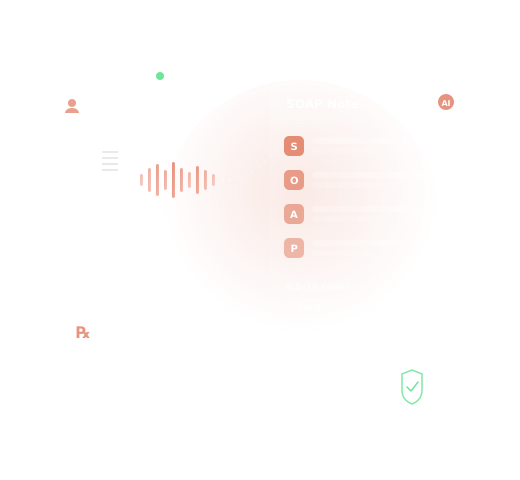
Automatic SOAP note generation: Converts consultation dialogue into a structured draft that can be adapted for CT intake, clinical context, and follow-up documentation.
Speaker diarization: Separates clinician and patient speech, which helps when documenting symptom history, prior scan details, and consent-related discussion in a clearer format.
ICD-10 and CPT suggestions: Provides coding support based on the documented encounter, helping teams prepare cleaner drafts for administrative review. Suggestions should always be checked by the clinician or coding staff.
Multilingual support: Useful in Indian healthcare settings where patient conversations may shift between English, Hindi, and regional languages during the same encounter.
On-premise or private deployment options: Supports organizations that prefer tighter control over infrastructure and workflow governance decisions.
Human review before finalization: Keeps the clinician in control. Drafts are meant to accelerate documentation, not bypass review or sign-off.
How It Works
The workflow for MedScribe is designed around real clinical documentation steps rather than generic transcription alone.
- Capture the consultation or intake conversation: During CT-related patient interaction, the system records the relevant discussion such as symptoms, referral reason, prior imaging, and preparation notes. This can happen in OPD-linked imaging workflows or hospital-based consult settings.
- Transcribe and structure the conversation: MedScribe converts speech into text and uses speaker diarization to distinguish who said what. It then organizes the content into clinically usable sections instead of leaving teams with a raw transcript.
- Draft SOAP notes automatically: Based on the conversation, the platform prepares a SOAP-style note draft that clinicians can adapt for CT documentation needs. This helps reduce time spent rewriting history and assessment details after the encounter.
- Suggest coding support: The system can surface ICD-10 and CPT suggestions linked to the documented encounter. These are intended as workflow aids for review, not final coding decisions without human validation.
- Review, edit, and sign off: The clinician checks the draft, corrects wording, adds missing context, and approves the final version before it becomes part of the record. This review checkpoint is essential for accuracy and operational control.
- Choose deployment posture for workflow governance: Depending on organizational needs, teams may use on-premise or private deployment options to support workflows aligned with internal IT and documentation practices.
Local context
In India, CT departments often work across mixed care settings: standalone diagnostic centers, multispecialty hospitals, and OPD-connected imaging units. Documentation may involve referrals from external physicians, multilingual patient communication, and varying levels of digital maturity. An AI medical scribe in India should therefore be practical, not theoretical. It should help teams document faster without forcing a complete workflow redesign.
For many organizations, the immediate need is not advanced automation everywhere, but better consistency in everyday records. That includes clearer intake summaries, more complete clinical context for scans, and easier handoff between clinicians, technicians, and administrative staff. An AI medical scribe in India can support these goals when used as a documentation copilot with clinician review built in.
Deployment flexibility also matters in India healthcare environments where IT preferences differ by organization. Some teams may prefer private or on-premise setups as part of their internal governance approach. The right choice depends on workflow, infrastructure, and operational priorities.
Use cases
CT intake documentation: Capture patient history, referral reason, prior imaging details, and preparation notes during pre-scan interaction.
Radiologist or clinician consultation support: Turn spoken case discussions into structured drafts that are easier to review and finalize.
Follow-up communication: Document post-scan discussions, next-step recommendations, or clarification conversations with patients and referring teams.
Administrative coding assistance: Use coding suggestions as a starting point for internal review workflows.
Multilingual encounters: Support documentation where patient conversations move across languages common in India healthcare settings.
FAQ
Below are common implementation questions from CT services evaluating documentation support tools.
Can this replace clinician documentation completely?
No. MedScribe is intended to generate draft documentation and coding support that clinicians review, edit, and approve before final sign-off.
Is it useful for imaging departments and not just general practice?
Yes. While the product is broadly applicable, CT services can use it to capture referral context, patient history, preparation discussion, and follow-up notes in a more structured way.
Does it support multilingual conversations?
Yes. Multilingual support is relevant for Indian clinics and hospitals where patient interactions may include English, Hindi, or regional languages.
Can organizations choose how the system is deployed?
Yes. On-premise and private deployment options can support workflows aligned with internal IT and governance preferences.
CTA
If your CT department is looking to reduce manual documentation effort without losing clinician oversight, MedScribe offers a practical path. Explore how an AI medical scribe in India can support intake notes, structured drafts, coding assistance, and final review workflows for imaging teams. For product details, teams can continue to the core MedScribe pages covering features, integrations, and pricing.