Introduction
An AI medical scribe in India can help dialysis units reduce documentation burden during high-frequency, repeat-care encounters where consistency matters. In nephrology and dialysis settings, clinicians, nurses, and coordinators often manage recurring patient interactions, treatment updates, symptom checks, medication changes, and follow-up planning across busy schedules. MedScribe is designed as an AI medical documentation copilot that converts consultation conversations into structured clinical notes and coding support, while keeping the clinician in control of review and sign-off.
For hospitals and clinics evaluating an AI medical scribe in India, the practical question is not just transcription accuracy. It is whether the tool fits daily workflows: capturing relevant dialogue, separating speakers, drafting usable SOAP notes, and supporting coding suggestions without adding another layer of admin work. In dialysis units, where patients return regularly and documentation needs to be clear across visits, a practical AI medical scribe can support continuity, handoffs, and cleaner records for the care team.
This page focuses on how an AI medical scribe India healthcare teams can use in dialysis settings supports routine documentation, multilingual conversations, and deployment choices such as private or on-premise setups based on operational preferences.
Department workflow
Dialysis unit workflows are repetitive but clinically detailed. A patient may arrive for scheduled dialysis, report interval symptoms, discuss fluid status, medication tolerance, vascular access concerns, diet adherence, or recent hospital events. The nephrologist or duty doctor may review progress, adjust plans, and coordinate with nursing staff. Documentation must often reflect history since the last session, current assessment, treatment considerations, and next steps.
In many units, these notes are still typed manually after the interaction or reconstructed from memory. That can slow clinicians down, especially when multiple patients are seen in sequence. An AI medical scribe in India is useful here because it can support structured note creation from the live or recorded conversation, helping teams move from raw dialogue to a draft that is easier to review and finalize.
For dialysis units, the workflow fit matters most in recurring OPD-style reviews, pre-dialysis assessments, interval follow-ups, and physician-patient discussions where the same documentation framework is used repeatedly. The goal is not to replace clinical judgment, but to reduce repetitive note-writing and improve consistency in how encounters are captured.
Features mapped to workflow
MedScribe is built around documentation tasks that map well to dialysis unit operations:
- Automatic SOAP note generation: Converts consultation conversations into structured subjective, objective, assessment, and plan drafts that clinicians can edit quickly.
- Speaker diarization: Distinguishes between clinician and patient voices, which is helpful when dialysis reviews involve repeated symptom checks and treatment discussions.
- ICD-10 and CPT suggestions: Provides coding support based on documented context, helping teams prepare cleaner drafts for downstream billing or record workflows.
- Multilingual support: Useful in Indian care settings where patient conversations may shift between English, Hindi, or regional languages during the same encounter.
- On-premise deployment options: Supports workflow and governance preferences for organizations that want tighter control over where systems run.
These capabilities are especially relevant in dialysis units because the same patient may be seen frequently, and each visit still requires a fresh, accurate summary. An AI medical scribe India healthcare organizations adopt should help standardize documentation without making the interaction feel rigid or scripted.
How It Works
The MedScribe workflow is designed to move from conversation capture to clinician-approved documentation in a clear sequence:
- Capture the consultation conversation: During a dialysis review, the clinician starts the session and captures the doctor-patient conversation through the configured workflow. This may include symptom review, interval events, medication discussion, access-related concerns, and treatment planning.
- Transcribe and structure the interaction: MedScribe converts the conversation into text and uses speaker diarization to separate who said what. This is useful when the encounter includes both patient-reported symptoms and clinician guidance that need to be reflected differently in the note.
- Draft a SOAP note automatically: The system organizes the interaction into a SOAP-style draft. For dialysis units, this can help clinicians quickly review subjective complaints, objective observations discussed during the encounter, assessment themes, and the proposed plan.
- Generate coding support: Based on the documented encounter, MedScribe can suggest ICD-10 and CPT codes as a support layer. These suggestions are intended to assist review, not replace clinician or billing judgment.
- Review, edit, and sign off: The clinician checks the draft, makes edits, confirms relevance, and finalizes the record. Human review is the operational checkpoint before any note is treated as complete.
- Choose deployment posture based on workflow needs: Organizations can evaluate private or on-premise deployment approaches where needed. This is best treated as a governance and operational decision tied to internal IT preferences and record-handling workflows.
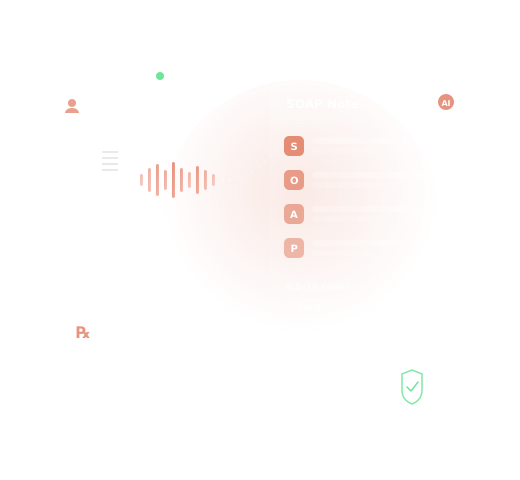
This stepwise flow is what makes an AI medical scribe in India practical for dialysis teams: it supports documentation speed while preserving clinician oversight at the final stage.
Local context
In India, dialysis units often operate under high patient volumes, mixed language environments, and documentation expectations that vary by hospital, clinic, and internal process. That makes flexibility important. An AI medical scribe in India should be able to support multilingual conversations, adapt to recurring review formats, and fit existing documentation habits rather than forcing a completely new process.
For independent nephrology clinics, the value may be faster note completion and less after-hours charting. For hospitals, the value may be more standardized documentation across consultants and shifts. For enterprise buyers, deployment posture and integration planning may be part of the evaluation. In each case, the product should support workflows aligned with local operational realities in India healthcare settings.
Because dialysis care is longitudinal, teams also benefit from notes that are easier to review across repeat visits. A practical AI medical scribe India healthcare buyers consider should help clinicians document today’s encounter clearly while supporting continuity for the next one.
Use cases
- Recurring nephrology follow-ups: Drafting structured notes for repeat patient reviews in dialysis OPD workflows.
- Pre-dialysis physician assessments: Capturing symptoms, interval events, and treatment considerations before session initiation.
- Medication and adherence discussions: Turning spoken updates into usable documentation for review and follow-up planning.
- Access-related complaints: Supporting note creation when patients report fistula, catheter, or site-related concerns.
- Multilingual consultations: Helping teams document encounters where patients switch between languages during discussion.
- Documentation standardization: Supporting more consistent SOAP-style notes across clinicians in busy dialysis units.
FAQ
Below are common implementation questions from dialysis clinics and hospitals evaluating documentation automation.
Can this be used during recurring dialysis reviews?
Yes. It is well suited to repeat consultations where clinicians need a structured summary of symptoms, assessment, and plan for each visit.
Does the product replace clinician documentation review?
No. The workflow is designed around draft generation followed by clinician edits and final sign-off before the record is finalized.
Can it support multilingual conversations common in India?
Yes. Multilingual support is part of the product design, which is useful when consultations include English plus Hindi or regional language usage.
Does it help with coding?
It can provide ICD-10 and CPT suggestions based on the documented encounter. These are support features and should be reviewed by the care or billing team.
CTA
If your dialysis unit is looking for a practical way to reduce repetitive note-writing, MedScribe offers a workflow-focused approach to documentation support. Explore how an AI medical scribe in India can fit nephrology and dialysis operations, review product details on /medscribe, compare capabilities on /medscribe/features, and assess deployment and rollout options based on your team’s needs.