Introduction
Emergency departments work under constant time pressure. Clinicians must assess patients quickly, coordinate with nursing teams, document findings, and keep records usable for follow-up, billing, and audit readiness. An AI medical scribe in India can support this environment by turning consultation and bedside conversations into structured draft notes that clinicians can review and finalize. For hospitals and clinics looking to reduce repetitive typing without changing clinical judgment, this approach helps keep documentation closer to the point of care.
MedScribe is designed as an AI documentation copilot for practical daily use. It converts spoken clinical interactions into draft SOAP notes, supports speaker diarization, suggests ICD-10 and CPT codes, and offers multilingual support for mixed-language consultations common in Indian care settings. For emergency medicine teams, the goal is not to replace decision-making, but to reduce documentation friction so doctors can spend more attention on triage, reassessment, and communication.
Department workflow
Emergency medicine documentation is different from routine OPD notes. The workflow often starts with triage, moves into rapid history taking, focused examination, immediate orders, reassessment, and disposition. Documentation may be created across multiple touchpoints rather than in one uninterrupted sitting. This creates gaps, delays, and duplicated effort when clinicians must reconstruct the encounter later.
An AI medical scribe in India is useful here because it can support note creation during or immediately after the interaction. In a typical emergency workflow, the doctor speaks with the patient or attendant, confirms symptoms, records relevant history, performs a focused exam, and discusses the plan. The scribe system can capture that conversation, separate speakers, structure the transcript, and prepare a draft note that reflects the encounter in a familiar format. The clinician then edits, adds missing details such as vitals, investigations, or procedures, and signs off before the record is finalized.
This is especially relevant in emergency settings where handoffs matter. A clearer draft note can help support continuity between the first assessment, observation, and final disposition. It can also reduce the burden of writing from memory after a busy shift.
Features mapped to workflow
Conversation capture and transcription: Emergency consultations are often fast and non-linear. MedScribe supports capture of the clinical conversation and converts it into text for downstream documentation.
Speaker diarization: In emergency care, multiple voices may be present, including doctor, patient, attendant, or nurse. Speaker separation helps make the draft easier to review and interpret.
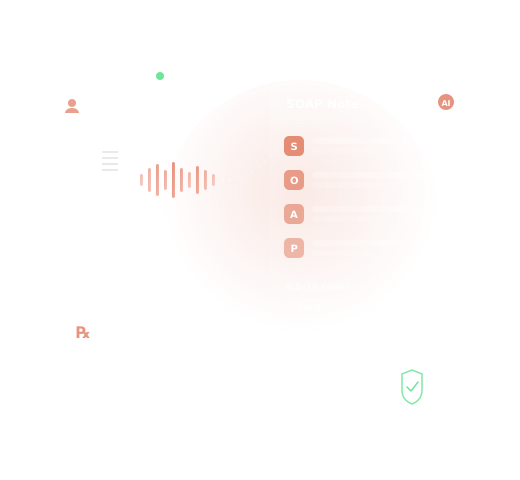
Automatic SOAP note drafting: Instead of starting from a blank screen, clinicians receive a structured draft with subjective and objective details organized into a usable format.
ICD-10 and CPT suggestions: Coding support can help teams move from narrative documentation toward more complete records, while keeping the clinician in control of final code selection.
Multilingual support: Many emergency interactions in India shift between English and regional languages. This is important for practical adoption in mixed-language environments.
On-premise or private deployment options: Hospitals may prefer different deployment postures based on internal governance, IT architecture, and workflow needs. The product is designed to support these operational choices.
These capabilities make AI medical scribe India healthcare workflows more usable for emergency departments that need speed, reviewability, and flexibility rather than generic dictation alone.
How It Works
The workflow below reflects how the product is used in real documentation operations for emergency medicine teams.
- Capture the encounter: During triage review, bedside assessment, or a focused emergency consultation, the clinician records the conversation using the configured workflow. The system is built to capture spoken interaction as the source for documentation.
- Transcribe and structure the conversation: The audio is converted into text, with speaker diarization used to distinguish clinician and patient voices where possible. This helps organize fragmented emergency conversations into a reviewable transcript.
- Generate a draft SOAP note: The system converts the structured transcript into a draft clinical note. For emergency medicine, this can include presenting complaints, relevant history, focused findings, assessment, and initial plan in a format the doctor can quickly edit.
- Suggest coding support: Based on the documented encounter, the platform can surface ICD-10 and CPT suggestions to support downstream documentation and administrative workflows. These are suggestions only and should be reviewed by the clinician or coding team.
- Clinician review and edits: The doctor reviews the draft, corrects inaccuracies, adds investigations, procedures, medications, disposition details, and any time-sensitive updates. Human review is the operational checkpoint before the note becomes part of the record.
- Finalize within the chosen deployment model: After edits and sign-off, the note can move into the hospital's documentation workflow. Depending on organizational preference, deployment can be aligned to on-premise or private environments as a governance and workflow decision.
Local context
Emergency departments in India often manage high patient volumes, mixed payer workflows, multilingual communication, and variable digital maturity across facilities. Some teams work in fully integrated hospital systems, while others still rely on partial digitization or hybrid documentation processes. In this setting, an AI medical scribe in India should be practical first: easy to review, adaptable to local documentation habits, and supportive of mixed-language encounters.
Hospitals may also evaluate whether a cloud, private, or on-premise setup fits their internal IT and governance approach. Rather than treating deployment as a marketing claim, it is better understood as an operational decision based on workflow, infrastructure, and data handling preferences. For emergency medicine teams, the value comes from faster draft creation and clearer review steps, not from removing clinician oversight.
Use cases
Rapid initial assessment: Create a draft note from the first doctor-patient interaction during emergency intake.
Observation and reassessment: Update documentation after repeat evaluation without rewriting the entire encounter from scratch.
Attendant-heavy conversations: Use speaker-aware transcription when family members provide history in urgent situations.
Mixed-language consultations: Support documentation where the conversation moves between English and local languages.
Coding-ready summaries: Help prepare records that are easier to review for coding and administrative follow-through.
Shift handoffs: Improve continuity by making draft notes available for clinician review before disposition or transfer.
For organizations comparing documentation tools, an AI medical scribe in India is most effective when it fits the actual emergency workflow: capture, structure, review, edit, and sign off.
FAQ
Can this be used in a busy emergency department?
Yes. The workflow is suited to fast-paced environments because it focuses on converting conversations into draft notes that clinicians can review quickly rather than document entirely from scratch.
Does the system replace clinician documentation review?
No. Draft notes and coding suggestions should always be reviewed, edited where needed, and signed off by the clinician before finalization.
Can it support multilingual conversations common in India?
The product includes multilingual support, which is useful for emergency settings where patients, attendants, and clinicians may switch between English and regional languages.
How does deployment work for hospitals with internal IT requirements?
Deployment posture can be chosen based on workflow and governance needs, including on-premise or private setups where appropriate.
CTA
If your emergency medicine team wants more consistent documentation without adding more typing to every shift, explore how an AI medical scribe in India can fit your workflow. Review the core product at /medscribe, compare capabilities at /medscribe/features, and assess how draft note generation, coding support, multilingual capture, and clinician sign-off can support emergency care documentation in India.