Introduction
Endocrinology consultations often involve long histories, medication adjustments, lab trend review, lifestyle counselling, and follow-up planning. That makes documentation important but time-consuming in busy OPD settings. An AI medical scribe in India can help endocrinologists and multispecialty clinics turn consultation conversations into structured draft notes that are easier to review, edit, and finalize. Instead of replacing clinical judgment, the system is designed to support the doctor during routine documentation tasks such as SOAP note drafting, coding suggestions, and visit summaries.
For clinics and hospitals managing diabetes, thyroid disorders, obesity, PCOS, metabolic syndrome, osteoporosis, and other endocrine conditions, the goal is practical workflow support. MedScribe captures the consultation, structures the transcript, drafts usable clinical notes, and presents coding suggestions for clinician review. This helps reduce repetitive typing while keeping the doctor in control of the final record. For teams evaluating an AI medical scribe in India, the value is usually operational: faster note completion, more consistent documentation, and a smoother handoff between consultation and record finalization.
Department workflow
Endocrinology workflows are documentation-heavy because each visit may combine symptom review, prior treatment response, lab interpretation, medication titration, and counselling. A typical OPD journey starts with patient history and current complaints, followed by discussion of blood sugar logs, thyroid function tests, HbA1c trends, weight changes, menstrual history, bone health, or imaging findings depending on the case. The clinician then assesses disease control, adjusts treatment, and outlines monitoring and follow-up.
In many Indian healthcare settings, this creates a documentation bottleneck. Doctors may need to summarize complex histories, capture examination findings, note treatment rationale, and prepare coding-ready records while maintaining patient flow. An AI medical scribe in India is useful here because it supports the natural consultation process rather than forcing a separate documentation step after the visit. For endocrinology, that means better support for longitudinal care where repeat visits depend on clear prior notes, medication changes, and trend-based assessment.
Features mapped to workflow
Conversation capture and transcription: The product listens to the consultation and converts speech into text, helping reduce manual note-taking during the encounter.
Speaker diarization: It separates clinician and patient speech, which is helpful in endocrine visits where history, counselling, and treatment planning are all substantial parts of the conversation.
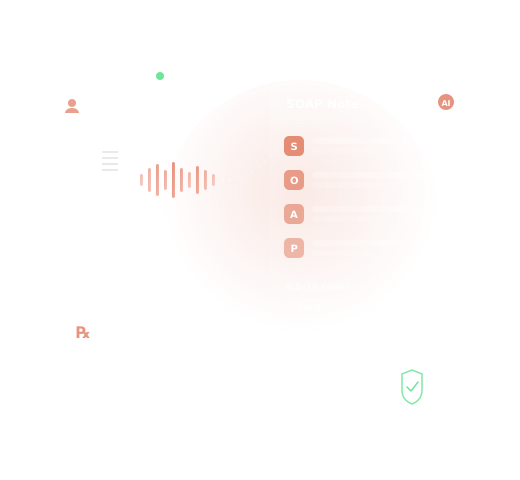
Automatic SOAP note generation: The transcript is structured into draft subjective, objective, assessment, and plan sections, making it easier to review and finalize records consistently.
ICD-10 and CPT suggestions: Coding support can help staff and clinicians prepare more complete documentation workflows, while keeping final coding decisions under human review.
Multilingual support: In India, consultations may shift between English and regional languages. Multilingual capability supports more natural doctor-patient communication without making documentation harder.
On-premise or private deployment options: Organizations with specific governance preferences can evaluate deployment choices that support workflows aligned with internal IT and data handling requirements.
How It Works
The workflow is designed to fit real consultation patterns in endocrinology clinics and hospitals.
- Capture the consultation conversation: During the OPD visit, the system records the doctor-patient interaction through the configured setup. It is built to handle natural clinical dialogue, including symptom discussion, medication history, lab review, and counselling.
- Transcribe and structure the interaction: The audio is converted into text with speaker diarization so the conversation is separated by participant. This helps organize who said what and prepares the content for clinical structuring.
- Draft a SOAP note automatically: The system converts the structured transcript into a draft SOAP note. For endocrinology, this may include history of present illness, relevant observations, assessment themes such as glycaemic control or thyroid status, and a plan covering medication changes, tests, and follow-up.
- Generate coding suggestions: Based on the documented encounter, the product can surface ICD-10 and CPT suggestions to support downstream documentation and billing workflows. These are suggestions only and should be reviewed by the clinician or authorized staff.
- Review, edit, and sign off: The clinician checks the draft note, makes edits, confirms accuracy, and finalizes the record. Human review is an operational checkpoint before any note becomes part of the patient record.
- Choose deployment posture for governance needs: Depending on the organization, the solution can be evaluated for on-premise or private deployment models. This is a workflow and governance decision that can support internal preferences for infrastructure and access control.
Local context
In India, endocrine care is often delivered across independent clinics, diabetes centres, and hospital OPDs with varying documentation maturity. Some teams work inside established digital systems, while others still rely on mixed workflows involving dictated notes, typed summaries, and manual coding support. An AI medical scribe in India can fit into this environment because the need is not only speed, but also practical consistency across high-volume follow-up care.
Multilingual consultations are common, especially when doctors explain long-term disease management, diet, insulin use, thyroid medication timing, or reproductive health implications. This is where AI medical scribe India healthcare workflows become relevant: the tool supports natural consultation language while helping convert the encounter into structured documentation. For hospitals and larger groups, deployment choices such as private or on-premise setups may also matter as part of internal governance planning.
Use cases
Diabetes follow-up visits: Capture glucose trends, medication adherence, insulin changes, diet counselling, and follow-up plans in a structured note.
Thyroid disorder consultations: Document symptom review, lab interpretation, dose adjustments, and monitoring instructions without extensive post-visit typing.
PCOS and metabolic clinic visits: Summarize menstrual history, weight changes, metabolic risk discussion, and treatment planning in a consistent format.
Obesity and lifestyle medicine counselling: Record counselling-heavy visits where much of the value lies in detailed discussion and longitudinal planning.
Hospital endocrine OPD workflows: Support clinicians who need draft notes and coding suggestions while maintaining human review before final sign-off.
Across these scenarios, an AI medical scribe in India is most useful when it reduces repetitive documentation effort without disrupting the consultation itself.
FAQ
Can this be used for diabetes and thyroid consultations?
Yes. It is suited to endocrine visits where history, lab review, counselling, and medication planning need to be captured in a structured note.
Does the product finalize notes automatically?
No. It creates draft documentation and coding suggestions, but clinician review, edits, and final sign-off remain essential before record finalization.
Is multilingual consultation support available?
The product is designed with multilingual support, which can help in Indian OPD settings where consultations may move between English and regional languages.
Can hospitals evaluate private or on-premise deployment?
Yes. Deployment posture can be considered based on workflow, infrastructure, and governance preferences.
CTA
If your endocrinology team wants more consistent notes with less manual typing, explore how an AI medical scribe in India can support daily OPD documentation. Review the product overview, feature details, and integration options to assess fit for your clinic or hospital workflow.
Explore MedScribe | View features | See integrations | Check pricing