Introduction
An AI medical scribe in India can help hospitals, research-linked clinics, and specialist practices improve how consultation documentation is prepared, reviewed, and organized for ethics-sensitive workflows. For Ethics Committee Support teams, the challenge is often not only capturing what happened in a consultation, but also making records easier to review, trace, and standardize across departments. MedScribe is designed as an AI documentation copilot that converts clinician-patient conversations into structured clinical notes, while keeping the clinician in control of edits and final sign-off.
In practical settings, Ethics Committee Support functions often interact with departments that need clearer records for protocol-linked care, investigator-led documentation, adverse event follow-up, and internal review preparation. An AI medical scribe in India can support these workflows by reducing manual note-taking burden, drafting SOAP notes from conversations, and surfacing coding suggestions that clinicians can verify before finalization. The result is a more usable documentation process for daily OPD and hospital workflows without changing the clinician’s responsibility for the final record.
This page focuses on how an AI medical scribe India healthcare workflow can support ethics-adjacent documentation needs in Indian care settings, especially where consistency, reviewability, and operational governance matter.
Department workflow
Ethics Committee Support teams usually work across clinical, administrative, and governance touchpoints rather than in isolation. In many hospitals and clinics, they may help coordinate documentation readiness for protocol-based care, support internal review requests, and assist in organizing records that need to be understandable across stakeholders. That means the quality of source documentation matters.
A typical workflow begins in the consultation room, where the clinician speaks with the patient, gathers history, discusses symptoms, reviews treatment context, and explains next steps. Traditionally, this requires either manual note entry during the visit or retrospective documentation after the encounter. Both approaches can create variation in note quality and increase administrative load.
For ethics-sensitive environments, the downstream impact is important. Teams may need records that are easier to interpret, consistently structured, and suitable for internal review. An AI medical scribe in India supports this by helping convert the consultation into a structured draft that can be reviewed by the clinician, refined, and then finalized within the organization’s preferred workflow. This is especially useful when multiple departments need a common documentation format.
Where hospitals manage multilingual patient interactions, speaker diarization and multilingual support can also improve clarity in the draft note. Instead of relying only on fragmented recollection after a busy OPD session, clinicians get a starting point that reflects the encounter in a more organized way.
Features mapped to workflow
Conversation capture and transcription: The product supports capture of consultation conversations and converts them into structured text. This helps create a reliable first draft for clinicians who need to document efficiently during high-volume OPD schedules.
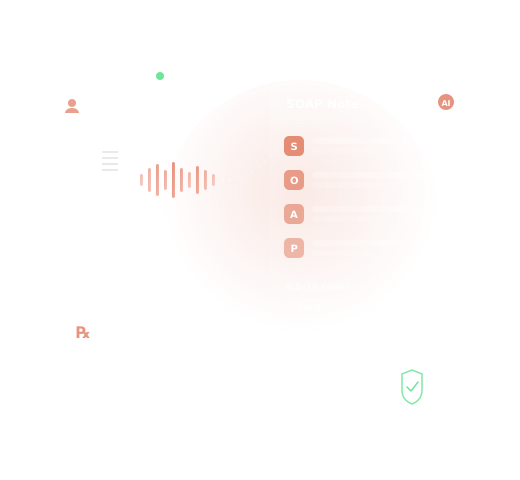
Automatic SOAP note generation: MedScribe emphasizes automatic SOAP drafting, which is useful when Ethics Committee Support teams prefer records that follow a recognizable clinical structure. Subjective, objective, assessment, and plan sections can be easier to review than free-form notes.
Speaker diarization: Distinguishing clinician and patient speech can improve readability and reduce confusion in the draft. This is helpful when records may later be reviewed by internal stakeholders who were not present during the consultation.
ICD-10 and CPT suggestions: Coding suggestions can support documentation completeness and downstream administrative workflows. These suggestions are meant to assist clinicians, not replace their judgment, and should be reviewed before use.
Multilingual support: In Indian healthcare settings, consultations may move between English and regional languages. Multilingual support can help preserve context and reduce the friction of documenting mixed-language encounters.
On-premise or private deployment options: For organizations with stricter governance preferences, deployment posture can be chosen as an operational decision. This supports workflows aligned with internal data handling expectations without making blanket compliance claims.
How It Works
The workflow of an AI medical scribe in India should be practical, reviewable, and easy to fit into existing clinical operations. MedScribe follows an end-to-end documentation flow built around clinician oversight.
- Capture the consultation conversation: During the OPD or inpatient interaction, the clinician uses the system to capture the consultation audio. The goal is to reduce manual note-taking while preserving the flow of the encounter.
- Transcribe and structure the interaction: The system converts speech into text, applies speaker diarization to separate patient and clinician voices, and organizes the conversation into a usable clinical structure. This creates a cleaner base for documentation review.
- Draft SOAP notes automatically: Based on the structured transcript, MedScribe generates a SOAP note draft. This gives the clinician a working note instead of a blank screen and supports more consistent documentation across departments.
- Surface coding suggestions: The platform can provide ICD-10 and CPT suggestions linked to the documented encounter. These are intended as coding support for clinician review, not as automatic final coding decisions.
- Review, edit, and sign off: The clinician checks the draft note, corrects details, adds missing context, and confirms the final version before the record is finalized. Human review is the operational checkpoint that keeps the clinician in control.
- Choose deployment posture for governance needs: Depending on organizational preferences, teams may evaluate on-premise or private deployment options. This is useful for hospitals that want documentation workflows aligned with internal governance and IT decisions.
Local context
In India, clinics and hospitals often manage high patient volumes, mixed digital maturity, and multilingual communication in the same care environment. That makes documentation efficiency a practical concern, especially for departments that support review-heavy or governance-linked processes. An AI medical scribe in India is most useful when it fits into everyday OPD routines rather than adding another layer of administrative work.
For Ethics Committee Support functions, the local context also includes coordination across clinicians, administrators, and institutional review stakeholders. Documentation tools need to be useful in real-world settings where time is limited and note quality still matters. An AI medical scribe India healthcare approach is therefore less about replacing clinical judgment and more about helping teams produce clearer, more consistent records that are easier to review internally.
Organizations may also differ in how they prefer to manage infrastructure. Some may evaluate private or on-premise deployment models as part of broader governance planning. In that context, the product is designed to align with operational preferences and support workflows aligned with institutional processes.
Use cases
Protocol-linked consultations: When clinicians need more structured notes for patients managed under defined care pathways, the system can help create standardized drafts for review.
Internal review preparation: Ethics Committee Support teams may need records that are easier to organize and interpret across departments. Structured SOAP notes can improve readability for internal stakeholders.
Adverse event follow-up documentation: In settings where follow-up conversations need clear documentation, conversation-to-note workflows can reduce delays in drafting records.
Busy OPD clinics: High-volume outpatient departments can use the tool to reduce manual typing burden and support more complete note capture during fast-paced schedules.
Multilingual consultations: Where patient interactions shift between English and local languages, multilingual support can help preserve context in the draft note.
FAQ
Can this replace clinician documentation responsibility?
No. The system assists with drafting and structuring notes, but the clinician reviews, edits, and signs off before the record is finalized.
Is this useful only for research settings?
No. It can also support routine hospital and clinic documentation where Ethics Committee Support teams value clearer, more standardized records.
Does it support coding workflows?
Yes, it can provide ICD-10 and CPT suggestions to support documentation and coding review, subject to clinician verification.
Can hospitals choose how the system is deployed?
Yes. Organizations may evaluate on-premise or private deployment options based on workflow, IT, and governance preferences.
CTA
If your team is evaluating an AI medical scribe in India for ethics-sensitive documentation workflows, MedScribe offers a practical path from conversation capture to clinician-reviewed notes. Explore how it can support clearer records, more consistent SOAP documentation, and operational workflows aligned with hospital or clinic governance needs. Review the product overview, features, integrations, and pricing to assess fit for your department.