Introduction
An AI medical scribe in India can help geriatric medicine teams reduce documentation load during busy outpatient and follow-up visits. Older adults often present with multiple chronic conditions, long medication lists, caregiver inputs, and functional concerns that make note-taking more detailed than a standard consultation. MedScribe is designed to convert consultation conversations into structured clinical documentation that clinicians can review, edit, and sign off before the record is finalized.
For hospitals, specialty clinics, and independent consultants, the value is practical: less time spent typing, more consistent SOAP note drafting, and support for coding suggestions based on the documented encounter. In geriatric medicine, where history taking may include cognition, mobility, falls, nutrition, sleep, continence, and social support, an AI medical scribe in India can support more complete capture of the visit while keeping the clinician in control of the final note.
This page focuses on daily workflow fit for Indian healthcare settings, including multilingual conversations, caregiver participation, and deployment choices such as private or on-premise setups for organizations that prefer tighter operational control.
Department workflow
Geriatric medicine consultations are rarely linear. A single visit may cover diabetes, hypertension, osteoarthritis, memory complaints, medication adherence, recent falls, and caregiver observations. Documentation must often reflect both the patient voice and the caregiver perspective, while preserving a clear clinical summary for future follow-up.
Typical department workflow includes registration, consultation, review of prior records, medication reconciliation, focused examination, assessment of function and cognition where relevant, care planning, and follow-up instructions. In many clinics, doctors also need to prepare referral notes, update problem lists, and document risk factors such as frailty or fall history. This creates a high documentation burden, especially in OPD settings with limited turnaround time between patients.
An AI medical scribe in India is useful here because it supports the consultation process rather than replacing it. The clinician can continue the visit naturally while the system helps organize the conversation into a draft note. That draft can then be refined to match the doctor’s preferred style and the organization’s record-keeping process.
Features mapped to workflow
Conversation capture and transcription: During a geriatric consultation, the system captures the discussion and converts speech into text. This is especially helpful when the visit includes both patient and caregiver input.
Speaker diarization: The product can distinguish speakers, helping separate clinician questions, patient responses, and caregiver comments. In geriatric medicine, this can improve clarity when documenting history and concerns raised by family members.
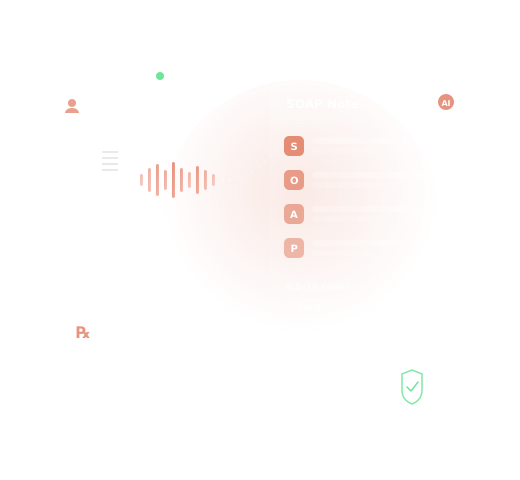
Automatic SOAP note generation: The transcript is structured into a draft SOAP note, giving the clinician a usable starting point instead of a blank screen. This supports faster completion of routine documentation.
ICD-10 and CPT suggestions: Based on the documented encounter, the system can surface coding suggestions for clinician review. These suggestions are intended to support workflow efficiency, not replace professional judgment.
Multilingual support: Many Indian consultations move between English and regional languages. Multilingual support can help teams document visits more naturally without forcing a single-language interaction.
On-premise or private deployment options: Some hospitals and larger groups prefer deployment models designed to align with internal governance and IT preferences. This can be an important operational consideration for enterprise adoption.
How It Works
Below is the typical end-to-end workflow for using MedScribe in geriatric medicine.
- Capture the consultation conversation: The clinician starts the encounter as usual, and the system records the consultation audio from the room or approved device setup. If a caregiver is present, their comments can also be captured as part of the encounter context.
- Transcribe and structure the discussion: MedScribe converts speech into text and applies speaker diarization to separate the clinician, patient, and caregiver where possible. The transcript is then organized into clinically relevant sections so the visit is easier to review.
- Draft a SOAP note automatically: Using the structured transcript, the product generates a draft SOAP note that reflects the consultation flow. In geriatric visits, this may include symptoms, medication issues, functional concerns, and care plan elements discussed during the encounter.
- Surface coding suggestions: The system provides ICD-10 and CPT suggestions based on the documented content. These are presented as workflow support for the clinician or billing team to review, confirm, modify, or ignore as needed.
- Review, edit, and sign off: The clinician checks the draft note, corrects details, adds examination findings or assessment nuance, and finalizes the record. Human review is the operational checkpoint before any note becomes part of the patient chart.
- Choose the deployment posture that fits operations: Organizations can evaluate cloud, private, or on-premise approaches based on workflow, IT environment, and governance preferences. This is best treated as an implementation decision that supports workflows aligned with internal policies.
Local context
In India, geriatric care often involves high patient volumes, mixed digital maturity, and multilingual communication. Some clinics work with full hospital information systems, while others rely on lighter digital workflows. An AI medical scribe in India should therefore be practical, flexible, and easy to fit into existing OPD routines rather than requiring a complete process redesign.
For geriatric medicine specifically, local context also includes family-led decision making, repeat follow-ups for chronic disease management, and the need to document medication changes clearly. An AI medical scribe India healthcare workflow is most useful when it helps clinicians preserve detail without extending consultation time. For larger institutions, deployment choices such as private environments or on-premise setups may also matter when planning implementation across departments.
Use cases
Comprehensive geriatric OPD visits: Capture long consultations involving multiple complaints, caregiver observations, and medication review, then convert them into structured draft notes.
Follow-up visits for chronic disease: Support repeat documentation for hypertension, diabetes, arthritis, heart failure, or cognitive decline where trends and treatment changes need to be recorded consistently.
Falls and frailty assessment: Help organize history related to mobility, balance, prior falls, assistive devices, and home support into a usable clinical summary.
Memory and cognition consultations: Document patient and caregiver narratives separately where relevant, making it easier to review concerns and plan next steps.
Medication reconciliation: Assist with note drafting when older adults present with polypharmacy, duplicate prescriptions, or adherence concerns that require careful documentation.
Hospital outpatient departments: Support clinicians who need faster note completion between appointments while maintaining a review step before finalization.
FAQ
Can this replace clinician judgment?
No. The product is designed to assist with documentation and coding support, but the clinician remains responsible for review, edits, and final sign-off.
Is it suitable for multilingual consultations?
Yes, multilingual support is part of the product narrative, which is useful for Indian clinical settings where consultations may shift between English and regional languages.
Does it work for caregiver-led discussions in geriatric care?
Yes. Speaker diarization can help separate different voices in the consultation, which is helpful when caregivers contribute important history.
Can hospitals consider private or on-premise deployment?
Yes. Deployment posture can be evaluated based on workflow, IT environment, and governance preferences. These options should be assessed as operational choices rather than guarantees.
CTA
If your geriatric medicine team wants to reduce manual note-taking and improve documentation flow, MedScribe offers a practical starting point. Explore how an AI medical scribe in India can fit your OPD workflow, support SOAP note drafting, and keep clinicians in control of the final record. Review the broader product details at /medscribe, explore capabilities at /medscribe/features, and assess implementation fit for your clinic or hospital.