Introduction
An AI medical scribe in India can help glaucoma services reduce documentation burden during busy OPD sessions while keeping the clinician in control of the final record. For ophthalmology teams managing glaucoma screening, follow-up visits, medication adjustments, pressure monitoring, and referral documentation, the challenge is often not only clinical complexity but also the time needed to convert conversations into structured notes. MedScribe is designed as an AI documentation copilot that turns consultation conversations into draft clinical notes and coding suggestions that clinicians can review, edit, and sign off.
For glaucoma services, documentation often spans symptoms, prior treatment history, medication adherence, intraocular pressure discussions, imaging references, and follow-up planning. An AI medical scribe in India supports this workflow by capturing the encounter, structuring the transcript, drafting SOAP-style notes, and presenting coding support in a practical format. The goal is not to replace clinical judgment, but to help doctors and care teams spend less time typing and more time focusing on patient interaction and decision-making.
This page is tailored for hospitals, eye clinics, and specialty centres looking for an AI medical scribe India healthcare workflow that fits real outpatient operations in glaucoma services.
Department workflow
Glaucoma care usually involves repeat visits, longitudinal records, and careful tracking of disease progression. In a typical department workflow, a patient may move from registration to technician assessment, then to consultant review, and finally to counselling, prescription, and follow-up scheduling. During the consultation, the doctor may discuss visual symptoms, family history, prior surgeries, medication tolerance, compliance with eye drops, pressure trends, and next-step investigations.
These encounters generate a large amount of clinically relevant information, but much of it remains in free-form conversation. That creates pressure on clinicians to document quickly between patients. An AI medical scribe in India can support glaucoma services by converting spoken interactions into structured drafts that are easier to review and finalize. This is especially useful in high-volume OPD settings where consistency, speed, and note completeness matter.
Because glaucoma management often requires continuity across visits, the value of documentation is not just speed. It is also about producing usable notes that support follow-up planning, communication across the care team, and cleaner records for future review.
Features mapped to workflow
MedScribe is built around practical documentation tasks that occur during real consultations. For glaucoma services, these capabilities map well to daily workflows:
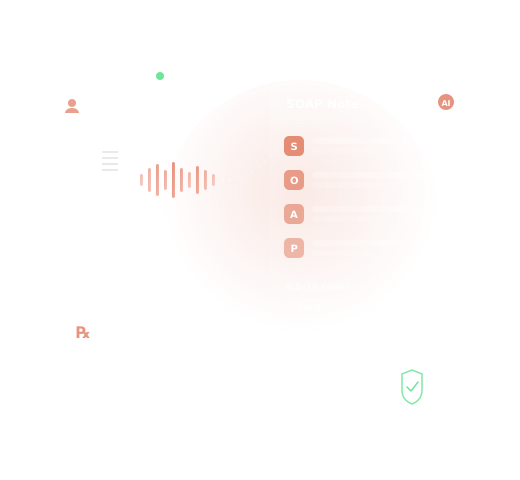
- Automatic SOAP note generation: Converts consultation content into a structured draft with subjective findings, objective observations, assessment, and plan.
- Speaker diarization: Helps distinguish between clinician and patient speech, which is useful when documenting symptoms, treatment history, and counselling points.
- Multilingual support: Supports consultations where English may be mixed with Indian languages during history-taking or patient education.
- ICD-10 and CPT suggestions: Provides coding support based on the documented encounter, with clinician review before use.
- On-premise or private deployment options: Supports workflows aligned with internal governance preferences and infrastructure choices.
- Review-first workflow: Keeps the clinician responsible for edits and final sign-off before the record is finalized.
For glaucoma clinics, these features are useful across first consultations, follow-up visits, medication review appointments, and referral documentation. An AI medical scribe in India is most effective when it fits into the existing care pathway rather than forcing a new one.
How It Works
Below is the practical end-to-end workflow for using MedScribe in glaucoma services:
- Capture the consultation conversation: During the glaucoma visit, the consultation audio is captured from the doctor-patient interaction. This may include symptom discussion, medication adherence, prior procedures, pressure-related concerns, and follow-up planning. The system is designed to support multilingual conversations common in Indian clinics.
- Transcribe and structure the encounter: The captured conversation is transcribed and organized with speaker diarization so the clinician can distinguish patient statements from doctor guidance. This helps create a cleaner base for documentation, especially in visits with detailed counselling.
- Draft a SOAP note automatically: The transcript is converted into a structured SOAP-style draft. For glaucoma services, this can help organize history, relevant findings discussed during the visit, assessment context, and the treatment or follow-up plan in a format that is easier to review.
- Surface coding suggestions: Based on the documented encounter, the system can present ICD-10 and CPT suggestions as decision support. These are intended to assist the workflow, not replace coder or clinician judgment.
- Review, edit, and sign off: The clinician reviews the draft note, makes corrections, adds missing details such as imaging references or medication changes, and approves the final version. Human review is the operational checkpoint before any record is finalized.
- Choose deployment posture for operations: Clinics and hospitals can evaluate on-premise or private deployment approaches based on workflow, IT environment, and governance preferences. This supports documentation operations aligned with internal policies and infrastructure decisions.
Local context
In India, glaucoma services often operate in a mix of standalone eye clinics, multispecialty hospitals, and specialty centres with varying documentation maturity. Some teams rely heavily on typed notes, some use templates, and others combine paper and digital workflows. An AI medical scribe in India is valuable in this environment because it can support practical documentation improvement without requiring clinicians to narrate in a rigid format.
For hospitals and clinics evaluating technology, deployment posture matters. Some organizations may prefer private or on-premise setups based on internal governance and IT planning. MedScribe is designed to support workflows aligned with those operational preferences. In glaucoma care, where repeat visits and longitudinal records are common, a practical documentation layer can help improve note consistency across the patient journey.
Use cases
- New glaucoma consultations: Capture history, symptoms, prior treatment, and initial management discussion into a structured draft.
- Follow-up visits: Document medication adherence, tolerance, pressure-related discussions, and next review plans more efficiently.
- High-volume OPD sessions: Reduce after-hours note completion by preparing drafts during or soon after consultations.
- Multilingual patient interactions: Support consultations where patients explain symptoms in a local language while the clinician documents in English.
- Referral and continuity documentation: Create clearer summaries for internal handoffs or external referrals.
- Coding support workflows: Assist teams with ICD-10 and CPT suggestions that can be reviewed before submission or record completion.
These use cases make an AI medical scribe in India relevant not only for large institutions but also for growing specialty practices that want more consistent documentation without adding unnecessary complexity.
FAQ
Can this be used during glaucoma follow-up visits?
Yes. It is well suited for repeat visits where medication review, symptom updates, and follow-up planning need to be documented quickly and consistently.
Does the system finalize notes automatically?
No. The workflow includes clinician review, edits, and final sign-off before the record is completed.
Can it support multilingual consultations in India?
Yes. Multilingual support is designed for real-world consultations where English may be mixed with Indian languages.
Is coding included in the workflow?
The product can provide ICD-10 and CPT suggestions as documentation support, with human review before use.
CTA
If your eye clinic or hospital is looking for an AI medical scribe in India that fits glaucoma workflows, MedScribe offers a practical path from conversation capture to reviewed clinical notes. Explore how it can support OPD efficiency, structured documentation, and clinician-led sign-off across glaucoma services. For broader product details, teams can also review the main MedScribe pages for features, integrations, and pricing before planning a workflow evaluation.