Introduction
High Dependency Units require fast, accurate, and review-ready documentation across frequent assessments, handovers, medication updates, and escalation notes. An AI medical scribe in India can help HDU teams reduce manual typing by turning clinician-patient and clinician-caregiver conversations into structured drafts that are easier to review and finalize. For hospitals and clinics managing mixed acuity patients, the goal is not to replace clinical judgment, but to support clearer records, more consistent note structure, and smoother documentation during busy shifts.
MedScribe is designed as an AI documentation copilot for practical care settings. It converts consultation audio into transcripts, organizes relevant details into SOAP-style drafts, and provides coding suggestions that clinicians can accept, edit, or ignore. For HDU environments in India, this approach supports documentation workflows aligned with operational needs such as rapid reassessment, multidisciplinary communication, and continuity across shifts. An AI medical scribe in India is most useful when it fits into existing review processes and keeps the clinician in control of the final record.
Department workflow
In HDU settings, documentation often happens in short intervals rather than one long consultation. A patient may be reviewed during admission, after a change in vitals, during specialist input, and again at handover. This creates repeated note-writing tasks that can slow clinicians down. Typical workflow points include initial assessment, interval progress notes, procedure-related updates, medication changes, escalation planning, and discharge or transfer summaries.
An AI medical scribe can support these moments by capturing spoken interactions, separating speakers, and preparing structured drafts that reflect the sequence of care. Instead of writing every detail from scratch, clinicians can review a draft, correct terminology, add missing findings, and sign off. For HDU teams, this can be especially useful when multiple clinicians contribute to the same patient journey and need a consistent note format.
For Indian hospitals, the practical value of an AI medical scribe in India also depends on multilingual communication. Patients and families may speak in one language while clinicians document in another. A workflow-aware scribe should therefore support multilingual conversations while still producing usable clinical documentation for internal records.
Features mapped to workflow
Conversation capture: Supports documentation from live or recorded clinical interactions, helping teams start with the actual discussion rather than retrospective recall.
Speaker diarization: Distinguishes between clinician, patient, and caregiver voices so the draft reflects who said what, which is useful in HDU reviews where family input and team communication matter.
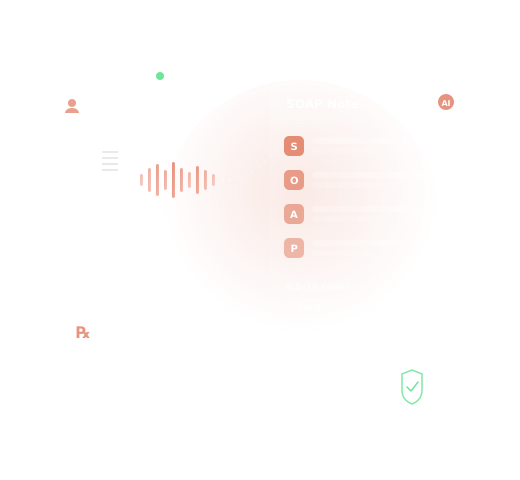
Automatic SOAP note generation: Converts the transcript into a structured clinical draft with subjective, objective, assessment, and plan sections, making progress notes easier to standardize.
Coding suggestions: Provides ICD-10 and CPT suggestions as decision support for billing and record workflows. These suggestions are intended for clinician review, not automatic finalization.
Multilingual support: Helps teams document consultations where spoken language and final note language may differ, a common requirement in India healthcare settings.
On-premise or private deployment options: Supports organizations that prefer tighter control over infrastructure and data handling as part of their governance model.
Clinician review before finalization: Keeps the final sign-off with the treating clinician, which is essential for HDU documentation quality.
How It Works
The workflow below reflects how the product is designed to support day-to-day clinical documentation rather than act as an autonomous record system.
- Capture the consultation or bedside discussion: The clinician starts audio capture during an HDU assessment, family update, or review conversation. The system records the interaction and prepares it for transcription. This can fit live documentation or post-encounter processing depending on the unit workflow.
- Transcribe and separate speakers: The audio is converted into text, and speaker diarization helps identify the clinician, patient, and caregiver or attendant. This is useful when HDU conversations include symptom updates, treatment explanations, and consent-related discussion points.
- Structure the transcript into a clinical draft: The system organizes relevant details into a SOAP note draft. Findings, symptoms, observations, and plan elements are grouped into a format that is easier to review than a raw transcript.
- Add coding support: Based on the documented encounter, the product surfaces ICD-10 and CPT suggestions to support downstream coding workflows. These are suggestions only and should be checked by the clinician or coding team before use.
- Review, edit, and sign off: The clinician reviews the draft, corrects terminology, adds missing exam details, removes irrelevant text, and approves the final note. Human review is the operational checkpoint before the record is finalized.
- Choose deployment posture for governance needs: Hospitals can evaluate on-premise or private deployment options based on internal IT, workflow, and governance preferences. This is a practical infrastructure decision intended to support workflows aligned with organizational requirements.
Local context
Healthcare teams in India often balance high patient volumes, mixed digital maturity, and multilingual communication. In HDU environments, this can make documentation uneven across shifts and clinicians. An AI medical scribe in India should therefore be practical first: easy to review, adaptable to existing note styles, and useful in both hospital and clinic-linked care settings. The strongest fit is where teams want to reduce repetitive typing while keeping control over the final clinical record.
For organizations evaluating AI medical scribe India healthcare solutions, deployment flexibility matters. Some institutions may prefer private or on-premise setups due to internal governance choices, while others may focus on faster implementation and workflow adoption. The right approach depends on operational readiness, IT support, and how documentation moves across departments.
Use cases
Admission assessments: Create a structured first-note draft from the initial HDU evaluation.
Progress reviews: Support repeated documentation during monitoring, treatment changes, and reassessment.
Family communication notes: Capture key discussion points from caregiver updates and counseling conversations.
Cross-specialty input: Help standardize notes when intensivists, physicians, and surgeons contribute to the same case.
Transfer or discharge summaries: Use prior structured notes to speed up final documentation for step-down transfer or discharge planning.
These use cases show why an AI medical scribe in India can be relevant beyond OPD settings and adapted to higher-observation workflows where documentation frequency is high.
FAQ
Can this be used in HDU settings with frequent reassessments?
Yes. The product is suited to workflows where clinicians need repeated note drafts for reviews, updates, and handovers, with final approval remaining with the clinician.
Does it generate final records automatically?
No. It creates draft documentation and coding suggestions that require human review, edits, and sign-off before record finalization.
Can it handle multilingual conversations?
Yes. Multilingual support is designed to help when patient communication and clinical documentation happen across different languages.
Is deployment flexible for hospitals?
Yes. On-premise and private deployment options can be considered based on workflow, IT, and governance preferences.
CTA
If your team is evaluating an AI medical scribe in India for HDU documentation, focus on workflow fit: conversation capture, structured SOAP drafting, coding support, multilingual usability, and reliable clinician review before sign-off. Explore how MedScribe can complement your existing documentation process through the product overview, compare capabilities on the features page, and assess implementation options based on your hospital or clinic workflow.