Introduction
Head neck onco surgery teams manage complex consultations, multidisciplinary planning, procedure discussions, follow-up reviews, and detailed documentation across OPD and hospital settings. An AI medical scribe in India can help reduce the time spent turning long clinical conversations into structured notes, while keeping the surgeon in control of the final record. For practices handling oral cavity cancers, thyroid and salivary gland cases, laryngeal lesions, neck dissections, reconstruction planning, and post-operative surveillance, documentation needs to be both clinically useful and operationally efficient.
MedScribe is designed as an AI medical documentation copilot for doctors, clinics, and hospitals. It converts consultation conversations into draft clinical notes and coding suggestions that can be reviewed, edited, and finalized by the clinician. For head neck onco surgery, this supports practical daily workflows such as documenting symptoms, examination findings, imaging references, biopsy history, operative planning, consent discussions, and follow-up status. The goal is not to replace clinical judgment, but to support faster note creation with a workflow aligned to real OPD and inpatient documentation needs.
Department workflow
In head neck onco surgery, documentation often starts before the patient enters the room and continues after the consultation ends. A typical workflow may include referral review, prior pathology or imaging summary, symptom history, tobacco or alcohol exposure history, examination of the oral cavity and neck, staging discussion, treatment planning, and coordination with medical oncology, radiation oncology, pathology, and anaesthesia teams. Surgeons may also need to document pre-operative counseling, reconstruction options, airway considerations, nutrition concerns, and post-operative follow-up findings.
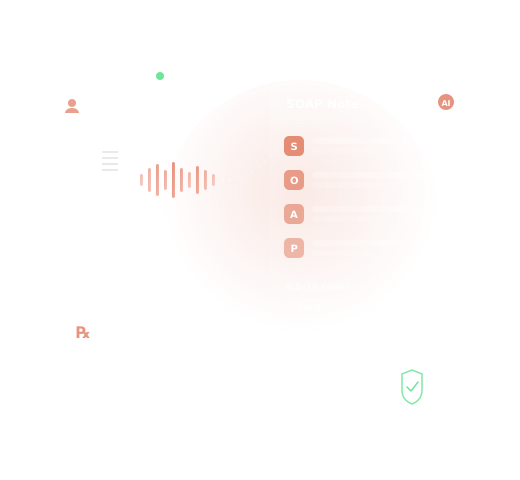
These encounters are information-dense and time-sensitive. In a busy OPD, the challenge is not only capturing the conversation accurately, but also structuring it into a usable note. An AI medical scribe in India can support this by organizing spoken content into a draft SOAP note, separating speakers, and surfacing coding suggestions for clinician review. This is especially useful when the same visit includes history taking, examination, treatment explanation, and planning for surgery or tumor board discussion.
Features mapped to workflow
For head neck onco surgery teams, useful documentation support should map directly to the way care is delivered:
- Automatic SOAP note generation: Converts consultation dialogue into a structured draft with subjective history, objective findings, assessment, and plan.
- Speaker diarization: Helps distinguish clinician and patient speech during detailed consultations, which is useful when symptoms, prior treatment history, and counseling points are discussed at length.
- Multilingual support: Supports workflows where patients may describe symptoms in one language while the clinician documents in another.
- ICD-10 and CPT suggestions: Provides coding support based on the documented encounter, with clinician review before use.
- Human review and edits: Keeps the surgeon or authorized team member in control of the final note before sign-off.
- On-premise or private deployment options: Supports organizations that prefer deployment choices aligned with internal governance and IT workflows.
This makes the product relevant not only for first consultations, but also for post-operative rounds, surveillance visits, second opinions, and multidisciplinary documentation handoffs. An AI medical scribe in India is most effective when it fits into existing clinical routines rather than forcing a new documentation style.
How It Works
The workflow below reflects how MedScribe is designed to support real clinical documentation from conversation capture to final sign-off:
- Capture the consultation conversation: During OPD, review, or counseling sessions, the clinician-patient conversation is captured through the configured workflow. This may include detailed symptom history, examination discussion, prior reports, and treatment planning relevant to head neck onco surgery.
- Transcribe and structure the encounter: The system processes the audio into text, applies speaker diarization, and organizes the content into clinically meaningful sections. This helps separate patient-reported symptoms from clinician observations and recommendations.
- Draft a SOAP note automatically: Based on the structured transcript, MedScribe generates a draft SOAP note. For this department, the draft may include presenting complaints, prior biopsy or imaging references mentioned in the conversation, examination findings, assessment themes, and next-step planning.
- Surface coding support: The platform can suggest ICD-10 and CPT codes based on the documented encounter. These are intended as support for the documentation workflow and should be reviewed by the clinician or authorized staff before use.
- Review, edit, and finalize: The clinician reviews the draft note, corrects details, adds missing context such as staging nuances or operative specifics, and signs off only when satisfied. Human review is an operational checkpoint before record finalization.
- Choose deployment posture for workflow needs: Depending on organizational preferences, teams can evaluate on-premise or private deployment approaches. This is a workflow and governance decision that may support internal data handling practices and IT requirements.
This practical flow is what makes an AI medical scribe in India useful for departments where consultations are long, nuanced, and documentation-heavy.
Local context
In India, head neck onco surgery practices often work across high patient volumes, mixed language interactions, referral-based care, and variable documentation maturity between standalone clinics and larger hospitals. Teams may need to document consultations quickly while still preserving enough detail for surgery planning, follow-up, and coordination with other specialties. An AI medical scribe in India can support these realities by helping clinicians move from conversation to draft documentation with less manual effort.
For hospitals and specialty centers, deployment choices also matter. Some organizations may prefer private or on-premise setups based on internal IT policies, infrastructure preferences, or governance requirements. MedScribe is designed to support workflows aligned with such operational needs without making blanket compliance claims. This keeps the discussion practical and implementation-focused for India healthcare teams evaluating documentation tools.
Use cases
- New cancer consultation: Capture symptom duration, risk factors, prior reports, examination findings, and treatment discussion into a structured draft note.
- Pre-operative counseling: Document procedure explanation, expected recovery, reconstruction discussion, and patient questions for review and sign-off.
- Post-operative follow-up: Summarize wound status, pathology discussion, nutrition or airway concerns, and next review plan.
- Second opinion visits: Organize long conversations involving prior treatment history, imaging references, and alternative management options.
- Multidisciplinary coordination: Create cleaner documentation that can support handoffs between surgery, oncology, pathology, and allied teams.
These scenarios show how AI medical scribe India healthcare workflows can be adapted to both clinic and hospital settings while keeping the clinician responsible for the final record.
FAQ
Below are common implementation questions from clinics and hospitals evaluating documentation support for this specialty.
Can this be used for complex surgical consultations?
Yes. It is designed to help convert detailed consultation conversations into draft notes, especially where history, examination, counseling, and planning happen in one visit. Final review remains with the clinician.
Does it replace the surgeon's documentation judgment?
No. The system assists with drafting and coding support, but the clinician reviews, edits, and signs off before the record is finalized.
Can it support multilingual consultations?
Yes. Multilingual support can help in settings where patients and clinicians use different languages during the encounter.
Is deployment flexible for hospitals?
Yes. Organizations can evaluate on-premise or private deployment approaches based on workflow, IT, and governance preferences.
CTA
If your team is evaluating an AI medical scribe in India for head neck onco surgery, start with the practical question: how much clinician time is currently spent converting rich conversations into usable notes? MedScribe is built to support consultation capture, SOAP drafting, coding suggestions, and clinician-led finalization in a workflow that fits daily OPD and hospital documentation. Explore the product overview, features, integrations, and pricing to assess fit for your clinic or hospital workflow.
Explore MedScribe | View features | See integrations | Review pricing