Introduction
Health Information Management teams are under constant pressure to improve documentation quality, reduce turnaround time, and support clinicians without adding more administrative burden. An AI medical scribe in India can help by turning consultation conversations into structured draft notes that are easier to review, complete, and store in the patient record. For hospitals, clinics, and multi-specialty OPD environments, this approach supports more consistent documentation while keeping the clinician in control of the final note.
For Indian healthcare settings, the need is practical: busy outpatient departments, multilingual patient interactions, variable documentation habits, and growing expectations around digital records. An AI medical documentation copilot can support these realities by capturing the encounter, organizing the transcript, drafting SOAP notes, and suggesting coding support for review. Instead of replacing clinical judgment, it is designed to reduce repetitive typing and help Health Information Management teams standardize workflows across departments.
This page explains how an AI medical scribe in India fits into daily HIM operations, what features matter most, and how clinics and hospitals can evaluate deployment choices such as private or on-premise setups based on workflow and governance needs.
Department workflow
In Health Information Management, documentation is not just about note creation. It includes record completeness, legibility, coding readiness, clinician review, and downstream usability for billing, audits, and continuity of care. In many Indian facilities, these steps are still fragmented across handwritten notes, dictated summaries, manual data entry, and delayed coding review.
An AI medical scribe supports the workflow at the point where documentation begins: the clinician-patient conversation. During OPD consultations, the system can capture the interaction, separate speakers, transcribe the discussion, and organize the content into a structured clinical draft. HIM teams benefit because the output is more standardized and easier to review than free-form notes created under time pressure.
For Health Information Management leaders, the value is operational. Draft notes can be reviewed faster, coding suggestions can be checked earlier, and documentation gaps can be identified before records are finalized. This is especially useful in high-volume clinics where note completion often spills beyond consultation hours. An AI medical scribe in India can therefore support both clinician efficiency and record quality without changing the core responsibility for final sign-off.
Features mapped to workflow
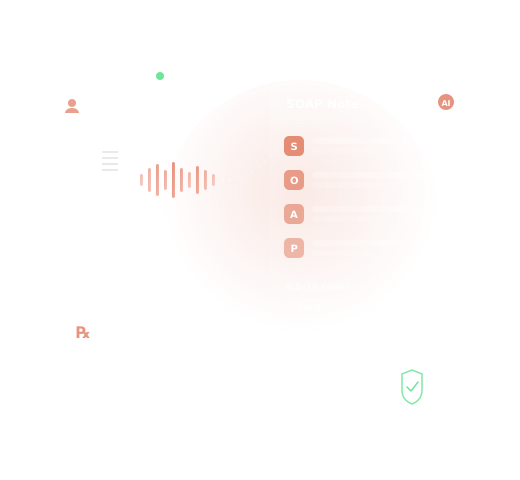
Automatic SOAP note generation: Converts consultation content into a structured draft with subjective, objective, assessment, and plan sections. This helps clinicians and HIM teams work from a consistent format rather than unstructured text.
Speaker diarization: Distinguishes between clinician and patient voices, which improves transcript readability and makes review easier during note validation.
Multilingual support: Useful for Indian care settings where consultations may shift between English and regional languages. This helps preserve context from real patient interactions.
ICD-10 and CPT suggestions: Provides coding support based on the documented encounter. These suggestions are intended for review, not automatic final coding, which keeps HIM oversight central.
Human review and edit controls: Drafts can be checked, corrected, and approved by the clinician before the record is finalized. This checkpoint is essential for safe operational use.
On-premise or private deployment options: Facilities with stricter internal governance preferences may choose deployment models that align with their infrastructure and data handling approach.
Integration readiness: The product narrative supports practical alignment with broader documentation workflows, including links to feature and integration pathways for teams evaluating rollout.
How It Works
The workflow of this product is designed around real consultation documentation rather than generic voice transcription. A typical implementation for an AI medical scribe in India follows these steps:
- Capture the consultation conversation: During the OPD or clinic visit, the system records the clinician-patient interaction through the configured device or workflow setup. The goal is to capture the encounter in a way that fits routine practice without forcing the doctor to dictate separately.
- Transcribe and structure the encounter: The audio is converted into text, with speaker diarization used to separate patient and clinician contributions. The transcript is then organized into clinically relevant sections so the raw conversation becomes easier to interpret.
- Draft a SOAP note automatically: Based on the structured transcript, the system generates a draft SOAP note. This gives the clinician and HIM team a usable starting point instead of a blank screen or fragmented handwritten summary.
- Suggest coding support for review: The documentation layer can surface ICD-10 and CPT suggestions linked to the encounter content. These are review aids for coding workflows and should be validated by the appropriate clinical or HIM user before use.
- Review, edit, and sign off: The clinician reviews the draft note, makes edits where needed, confirms accuracy, and completes final sign-off before the record is finalized. This human checkpoint is central to safe documentation workflows.
- Choose deployment posture based on governance needs: Depending on the organization, the workflow can be supported through private or on-premise deployment choices. This is a practical infrastructure decision for hospitals and clinics that want closer control over operational environments.
Local context
Indian healthcare organizations often manage high patient volumes, mixed digital maturity, and multilingual consultations across specialties. In this environment, documentation tools need to be practical, not theoretical. An AI medical scribe in India is most useful when it supports daily OPD throughput, reduces after-hours note completion, and helps standardize records across clinicians with different documentation styles.
For Health Information Management teams, local relevance also means flexibility. Some facilities may prefer cloud-based workflows for faster rollout, while others may evaluate private or on-premise deployment due to internal governance preferences. The right choice depends on infrastructure, review processes, and how the organization wants to manage documentation operations at scale.
The broader opportunity in AI medical scribe India healthcare is not simply automation. It is better coordination between clinicians, documentation teams, and coding workflows so records are more usable across care delivery and administration.
Use cases
Busy OPD clinics: Draft notes are prepared from live consultations, helping doctors complete documentation faster and reducing backlog for HIM review.
Multi-specialty hospitals: Standardized SOAP drafting supports more consistent note structures across departments, making records easier to audit and manage.
Clinics with multilingual consultations: Speech capture and multilingual support help preserve encounter details that may otherwise be lost in rushed manual summaries.
Coding-assisted workflows: HIM and revenue cycle teams can review coding suggestions earlier in the documentation process, improving readiness for downstream tasks.
Governance-sensitive deployments: Organizations that need tighter infrastructure control can evaluate private or on-premise setups as part of their operational planning.
FAQ
Can this replace clinician review?
No. The system creates draft documentation and coding suggestions, but the clinician should review, edit, and sign off before the record is finalized.
Is it useful for Indian OPD settings?
Yes, especially where consultation volumes are high and documentation time is limited. The workflow is designed to support practical outpatient documentation needs.
Does it support coding workflows?
It can provide ICD-10 and CPT suggestions based on the encounter content. These suggestions are intended to support review, not replace HIM or clinician judgment.
Can hospitals choose different deployment models?
Yes. Organizations may evaluate private or on-premise deployment options based on infrastructure, workflow, and governance preferences.
CTA
If your Health Information Management team is evaluating ways to improve documentation quality and reduce manual note burden, an AI medical scribe in India can be a practical next step. Explore how conversation capture, SOAP drafting, coding support, and clinician review can fit your OPD and hospital workflows. Review the product pathways for MedScribe overview, compare capabilities on features, and assess rollout considerations based on your documentation environment.