Introduction
Heart failure clinics manage repeat visits, medication adjustments, symptom review, counselling, and close follow-up documentation. An AI medical scribe in India can help clinicians reduce manual note-taking during these encounters by turning consultation conversations into structured draft notes for review. For hospitals and specialty clinics, the goal is practical: support faster documentation, clearer records, and more consistent capture of the clinical story without changing how cardiologists, nurses, and coordinators work with patients.
MedScribe is designed as an AI documentation copilot for daily OPD and follow-up workflows. It converts doctor-patient conversations into usable clinical notes, supports SOAP drafting, and provides coding suggestions that clinicians can review before final sign-off. In a heart failure setting, this is useful when visits include symptom progression, fluid status discussion, medication titration, adherence checks, device history, and care-plan reinforcement. Rather than replacing clinical judgment, the system supports documentation workflows aligned with existing care processes in India.
For organisations evaluating an AI medical scribe in India, the key question is not only transcription accuracy. It is whether the tool fits real clinic operations, supports multilingual conversations, and gives doctors control over edits and approval. That is especially relevant in heart failure clinics where follow-up notes often need to be detailed, longitudinal, and easy to review across visits.
Department workflow
Heart failure clinics typically run on high-information consultations. A patient may arrive with prior discharge summaries, medication lists, weight trends, blood pressure readings, lab reports, and symptom updates such as breathlessness, edema, fatigue, orthopnea, or reduced exercise tolerance. The clinician must quickly review history, assess current status, document examination findings, update treatment plans, and communicate next steps.
Documentation pressure increases when the clinic handles both new evaluations and repeat follow-ups. New visits may require fuller history capture, while follow-ups often depend on precise comparison with prior notes. In many settings, doctors also need to document counselling on salt restriction, fluid management, adherence, warning signs, and escalation plans. An AI medical scribe in India is most useful here when it supports this rhythm of care: listening to the consultation, structuring the narrative, and preparing a draft that can be reviewed quickly before the record is finalized.
For India healthcare teams, multilingual interactions are common. A consultation may move between English, Hindi, and regional language phrases, especially during symptom description or caregiver discussion. This makes workflow-fit more important than generic dictation. The product should help capture the encounter in a clinically usable format while preserving clinician oversight.
Features mapped to workflow
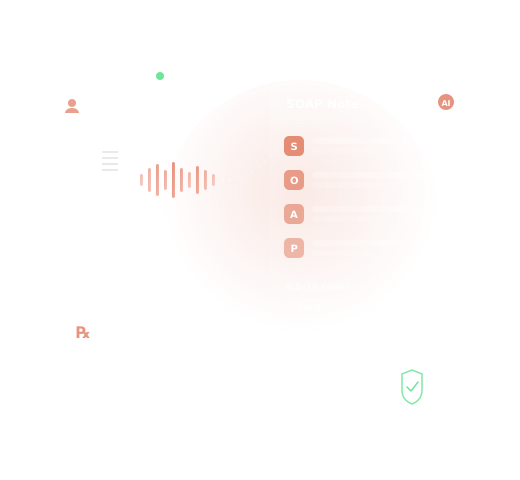
Automatic SOAP note generation: Heart failure visits often follow a predictable but detailed structure. Automatic SOAP drafting helps organize subjective symptoms, objective findings, assessment, and plan into a format clinicians already use.
Speaker diarization: In specialty clinics, both patient and caregiver may speak during the visit. Speaker separation helps distinguish who said what, improving clarity in the draft note.
ICD-10 and CPT suggestions: Coding support can help teams prepare more complete documentation workflows by surfacing likely coding options for clinician review. Suggestions remain reviewable and should not replace coding judgment.
Multilingual support: Useful for clinics where consultations mix English with Indian languages, especially during symptom explanation, medication adherence discussion, and discharge counselling.
On-premise deployment options: Some hospitals prefer private or on-premise deployment as a workflow and governance decision. This can support internal IT preferences and data handling models without changing the clinician experience.
Human review before finalization: Draft notes are only useful when doctors can edit, correct, and sign off. This checkpoint is essential in heart failure care where medication changes and follow-up instructions must be precise.
How It Works
The workflow for an AI medical scribe in India should be simple enough for busy OPD teams and specific enough for specialty documentation. MedScribe follows an end-to-end process built around conversation capture, structured drafting, coding support, and clinician approval.
- Capture the consultation conversation: During the visit, the system records or ingests the doctor-patient interaction, including caregiver input where relevant. Speaker diarization helps separate clinician, patient, and attendant voices so the transcript is easier to interpret in a heart failure follow-up or new assessment.
- Transcribe and structure the encounter: The audio is converted into text and organized into clinically meaningful sections. Symptom updates, medication adherence comments, prior hospitalization references, and lifestyle counselling can be grouped into a more usable draft structure rather than a raw transcript.
- Generate a SOAP draft note: Based on the structured conversation, the product prepares a SOAP-style draft. In a heart failure clinic, this may include symptom review, relevant examination discussion, assessment themes, and a plan covering medication changes, investigations, counselling, and follow-up timing.
- Surface coding suggestions for review: The system can suggest ICD-10 and CPT options linked to the documented encounter. These are intended as support for the documentation workflow and should be reviewed by the clinician or coding team before use.
- Clinician edits and sign-off: The doctor reviews the draft, corrects any omissions, refines the assessment, and confirms the final plan. Human review is the operational checkpoint before the note becomes part of the patient record.
- Choose deployment posture based on governance needs: Hospitals and clinics may evaluate private or on-premise deployment depending on internal IT and data governance preferences. This is a workflow and infrastructure choice designed to align with organisational requirements.
Local context
In India, heart failure clinics often balance specialist demand, repeat follow-up volume, and variable documentation habits across consultants and care teams. A practical AI medical scribe in India should therefore support everyday realities: mixed-language consultations, caregiver participation, time-limited OPD slots, and the need for concise but complete records. It should also fit both standalone specialty clinics and larger hospitals with internal IT preferences.
For India healthcare organisations, the value is operational rather than promotional. Teams may use the tool to reduce after-hours note completion, improve consistency in follow-up documentation, and support cleaner handoffs across clinicians. Because these pages are meant for practical evaluation, it is useful to compare workflow details with related product information on core MedScribe pages and feature pages before selecting a deployment model.
Use cases
New heart failure evaluation: Capture history, symptom burden, prior admissions, medication background, and initial care plan in a structured draft.
Follow-up medication titration visits: Document changes in symptoms, blood pressure trends, weight changes, adherence, and revised treatment instructions.
Post-discharge review: Summarize interval events, discharge medication reconciliation discussion, warning sign counselling, and next follow-up plan.
Caregiver-involved consultations: Use speaker diarization to better separate patient and caregiver inputs during complex discussions.
Multilingual OPD encounters: Support consultations where English mixes with Hindi or regional language phrases during symptom explanation and counselling.
FAQ
Can this be used in a heart failure follow-up clinic?
Yes. It is suited to repeat visits where clinicians need structured notes covering symptoms, medication changes, counselling, and follow-up plans.
Does it replace clinician documentation review?
No. The draft note should always be reviewed, edited where needed, and signed off by the clinician before finalization.
Can it support multilingual consultations in India?
The product is designed with multilingual support, which can help in clinics where conversations shift between English and Indian languages.
How are coding suggestions handled?
ICD-10 and CPT suggestions are provided as workflow support. They should be reviewed by the clinician or coding team before use.
Is private deployment possible?
Some organisations may choose private or on-premise deployment based on internal workflow and governance preferences.
CTA
If your cardiology service or specialty OPD is evaluating an AI medical scribe in India, focus on workflow fit: how well it captures consultations, drafts SOAP notes, supports coding review, and preserves clinician control. Explore MedScribe for product details, review feature-specific capabilities, and assess whether the documentation flow matches your heart failure clinic operations in India.