Introduction
An AI medical scribe in India can help hemato oncology teams reduce documentation burden during complex consultations, follow-ups, treatment discussions, and supportive care visits. In this specialty, clinicians often manage detailed histories, lab trends, chemotherapy planning, symptom review, adverse event tracking, and longitudinal care coordination. That makes note creation time-consuming, especially in busy OPD settings where doctors need to stay focused on the patient while still producing structured records.
MedScribe is designed as an AI documentation copilot that converts consultation conversations into draft clinical notes and coding suggestions for clinician review. For hospitals and clinics evaluating an AI medical scribe in India, the practical value is not just transcription. The product supports a workflow that starts with conversation capture, structures the interaction, drafts SOAP notes, suggests ICD-10 and CPT codes, and keeps the clinician in control for edits and final sign-off. For hemato oncology, this can support more consistent documentation across new patient visits, review appointments, infusion-related discussions, and survivorship or palliative care conversations.
The goal is simple: help doctors spend less time typing and more time on clinical decision-making, patient counselling, and care coordination. This page focuses on how an AI medical scribe fits real hemato oncology workflows in India, with practical detail for implementation teams, department heads, and clinic operators.
Department workflow
Hemato oncology documentation is rarely linear. A single visit may include prior diagnosis review, pathology or bone marrow findings, staging context, treatment intent, cycle status, toxicity assessment, transfusion history, infection risk, medication reconciliation, and next-step planning. In many centres, the doctor also needs to document counselling around prognosis, treatment options, side effects, and follow-up intervals.
Typical department workflow includes patient registration, consultation, review of prior records and investigations, discussion with patient and family, treatment planning, note completion, coding support, and handoff to pharmacy, infusion, billing, or follow-up scheduling. Because these visits are information-dense, clinicians often document after the encounter, which can create delays, incomplete notes, or variable structure across providers.
An AI medical scribe in India is useful in this setting when it supports the natural consultation flow rather than forcing extra clicks. For hemato oncology, the best fit is a system that can capture multi-speaker conversations, organize details into clinically familiar sections, and present a draft that the doctor can quickly verify before finalizing the record.
Features mapped to workflow
Automatic SOAP note generation: Converts consultation dialogue into a draft note with subjective history, objective findings discussed during the visit, assessment framing, and plan elements. This is especially useful for follow-up visits where symptom progression, treatment tolerance, and next-cycle planning need to be documented clearly.
Speaker diarization: Distinguishes between clinician and patient speech, which helps when family members are present or when counselling forms a large part of the encounter. In hemato oncology, this can improve readability of the draft note by separating reported symptoms from physician recommendations.
Multilingual support: Many consultations in India move between English and regional languages. Multilingual support can help preserve the flow of the encounter while still producing a usable draft note for review.
ICD-10 and CPT suggestions: Coding support can help teams prepare more complete documentation for downstream billing and reporting workflows. Suggestions should still be reviewed by the clinician or coding team before use.
On-premise or private deployment options: For organisations with stricter governance preferences, deployment posture can be chosen as an operational decision. This supports workflows aligned with internal IT and data handling requirements without changing the clinician experience.
Review-first workflow: The draft is not the final record. Doctors can edit, add missing context such as staging or regimen details, and sign off only after review. This is important in hemato oncology, where precision in diagnosis, treatment intent, and follow-up planning matters.
How It Works
Below is the typical end-to-end workflow for using this product in hemato oncology OPD and review settings:
- Capture the consultation conversation: During the visit, the system records the interaction between clinician and patient. It is built to support real consultation flow, including mixed-language conversations and multi-speaker exchanges common when attendants are present.
- Transcribe and structure the encounter: The captured audio is converted into text and organized using speaker diarization. Instead of leaving the output as raw transcript, the system prepares structured clinical content that is easier to review in a hemato oncology context.
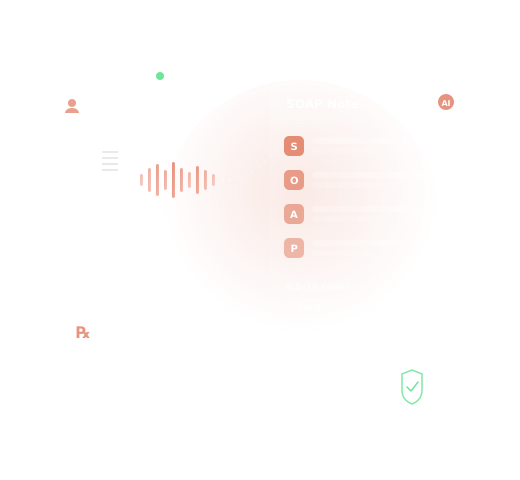
- Draft a SOAP note automatically: Based on the conversation, the product generates a draft SOAP note. This may include presenting concerns, treatment tolerance updates, symptom review, physician assessment framing, and plan items such as investigations, medication changes, counselling points, or follow-up timing.
- Suggest coding support: The workflow can surface ICD-10 and CPT suggestions based on the documented encounter. These suggestions are intended to assist documentation and coding workflows, not replace human judgment.
- Clinician reviews and edits: The doctor checks the draft, corrects terminology, adds specialty-specific details such as diagnosis subtype, cycle number, regimen references, or adverse event context, and confirms that the note reflects the actual encounter.
- Finalize the record with sign-off: Only after human review does the clinician approve the note for record finalization. Organisations can also choose on-premise or private deployment models as part of their governance and workflow design.
Local context
In India, hemato oncology departments often balance high documentation needs with variable OPD volumes, mixed digital maturity, and multilingual patient communication. That is why an AI medical scribe in India should be practical first: easy to fit into daily consultations, useful for both independent specialists and hospital departments, and flexible enough for different infrastructure preferences.
For some organisations, the priority may be faster note turnaround in busy clinics. For others, it may be more consistent documentation across consultants, fellows, or rotating teams. Some hospitals may prefer private or on-premise deployment options as part of internal governance planning. In each case, the value of an AI medical scribe India healthcare workflow comes from reducing repetitive documentation effort while preserving clinician oversight.
Use cases
New patient consultations: Capture detailed history, prior treatment summary, symptom burden, and counselling discussion into a structured draft note.
Follow-up oncology reviews: Document response discussions, toxicity review, medication changes, and next-cycle planning more consistently.
Hematology evaluations: Support note drafting for anaemia workup discussions, marrow disorder follow-ups, transfusion planning, and longitudinal monitoring visits.
Treatment counselling visits: Summarize physician-patient discussions around regimen expectations, side effects, supportive care, and follow-up instructions.
High-volume OPD sessions: Help clinicians complete notes faster after each encounter instead of batching documentation late in the day.
Multi-location groups: Standardize documentation approach across clinics while allowing each doctor to review and edit notes in their own style.
FAQ
Can this replace clinician documentation judgment?
No. The product creates draft notes and coding suggestions, but the clinician reviews, edits, and signs off before the record is finalized.
Is it useful for mixed-language consultations?
Yes. Multilingual support is designed for real-world consultations in India where doctors and patients may switch between English and regional languages.
Does it support coding workflows?
It can provide ICD-10 and CPT suggestions to support downstream workflows. These suggestions should be checked by the clinician or coding team.
Can hospitals choose different deployment models?
Yes. On-premise or private deployment options can be considered based on organisational workflow, IT preferences, and governance needs.
CTA
If your hemato oncology team is evaluating an AI medical scribe in India, start with the day-to-day workflow: consultation capture, structured draft notes, coding support, clinician review, and final sign-off. Explore how MedScribe can support practical OPD documentation needs for hospitals and specialty clinics, and review related product details on /medscribe, /medscribe/features, /medscribe/integrations, and /medscribe/pricing.