Introduction
Hematology consultations often involve detailed histories, symptom timelines, prior reports, treatment plans, and follow-up instructions that must be documented clearly. An AI medical scribe in India can help clinics and hospitals reduce manual note-taking during OPD visits, follow-ups, and procedure-related consultations. Instead of relying only on after-hours documentation, doctors can use an AI documentation copilot to convert consultation conversations into structured clinical notes that are ready for review.
For hematology teams, the value is practical: clearer documentation, more consistent note structure, and less time spent rewriting routine details. MedScribe is designed to support daily clinical workflows by turning doctor-patient conversations into draft SOAP notes, highlighting coding suggestions, and keeping the clinician in control of edits and final sign-off. This makes it useful for specialists managing anemia workups, coagulation discussions, blood disorder follow-ups, infusion planning, and long-term monitoring where documentation quality matters.
The goal is not to replace clinical judgment. It is to support documentation workflows aligned with how Indian healthcare teams work every day, whether in independent clinics, specialty centres, or multispecialty hospitals.
Department workflow
Hematology documentation can be more layered than a standard general medicine visit. A single encounter may include prior lab review, transfusion history, medication adherence, bleeding symptoms, family history, treatment response, and next-step planning. In busy settings, this creates pressure on clinicians to listen carefully, counsel thoroughly, and still complete records on time.
Typical workflow points where documentation support is useful include new patient evaluations, follow-up visits for chronic blood disorders, therapy monitoring, pre-procedure counselling, and coordination with pathology or oncology teams. During these encounters, clinicians often need to capture symptom chronology, examination findings, assessment logic, and a clear plan with investigations or treatment changes.
An AI medical scribe in India fits into this workflow by helping structure the conversation as it happens. Instead of starting from a blank screen after the consultation, the doctor gets a draft note that reflects the encounter in a usable format. This can be especially helpful in high-volume OPD settings where consistency across notes improves continuity of care and internal communication.
Features mapped to workflow
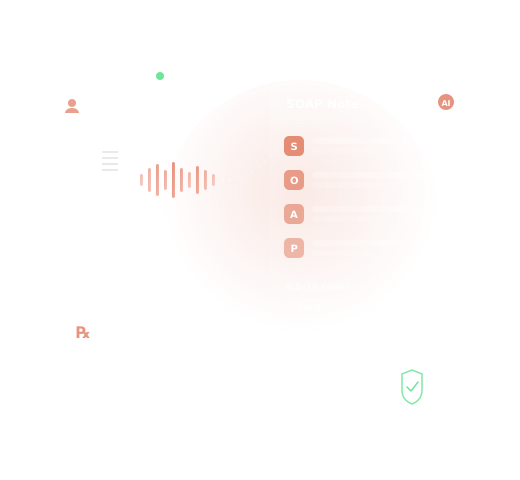
MedScribe is built around practical documentation tasks rather than generic automation. For hematology teams, automatic SOAP note generation can help convert consultation dialogue into a familiar clinical structure. Speaker diarization helps distinguish between clinician and patient voices, which is useful when histories are detailed or when attendants contribute important context. Multilingual support can assist in settings where consultations move between English and Indian languages during the same visit.
ICD-10 and CPT suggestion support can help clinicians and administrative teams review likely coding options alongside the drafted note. These are suggestions for review, not automatic final coding decisions. This is useful when practices want a more organized handoff from consultation to billing or internal record completion.
Deployment posture also matters. Some organizations may prefer private or on-premise deployment choices based on internal governance, IT architecture, or data handling preferences. MedScribe supports workflow decisions of this kind without changing the core clinical process: capture the conversation, generate a structured draft, review it, edit it, and finalize the record.
Because this page is focused on practical use, it complements broader product information available on core pages such as /medscribe and /medscribe/features.
How It Works
The workflow for an AI medical scribe in India should be simple enough for routine OPD use while preserving clinician oversight. MedScribe follows an end-to-end documentation flow designed for real consultations.
- Capture the consultation conversation: During the visit, the system records or ingests the doctor-patient conversation based on the clinic's chosen workflow. This can support in-room documentation without forcing the clinician to type continuously.
- Transcribe and structure the dialogue: The audio is converted into text, with speaker diarization used to separate clinician and patient contributions. This helps organize symptom descriptions, questions, counselling points, and responses into a clearer encounter record.
- Draft a SOAP note automatically: The system converts the structured transcript into a draft SOAP note. For hematology, this can help organize history, relevant findings, assessment themes, and the treatment or investigation plan into a format clinicians already use.
- Surface coding suggestions for review: Based on the documented encounter, the platform can present ICD-10 and CPT suggestions to support downstream documentation and billing workflows. These suggestions are intended for clinician or staff review before use.
- Review, edit, and sign off: The clinician reviews the draft note, corrects details, adds nuance where needed, and approves the final version before the record is completed. Human review is the operational checkpoint that keeps the final documentation clinically accountable.
- Choose deployment posture to match governance needs: Organizations can evaluate private or on-premise deployment options as workflow and governance decisions. This helps teams align documentation operations with internal IT preferences while keeping the same review-first clinical process.
Local context
In India, hematology practices often balance high patient volumes, mixed digital maturity, and multilingual communication. Some clinics may work with fully digital records, while others combine hospital systems, scanned reports, and manual follow-up processes. An AI medical scribe in India is most useful when it adapts to these realities rather than assuming a single documentation model.
For example, a specialist may review outside lab reports, discuss prior admissions, and explain long-term treatment plans in more than one language during the same consultation. Documentation support that can handle multilingual conversations and produce a structured draft can reduce the burden of reconstructing the visit later. In larger hospitals, the same capability can support more standardized note quality across consultants and departments.
The result is a more practical documentation workflow for India healthcare settings: less repetitive typing, more consistent note structure, and a clearer review process before records are finalized.
Use cases
Hematology teams can use MedScribe across several common scenarios. In new patient consultations, it can help capture detailed symptom history, prior investigations, and initial assessment planning. In follow-up visits, it can support faster documentation of treatment response, adverse effects, medication changes, and next review instructions. For chronic condition management, it can help maintain consistency in longitudinal notes across repeated visits.
It is also useful in multidisciplinary environments where hematology overlaps with oncology, pathology, transfusion medicine, or internal medicine. A structured draft note can make handoffs easier and reduce variability in how key details are recorded. For clinics exploring an AI medical scribe in India, these use cases matter more than broad automation claims because they reflect the daily work of OPD and specialty care.
FAQ
Below are common implementation questions from clinics and hospitals evaluating AI documentation support for hematology workflows in India.
CTA
If your team wants a more efficient way to document hematology consultations, MedScribe offers a practical path from conversation capture to reviewed clinical notes. Explore the core product at /medscribe, compare capabilities at /medscribe/features, and assess whether an AI medical scribe in India fits your OPD, specialty clinic, or hospital workflow. The best starting point is a workflow review focused on note quality, review checkpoints, and how documentation moves from consultation to final record.