Introduction
AI medical scribe in India is becoming a practical option for hospitals, clinics, and diagnostic centres that want to reduce documentation load without disrupting clinical judgment. In hematology lab settings, documentation often spans clinician discussions, pathology interpretations, follow-up recommendations, coding support, and coordination with referring doctors. An AI medical documentation copilot can help convert consultation conversations into structured notes that are easier to review, edit, and finalize.
For hematology-focused workflows, the value is not only speed. Teams also need consistency in note structure, support for multilingual conversations, and a clear review step before any record is saved. MedScribe is designed to support these needs by turning spoken interactions into draft clinical documentation, including SOAP-style notes and coding suggestions, while keeping the clinician in control of edits and sign-off. This makes AI medical scribe in India relevant for both specialist consultations and high-volume OPD environments connected to lab services.
The goal is simple: reduce repetitive typing, improve note completeness, and support workflows aligned with day-to-day care delivery in Indian healthcare settings.
Department workflow
Hematology lab workflows often involve more than a single encounter note. A patient may arrive with prior reports, referral notes, symptoms discussed in OPD, and a need for interpretation of CBC, peripheral smear, coagulation, or follow-up testing. Clinicians and support staff may document history, provisional impressions, treatment context, and next-step recommendations across multiple systems.
In practice, this creates several friction points: manual note-taking during consultations, delayed documentation after clinic hours, inconsistent formatting between doctors, and extra effort to prepare records for billing or coding review. In busy centres, the challenge increases when conversations shift between English and regional languages, or when multiple speakers are involved in the room.
An AI medical scribe in India can fit into this workflow by capturing the consultation conversation, separating speakers, structuring the transcript, and drafting a usable note for clinician review. For hematology lab teams, this is especially useful where interpretation-heavy discussions need to be documented clearly but efficiently.
Features mapped to workflow
MedScribe is built as an AI medical documentation copilot for doctors and clinics. For hematology lab use, its core capabilities map well to common operational steps:
- Conversation capture and transcription: Supports the first stage of documentation by converting spoken consultation content into text.
- Speaker diarization: Helps distinguish between clinician and patient speech, which is useful when history, symptoms, and recommendations need to be separated clearly.
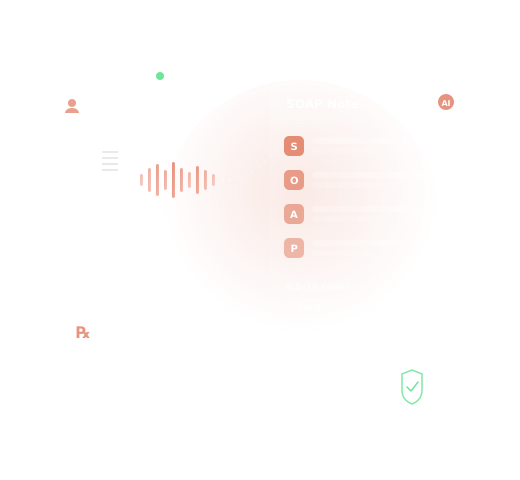
- Automatic SOAP note generation: Converts raw conversation into a structured draft note that is easier to review than a plain transcript.
- ICD-10 and CPT suggestions: Provides coding support to help teams prepare documentation for downstream administrative workflows. Suggestions should always be reviewed by the clinician or billing team.
- Multilingual support: Useful in Indian healthcare settings where consultations may move between English, Hindi, and regional languages.
- On-premise deployment options: Supports organizations that prefer private or on-premise deployment choices as part of their workflow and governance approach.
These features make AI medical scribe India healthcare adoption more practical for departments that need documentation support without forcing doctors to change how they speak with patients.
How It Works
Below is a practical view of how the product works in a hematology lab or hematology-linked OPD workflow:
- Capture the consultation conversation: During the patient interaction, the system records the discussion between clinician and patient. This may include symptoms, prior lab findings, treatment history, and follow-up advice relevant to hematology care.
- Transcribe and organize the discussion: The audio is converted into text, and speaker diarization helps separate who said what. This is useful when documenting patient history versus clinician assessment.
- Draft a structured SOAP note: The system converts the conversation into a draft SOAP note, organizing subjective history, objective findings discussed during the visit, assessment, and plan. This gives the clinician a usable starting point instead of a blank screen.
- Add coding support: Based on the drafted note, the system can suggest ICD-10 and CPT codes to support downstream documentation and billing workflows. These are suggestions only and should be checked by the responsible team.
- Review, edit, and sign off: The clinician reviews the draft, corrects terminology, adds lab-specific interpretation where needed, and approves the final version before it becomes part of the record. Human review is the operational checkpoint that keeps the workflow clinically accountable.
- Choose deployment posture: Organizations can evaluate cloud, private, or on-premise deployment options based on internal workflow, IT preferences, and governance needs. This is a practical implementation decision rather than a compliance claim.
Local context
In India, hematology services often operate across a mix of standalone labs, multispecialty hospitals, cancer centres, and referral-driven OPD setups. Documentation needs can vary by site, but the common requirement is to keep notes clear, timely, and reviewable. An AI medical scribe in India should therefore support practical realities such as multilingual consultations, variable digital maturity, and the need to work alongside existing documentation habits.
For many organizations, adoption decisions are less about novelty and more about whether the tool fits current workflows. Teams may want a solution that complements existing systems, supports private deployment preferences, and helps clinicians spend less time typing after hours. That is where a focused, workflow-oriented approach to AI medical scribe in India becomes useful.
Use cases
- Hematology OPD consultations: Drafting notes from patient discussions on anemia, bleeding disorders, thrombosis workups, or follow-up visits.
- Referral review visits: Summarizing prior reports, symptoms, and next-step recommendations into a structured note.
- High-volume hospital clinics: Reducing manual documentation burden during busy OPD sessions while preserving clinician review.
- Multilingual patient interactions: Supporting note creation when consultations include English plus Hindi or regional language usage.
- Documentation standardization: Helping departments maintain more consistent note structure across clinicians.
These scenarios show how AI medical scribe India healthcare tools can support both specialist and operational needs without replacing clinical decision-making.
FAQ
Can this be used in a hematology lab setting?
Yes. It is suited to hematology-linked consultations and review workflows where clinicians need structured notes from patient conversations, report discussions, and follow-up planning.
Does the system finalize records automatically?
No. The intended workflow includes clinician review, edits, and final sign-off before documentation is finalized.
Can it support multilingual consultations?
Yes. Multilingual support is useful for Indian healthcare environments where consultations may include more than one language.
Does it provide coding support?
Yes. It can suggest ICD-10 and CPT codes based on the drafted note, but these suggestions should be reviewed by the appropriate clinician or administrative team.
CTA
If your hematology lab or hospital team wants to reduce manual note-taking and improve documentation consistency, MedScribe offers a practical starting point. Explore how an AI medical scribe in India can support conversation capture, SOAP drafting, coding assistance, and clinician-led review for everyday workflows. For broader product details, teams can also review the main product, features, integrations, and pricing journeys as part of their evaluation process.