Introduction
AI medical scribe in India is becoming a practical option for hospitals and specialty clinics that want to reduce documentation load without disrupting clinical judgment. In hepatobiliary surgery, consultations often involve complex histories, prior imaging, operative planning, medication review, and follow-up instructions. That makes note creation time-consuming, especially in busy OPD settings where surgeons need to move quickly between new evaluations, post-operative reviews, and multidisciplinary discussions. An AI medical documentation copilot can help convert consultation conversations into structured drafts that are easier to review, edit, and finalize.
For hepatobiliary teams, the value is not only speed. It is also consistency across SOAP notes, better capture of clinical details, and support for coding-oriented documentation. MedScribe is designed to assist with consultation capture, transcription structuring, SOAP note drafting, ICD-10 and CPT suggestions, speaker diarization, multilingual support, and deployment options such as on-premise or private environments. For organizations evaluating an AI medical scribe in India, the goal is to support daily workflows aligned with existing documentation practices rather than replace clinician oversight.
Department workflow
Hepatobiliary surgery documentation has a distinct rhythm. A typical day may include first-time consultations for gallbladder disease, liver lesions, biliary obstruction, pancreatic masses, jaundice workup, and referrals after imaging. It also includes post-operative visits, drain and wound reviews, pathology discussions, and coordination with gastroenterology, oncology, radiology, and anesthesia teams. Each encounter can generate a large amount of information: presenting symptoms, prior procedures, imaging findings, liver function trends, comorbidities, operative risk factors, and treatment planning.
In many clinics, the surgeon or assistant documents while also trying to maintain eye contact, explain options, and answer family questions. This can lead to delayed note completion, uneven detail, or after-hours charting. An AI documentation copilot fits into this workflow by listening to the consultation, separating speakers, organizing the transcript into clinically useful sections, and preparing a draft note for review. For hepatobiliary surgery, that means the surgeon can focus more on decision-making while still retaining control over the final record.
Features mapped to workflow
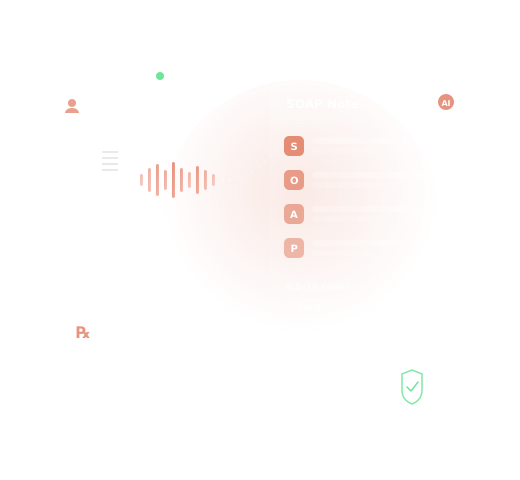
Automatic SOAP note generation: Consultation conversations can be converted into structured subjective, objective, assessment, and plan drafts. This is useful when discussing symptoms such as abdominal pain, jaundice, fever, weight loss, appetite changes, prior admissions, and imaging-led referrals.
Speaker diarization: In specialty consultations, both patient and clinician contribute important details, and family members may also speak. Speaker separation helps organize who said what, making the draft easier to verify.
ICD-10 and CPT suggestions: Coding support can help teams prepare more complete documentation for downstream billing and record workflows. Suggestions should still be reviewed by the clinician or coding team before use.
Multilingual support: In India, hepatobiliary consultations may move between English, Hindi, and regional languages. Multilingual capture can support more natural conversations while still producing usable documentation drafts.
On-premise or private deployment options: Some hospitals prefer deployment choices that fit internal governance and IT preferences. These options are workflow and infrastructure decisions that can support documentation operations aligned with organizational requirements.
Review-first design: Drafts are intended for clinician review, edits, and sign-off before finalization. This is especially important in surgical specialties where operative planning and risk communication must be precise.
How It Works
The workflow for an AI medical scribe in India should be simple enough for OPD use while preserving clinical review at every important checkpoint.
- Capture the consultation conversation: During a hepatobiliary surgery visit, the system records or receives the consultation audio from the approved workflow. It captures the discussion around symptoms, prior imaging, lab history, operative history, medications, and treatment options. Speaker diarization helps distinguish clinician and patient contributions.
- Transcribe and structure the encounter: The conversation is converted into text and organized into clinically meaningful segments. Multilingual support can help when the consultation shifts between English and local languages. This structured transcript becomes the base for note drafting rather than a raw transcript alone.
- Draft a SOAP note automatically: The platform prepares a usable SOAP note draft with key history, relevant findings discussed in the visit, assessment themes, and plan items such as further imaging, pre-operative workup, referral coordination, or follow-up timing. The draft is designed to reduce manual typing, not replace clinical reasoning.
- Generate coding support cues: Based on the documented encounter, the system can surface ICD-10 and CPT suggestions to support downstream documentation workflows. These are prompts for review and refinement, especially useful when specialty visits involve procedural planning or post-operative follow-up.
- Clinician review, edit, and sign-off: The surgeon or authorized team member reviews the draft, corrects terminology, adds missing context, confirms coding relevance, and finalizes the note. Human review is the operational checkpoint before the record is completed.
- Choose deployment posture for governance needs: Depending on hospital preferences, teams may evaluate cloud, private, or on-premise deployment approaches. This decision supports workflow design, data handling preferences, and integration planning with existing systems.
Local context
In India, hepatobiliary surgery practices often manage high patient volumes, mixed payer environments, and multilingual consultations. Documentation needs can vary between standalone specialty clinics, multispecialty hospitals, academic centers, and surgical groups. That is why AI medical scribe in India should be evaluated for practical fit: how quickly it supports OPD note completion, whether it handles mixed-language conversations, and how well it aligns with existing review and sign-off habits.
Teams may also prefer deployment flexibility depending on internal IT policies and infrastructure maturity. For some organizations, private or on-premise options may be important when planning adoption. The most useful approach is to assess whether the tool supports everyday documentation quality, reduces repetitive typing, and helps surgeons complete records with less administrative friction.
Use cases
New surgical consultation: Capture detailed symptom history, prior scans, referral notes, and preliminary management planning in a structured draft.
Post-operative follow-up: Document recovery progress, wound status, drain output discussions, pathology review, medication changes, and next steps.
Complex counseling visits: Support note creation when explaining operative risks, alternatives, expected recovery, and multidisciplinary recommendations.
High-volume OPD sessions: Reduce after-hours documentation burden by preparing drafts during or soon after the encounter.
Mixed-language consultations: Help clinicians maintain natural communication with patients while still producing organized notes.
For hospitals comparing tools, an AI medical scribe in India is most valuable when it improves note readiness without forcing major workflow change. In hepatobiliary surgery, that means supporting nuanced documentation while keeping the surgeon in control of the final record.
FAQ
Can this be used for hepatobiliary surgery OPD visits?
Yes. It is suited to consultation-heavy workflows where history, imaging discussion, assessment, and planning need to be documented in a structured way.
Does it replace clinician documentation review?
No. The draft should be reviewed, edited where needed, and signed off by the clinician or authorized team before finalization.
Can it support multilingual consultations in India?
Yes. Multilingual support can help when visits include English plus Hindi or regional language conversation, subject to workflow setup and review.
Does it help with coding?
It can provide ICD-10 and CPT suggestions as documentation support cues, but coding choices should still be validated by the clinician or coding team.
CTA
If your hepatobiliary surgery team is exploring an AI medical scribe in India, focus on practical outcomes: faster note drafting, better documentation consistency, and a review workflow that fits your OPD. Explore the product overview, features, integrations, and pricing paths to assess fit for your clinic or hospital documentation process.