Introduction
Hepatology consultations often involve detailed history taking, medication review, lab interpretation, imaging follow-up, and longitudinal documentation across repeat visits. An AI medical scribe in India can help reduce the time clinicians spend turning conversations into structured notes, while keeping the doctor in control of the final record. For hospitals, liver clinics, and multispecialty practices, the goal is practical: capture the consultation, organize it into usable documentation, and support coding and follow-up workflows without disrupting OPD flow.
MedScribe is designed as an AI documentation copilot for doctors and care teams. It converts consultation conversations into draft clinical notes, supports SOAP formatting, suggests ICD-10 and CPT codes for review, and helps organize information for faster completion. In hepatology settings, this is useful for chronic liver disease follow-up, hepatitis management, cirrhosis reviews, fatty liver counselling, transplant evaluation documentation, and medication monitoring. The product is built for day-to-day use, with multilingual support, speaker diarization, and deployment options such as on-premise or private environments based on operational needs.
For provider organizations evaluating an AI medical scribe in India, the key question is not just transcription accuracy. It is whether the workflow fits real clinics: busy OPDs, mixed language conversations, repeat patients, and the need for clinician review before sign-off. This page focuses on that practical fit for hepatology teams in India.
Department workflow
Hepatology documentation is rarely a simple one-time note. Many patients return with prior lab trends, ultrasound or elastography findings, medication changes, alcohol history, viral marker updates, and symptom progression. During a typical visit, the clinician may review abdominal symptoms, jaundice, ascites, encephalopathy history, appetite, weight changes, prior admissions, and treatment adherence. The note then needs to reflect assessment, plan, investigations, and follow-up advice clearly.
In many Indian clinics, doctors also navigate multilingual conversations with patients and attendants, while balancing high patient volumes. This creates documentation pressure: important details may be captured verbally but entered later, often after the consultation. An AI medical scribe India healthcare workflow is most useful when it supports this reality by helping structure the encounter quickly, rather than forcing a rigid process.
For hepatology, the documentation burden may include initial consultation notes, follow-up SOAP notes, procedure-related summaries, counselling documentation, and coding support for billing or internal workflow review. A practical scribe workflow should help clinicians move from conversation to draft note efficiently, while preserving the ability to edit nuanced findings and finalize the record only after review.
Features mapped to workflow
Automatic SOAP note generation: Consultation audio can be transformed into a draft subjective, objective, assessment, and plan note. For hepatology, this helps organize symptoms, prior history, examination findings, investigations, and treatment plans into a familiar structure.
Speaker diarization: In liver clinics, both patient and caregiver may speak during the same encounter. Speaker separation helps distinguish clinician prompts from patient responses, making the draft note easier to review and refine.
Multilingual support: Many consultations in India move between English and regional languages. Multilingual capability supports more natural conversations while still helping produce structured documentation.
ICD-10 and CPT suggestions: Coding suggestions can support downstream review for billing or record organization. These suggestions are intended for clinician or staff validation, not automatic finalization.
On-premise or private deployment options: Some hospitals prefer infrastructure choices aligned with internal governance, IT architecture, or data handling preferences. Deployment posture can be selected as an operational decision based on workflow and institutional requirements.
Complements existing product pages: Teams that want broader product details can explore workflow overviews, features, integrations, and pricing through related MedScribe pages, while this page stays focused on hepatology use in India.
How It Works
The workflow of an AI medical scribe in India should be clear, reviewable, and easy to adopt in OPD settings. MedScribe follows a practical sequence from conversation capture to clinician sign-off:
- Capture the consultation conversation: During the hepatology visit, the doctor-patient discussion is captured through the configured workflow. This may include symptom review, prior reports, medication adherence, lifestyle counselling, and follow-up planning. Multilingual conversations can be handled more naturally, and speaker diarization helps separate voices for cleaner downstream processing.
- Transcribe and structure the encounter: The captured conversation is converted into text and organized into clinically relevant sections. Instead of leaving the team with a raw transcript, the system prepares structured content that is easier to review in the context of hepatology documentation.
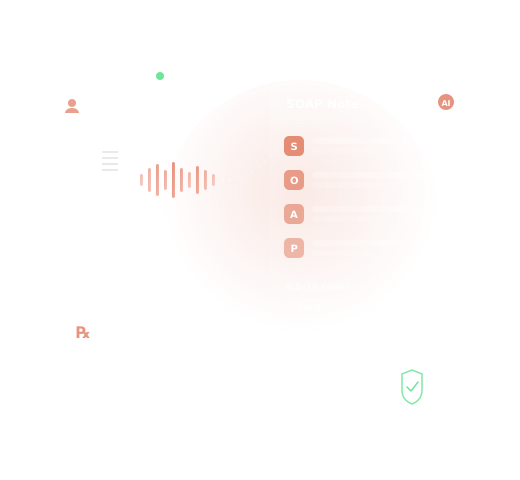
- Draft a SOAP note automatically: Based on the structured transcript, MedScribe generates a draft SOAP note. This can include the patient history discussed, relevant objective details mentioned in the encounter, the working assessment, and the plan for tests, medicines, counselling, or follow-up. The draft is meant to accelerate documentation, not replace clinician judgment.
- Suggest coding for review: The system can surface ICD-10 and CPT suggestions linked to the documented encounter. These suggestions support staff and clinician workflows, especially where coding review is part of billing or internal record processes. Final code selection remains a human decision.
- Review, edit, and sign off: The clinician reviews the draft note, corrects nuances, adds missing context such as lab trends or imaging interpretation, and confirms the final version before record completion. This human checkpoint is essential for quality and clinical ownership.
For organizations comparing deployment models, MedScribe can also fit different infrastructure preferences. Some teams may choose on-premise or private deployment approaches to support workflows aligned with internal governance and IT planning, while others may prioritize faster operational rollout.
Local context
In India, hepatology services are delivered across standalone clinics, gastroenterology centers, tertiary hospitals, and multispecialty networks. Documentation needs vary by setup, but common themes remain: high OPD throughput, repeat follow-ups, mixed-language consultations, and the need to keep doctors focused on patient interaction. An AI medical scribe in India is most valuable when it supports these realities without adding operational friction.
For example, a liver clinic may need faster follow-up note completion for chronic hepatitis or fatty liver counselling, while a hospital-based hepatology unit may prioritize consistency across consultants and junior staff. In both cases, the product value is reusable: faster draft creation, clearer structure, coding support, and a review-first workflow. The contextual variation lies in how each organization deploys it, who reviews the drafts, and how it fits existing documentation habits.
Because healthcare organizations in India often have different IT and governance preferences, deployment choices should be evaluated as workflow decisions. Teams looking for an AI medical scribe in India typically assess language support, review controls, note quality, and fit with current systems before scaling usage.
Use cases
Chronic liver disease follow-up: Draft repeat visit notes with symptom updates, medication review, counselling, and next-step planning.
Hepatitis management: Organize history, treatment adherence, lab review, and follow-up recommendations into a structured note.
Fatty liver and metabolic counselling: Capture lifestyle discussion, risk factors, and action plans without relying on delayed manual note entry.
Cirrhosis review visits: Support documentation of complications, prior admissions, medication changes, and monitoring plans.
Transplant evaluation or referral documentation: Help summarize complex discussions into a usable draft for clinician refinement.
Hospital and clinic standardization: Support more consistent note structure across consultants, departments, or locations while preserving clinician review.
FAQ
Can this replace clinician documentation entirely?
No. MedScribe is designed to create draft documentation and coding suggestions that clinicians review, edit, and approve before final sign-off.
Is it useful for multilingual consultations?
Yes. Multilingual support is intended to help teams working in English and regional language conversations common in Indian OPDs.
Does it support hepatology-specific workflows?
It supports hepatology workflows by turning consultation conversations into structured notes that clinicians can adapt for liver disease follow-up, counselling, and treatment planning.
Can hospitals choose different deployment models?
Yes. On-premise or private deployment options can be considered based on workflow, infrastructure, and internal governance preferences.
CTA
If your team is evaluating an AI medical scribe in India for hepatology services, focus on workflow fit: how quickly notes are drafted, how easily clinicians can review them, and how well the system supports multilingual OPD care. Explore the MedScribe product pages for features, integrations, and pricing, then assess how the workflow can support your clinic or hospital documentation process in India.