Introduction
An AI medical scribe in India can help immunohematology teams reduce documentation load during busy OPD, transfusion medicine, and lab-linked clinical workflows. In settings where clinicians must balance patient interaction, interpretation of blood group or antibody findings, and careful record keeping, a documentation copilot can support faster note creation without replacing clinical judgment. MedScribe is designed to convert consultation conversations into structured clinical notes, with support for SOAP drafting, coding suggestions, speaker diarization, multilingual conversations, and deployment options such as private or on-premise setups. For hospitals and clinics that want more consistent records while keeping the doctor in control, this approach is practical, review-driven, and aligned with day-to-day care delivery.
For immunohematology, documentation often spans consultation history, transfusion reactions, prior sensitization, pregnancy history, antibody screening context, and follow-up planning. That makes note quality important not only for continuity of care but also for communication across departments. An AI medical scribe in India is most useful when it fits existing workflows, supports human review, and helps clinicians finalize records faster after each encounter.
Department workflow
Immunohematology workflows can involve outpatient consultations, pre-transfusion assessments, reaction reviews, referral discussions, and coordination with pathology or blood bank teams. Clinicians may need to capture symptoms, prior transfusion history, medication context, pregnancy-related history, laboratory interpretation, and next-step recommendations in a clear format. In many hospitals, this information is documented across a mix of dictated notes, typed summaries, and manual updates to hospital systems.
An AI medical scribe in India can support this workflow by turning the consultation into a structured draft that is easier to review and finalize. Instead of starting from a blank screen after every patient interaction, the clinician receives a note organized into subjective findings, objective context, assessment, and plan. This is especially useful when the encounter includes multilingual discussion, multiple speakers, or detailed history taking. The goal is not to automate clinical decisions, but to reduce repetitive documentation effort and improve consistency in how encounters are recorded.
Features mapped to workflow
Conversation capture and transcription: The product captures the consultation conversation and converts it into text for downstream note generation. This helps when clinicians want a more complete first draft based on the actual encounter.
Speaker diarization: In immunohematology consultations, both clinician and patient may provide important details. Speaker separation helps attribute statements correctly and improves note clarity during review.
Automatic SOAP note generation: The system drafts structured notes that can be adapted for OPD reviews, transfusion-related assessments, and follow-up visits. This reduces time spent reorganizing raw transcripts into usable documentation.
ICD-10 and CPT suggestions: Coding support can help teams prepare more complete documentation workflows. Suggestions remain reviewable so clinicians or billing teams can confirm relevance before final use.
Multilingual support: Many Indian care settings involve mixed-language consultations. Multilingual capability supports more natural patient interactions while still producing structured documentation.
On-premise or private deployment options: For organizations with specific governance preferences, deployment posture can be chosen to support workflows aligned with internal IT and data handling practices.
How It Works
The workflow is designed to move from live conversation to clinician-approved documentation in a practical sequence:
- Capture the consultation: During an immunohematology consultation, the conversation is recorded through the configured workflow. This may include history related to transfusions, prior reactions, antibody findings, pregnancy history, and current symptoms. Multilingual speech handling supports natural doctor-patient interaction.
- Transcribe and separate speakers: The audio is transcribed and processed with speaker diarization so the system can distinguish clinician and patient contributions. This creates a cleaner base for documentation, especially in detailed history-taking encounters.
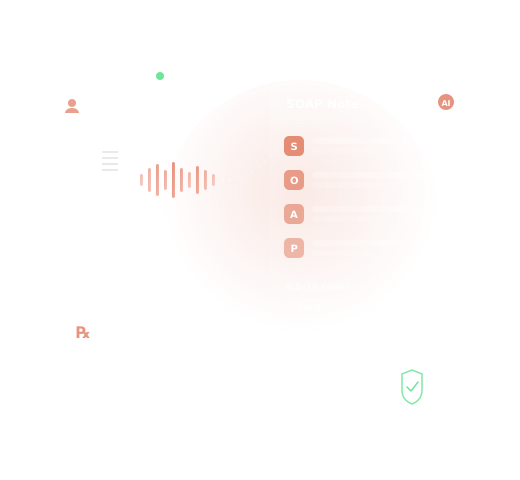
- Structure the encounter into a draft: The transcript is organized into a SOAP-style note. Relevant details such as subjective complaints, objective context, assessment points, and plan items are arranged into a usable clinical draft rather than a raw transcript.
- Add coding support: The system can surface ICD-10 and CPT suggestions based on the documented encounter. These are intended as workflow aids and should be reviewed by the clinician or authorized team before use.
- Review, edit, and sign off: The clinician checks the draft, edits wording, adds missing interpretation, and confirms that the note reflects the actual encounter. Human review is the operational checkpoint before the record is finalized.
- Finalize within the chosen deployment model: Depending on organizational preference, teams can use private or on-premise deployment approaches as governance and workflow decisions. This supports implementation aligned with internal infrastructure choices.
Local context
In India, immunohematology services often operate within broader hospital ecosystems where clinicians, blood bank teams, and diagnostic departments need timely documentation. An AI medical scribe in India is valuable when it supports practical realities: mixed-language consultations, variable documentation styles, and the need to complete notes without extending clinician hours. Hospitals may also prefer implementation choices that fit their own IT environment, which is why private and on-premise options matter as operational considerations.
For clinics and hospitals evaluating an AI medical scribe in India, the most important question is whether it helps doctors finish records faster while preserving review control. In immunohematology, where interpretation and follow-up planning can be nuanced, the clinician remains the final authority on the note. The software supports documentation workflows; it does not replace specialist judgment.
Use cases
Outpatient immunohematology consultations: Draft notes from detailed patient history and symptom discussions.
Transfusion reaction follow-up: Capture chronology, symptoms, prior exposure history, and plan for further evaluation in a structured format.
Pre-transfusion assessment documentation: Organize relevant history, prior reactions, and clinician recommendations into a consistent note.
Referral and second-opinion visits: Summarize complex prior history and current assessment for continuity across departments.
Multilingual patient encounters: Support documentation when the consultation shifts between English and regional languages.
These scenarios show how an AI medical scribe in India can be applied in real clinical settings without changing the core responsibility of the treating team.
FAQ
Can this be used for specialist consultations in immunohematology?
Yes. The workflow is suitable for specialist encounters where detailed history, interpretation, and follow-up planning need to be documented in a structured way.
Does the product replace clinician review?
No. The draft note and coding suggestions are intended to support the clinician. Final review, edits, and sign-off remain essential before record completion.
How does multilingual support help in India healthcare settings?
It helps when consultations include a mix of English and local languages, allowing more natural patient communication while still producing structured documentation.
Can hospitals choose how the system is deployed?
Yes. Private or on-premise deployment options can support workflows aligned with internal governance and infrastructure preferences.
CTA
If your team is exploring AI medical scribe India healthcare workflows for immunohematology, start with a practical evaluation focused on note quality, review effort, and fit with daily OPD operations. MedScribe is built to support consultation capture, SOAP drafting, coding assistance, and clinician-controlled finalization. Explore the broader product at /medscribe, review capabilities at /medscribe/features, and assess whether an AI medical scribe in India fits your documentation workflow.