Introduction
Infection control nursing teams manage high-volume documentation across surveillance rounds, isolation reviews, device-related infection tracking, hand hygiene observations, antimicrobial stewardship coordination, and communication with clinicians. An AI medical scribe in India can help reduce manual note-taking by turning spoken clinical discussions into structured drafts that are easier to review, edit, and finalize. For hospitals and clinics, the value is practical: less time spent rewriting routine observations, more consistency in note structure, and better support for daily OPD and inpatient workflows.
MedScribe is designed as an AI documentation copilot for healthcare teams that need usable clinical notes from real conversations. It supports automatic SOAP note drafting, speaker diarization, multilingual workflows, and coding suggestions that can assist downstream documentation tasks. For infection control nursing, this means ward discussions, review calls, and clinician interactions can be converted into organized drafts while keeping the nurse or clinician in control of final sign-off. The goal is not to replace judgment, but to support faster, clearer documentation aligned with routine healthcare operations in India.
Department workflow
Infection control nursing documentation often spans multiple touchpoints in a single day. A nurse may begin with surveillance rounds, document suspected healthcare-associated infection indicators, discuss findings with treating teams, review line and catheter status, and update internal records for follow-up. These workflows are repetitive but detail-sensitive. Missing a date, device status, symptom progression, or escalation note can create rework later.
An AI medical scribe in India is useful in this setting because it supports documentation where conversations already happen. Instead of relying only on handwritten notes or delayed typing, teams can capture the interaction, generate a structured draft, and review it while details are still fresh. This is especially relevant when infection control nurses coordinate with physicians, microbiology teams, quality teams, and ward staff across multilingual environments.
Typical department tasks that benefit from structured AI-assisted documentation include surveillance summaries, isolation precaution discussions, device-associated infection review notes, antimicrobial follow-up conversations, hand hygiene audit commentary, and escalation summaries for suspected outbreaks. The output can then be reviewed and adapted to the organization’s preferred format before being added to the medical record or internal workflow.
Features mapped to workflow
For infection control nursing, product value comes from how features map to daily work rather than from generic automation claims. MedScribe supports conversation capture and transcription so spoken reviews can become draft documentation without starting from a blank page. Speaker diarization helps separate clinician, nurse, and patient voices where relevant, making the draft easier to interpret during review.
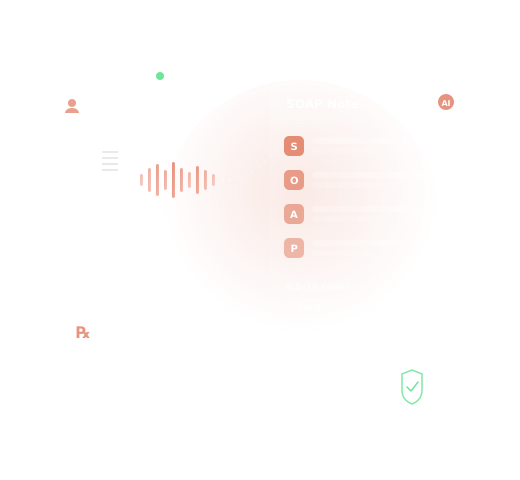
Automatic SOAP note generation is useful when teams need a consistent structure for observations, assessments, and planned actions. Even when the final note is adapted into an internal infection control format, a SOAP-style draft can speed up first-pass documentation. ICD-10 and CPT suggestions can support coding-aware workflows where documentation quality affects downstream administrative or reporting processes, while still requiring human review.
Multilingual support matters in India because ward communication may shift between English and regional languages. This can help teams document discussions more naturally without forcing every interaction into a single language pattern. On-premise deployment and private deployment options are operational choices for organizations that want tighter control over where documentation workflows run. These options support workflows aligned with internal governance preferences rather than making blanket compliance claims.
Overall, AI medical scribe India healthcare use cases are strongest where teams need repeatable note structure, faster turnaround, and clinician-reviewed outputs that fit existing documentation habits.
How It Works
The workflow is designed to support real clinical documentation from capture to final review. For infection control nursing teams, the process can fit ward rounds, review meetings, and clinician discussions without changing the core responsibility for documentation approval.
- Capture the consultation or review conversation: During a ward discussion, infection surveillance review, or clinician-nurse handoff, the audio interaction is captured through the documentation workflow. This may include multilingual speech and multiple speakers involved in the same discussion.
- Transcribe and identify speakers: The system converts speech into text and uses speaker diarization to distinguish participants where possible. This helps separate observations, recommendations, and responses so the draft is easier to validate.
- Structure the transcript into a clinical draft: The raw conversation is organized into a usable note, including SOAP-style drafting where appropriate. For infection control nursing, this can help convert scattered discussion points into a clearer summary of findings, assessment, and next steps.
- Add coding support and documentation cues: The workflow can surface ICD-10 or CPT suggestions to support coding-aware documentation processes. These are suggestions only and should be checked by the clinician or authorized documentation team before use.
- Review, edit, and sign off: The nurse or clinician reviews the generated draft, corrects details, removes irrelevant content, and confirms the final wording. Human review is the operational checkpoint before any record is finalized.
- Finalize based on deployment preference: Organizations can choose deployment approaches such as on-premise or private environments based on workflow, IT, and governance needs. This is a practical implementation decision that supports how the hospital wants documentation systems to operate.
Local context
Healthcare teams in India often work across mixed digital maturity levels, from hospitals with established systems to clinics still balancing paper and digital records. In this environment, an AI medical scribe in India should be practical, flexible, and easy to review rather than overly complex. Infection control nursing teams may need to document in English while discussing cases in another language, coordinate across departments, and maintain consistent note quality despite workload variation.
This is where a consultative implementation approach matters. The product should support existing documentation habits, not force a complete workflow reset. An AI medical scribe in India can be introduced first for high-frequency note types, then expanded as teams become comfortable with review and sign-off processes. For hospitals evaluating deployment posture, private or on-premise options may be considered as part of internal IT planning and governance decisions.
Use cases
Common infection control nursing use cases include documenting surveillance round findings, summarizing discussions on isolation precautions, drafting notes after device-related infection reviews, capturing antimicrobial stewardship conversations, and preparing follow-up summaries after escalation meetings. In outpatient and inpatient settings alike, the product can help create a first draft quickly so teams spend more time validating content than manually reconstructing conversations.
Another practical use case is standardizing note quality across shifts. When multiple staff members contribute to infection control documentation, structured AI-assisted drafts can reduce variation in format and improve readability. An AI medical scribe in India is especially helpful when teams need to move from spoken updates to documented action points without delaying care coordination.
FAQ
Below are common implementation questions from clinics and hospitals evaluating documentation support for infection control nursing workflows.
Can this be used for infection control nursing notes?
Yes. It is designed to help convert clinical conversations into structured draft notes that can be reviewed and adapted for infection control workflows.
Does it replace clinician or nurse review?
No. The draft should always be reviewed, edited where needed, and approved by the responsible clinician or nurse before finalization.
Can it support multilingual conversations?
Yes. Multilingual support is useful for Indian healthcare settings where discussions may move between English and regional languages.
What kind of outputs does it generate?
It can generate structured clinical drafts such as SOAP-style notes and provide coding suggestions to support documentation workflows.
Is deployment flexible for hospitals?
Yes. Deployment options such as on-premise or private environments can be considered based on workflow, IT, and governance preferences.
CTA
If your hospital or clinic wants to reduce manual documentation effort for infection control nursing, MedScribe offers a practical starting point. Use it to capture conversations, generate structured drafts, and keep human review at the center of record finalization. Explore how an AI medical scribe in India can support daily documentation workflows with a more consistent and review-friendly process.