Introduction
Infectious Diseases teams often manage complex consultations that involve symptom timelines, exposure history, prior treatment, antimicrobial plans, isolation considerations, and follow-up instructions. That makes documentation detailed, repetitive, and time-sensitive. An AI medical scribe in India can help reduce manual note-taking by turning consultation conversations into structured draft documentation that clinicians can review and finalize. For hospitals, specialty clinics, and multi-doctor practices, the goal is practical: support faster note completion, improve consistency in records, and reduce after-hours documentation burden without changing how clinicians think through cases.
MedScribe is designed as an AI documentation copilot for day-to-day OPD and inpatient workflows. It converts clinician-patient conversations into usable clinical notes, supports SOAP formatting, and provides coding suggestions that can be reviewed before final sign-off. For Infectious Diseases settings in India, this is useful where encounters may include multilingual conversations, referral summaries, medication changes, and detailed counseling. Rather than replacing clinical judgment, the product supports the documentation layer around it. This makes an AI medical scribe in India relevant for teams looking to standardize records while keeping the clinician in control of the final chart.
Department workflow
Infectious Diseases documentation usually starts before the consultation itself. A patient may arrive with prior lab reports, referral notes, imaging, discharge summaries, or antimicrobial history from another facility. During the encounter, the clinician may need to capture fever pattern, travel or exposure history, comorbidities, prior antibiotic use, immunization context, and risk factors. The assessment may then branch into differential diagnosis, testing plans, treatment decisions, infection control advice, and follow-up timing.
Because these visits are information-dense, clinicians often switch between listening, questioning, examining, and documenting. In busy Indian healthcare environments, this can create uneven note quality or delayed completion. An AI medical scribe in India fits into this workflow by helping capture the conversation, organize it into structured sections, and prepare a draft note that reflects the encounter flow. This is especially useful for repeat follow-ups, antimicrobial stewardship discussions, chronic infection management, and consults that require careful chronology.
For Infectious Diseases departments, the documentation burden is not only about volume. It is also about clarity. Teams need records that are easy to review later, useful for handoffs, and practical for coding and billing workflows where applicable. A documentation copilot supports this by creating a starting point that clinicians can edit instead of writing every note from scratch.
Features mapped to workflow
Automatic SOAP note generation: Consultation audio can be transformed into draft Subjective, Objective, Assessment, and Plan sections. This helps Infectious Diseases clinicians document symptom progression, exam findings, treatment rationale, and follow-up plans in a familiar format.
Speaker diarization: The system distinguishes between speakers so the draft note better reflects who said what during the consultation. In specialty visits where family members, caregivers, or interpreters may be present, this helps preserve context during review.
Multilingual support: Many Indian consultations move between English and regional languages. Multilingual support helps teams document encounters more naturally without forcing a single-language interaction style.
ICD-10 and CPT suggestions: Coding support can help staff and clinicians review likely documentation-linked codes. Suggestions are intended to assist workflow, with human validation before use.
On-premise deployment options: Some hospitals prefer private or on-premise deployment based on internal IT, governance, or data handling preferences. MedScribe supports deployment choices designed to align with institutional workflow and infrastructure decisions.
Review-first workflow: Drafts are not the final record. Clinicians review, edit, and approve the note before it is saved or used downstream. This is important in Infectious Diseases, where subtle wording can affect continuity of care.
How It Works
The product workflow is built around real consultation documentation rather than generic transcription alone. For an Infectious Diseases clinic or hospital team, the process typically looks like this:
- Capture the consultation conversation: During the patient visit, the encounter audio is captured through the configured workflow. This may include history taking, symptom discussion, prior treatment review, and counseling. The goal is to support natural clinician-patient interaction without requiring constant manual typing.
- Transcribe and structure the encounter: The system converts speech into text and applies speaker diarization to separate clinician and patient dialogue. It then organizes relevant details such as presenting complaints, exposure history, medication history, and follow-up instructions into a structured draft.
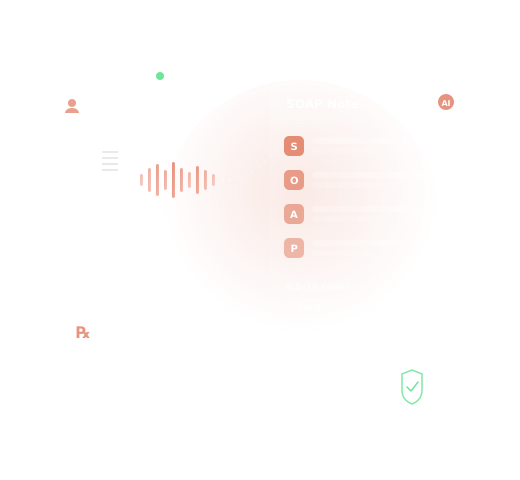
- Generate a SOAP note draft: Based on the conversation, MedScribe prepares a SOAP-style note with clinically useful sections. For Infectious Diseases, this can help organize chronology, assessment points, and treatment planning in a format that is easier to review than raw transcript text.
- Suggest coding support: The draft can include ICD-10 and CPT suggestions linked to the documented encounter. These suggestions are intended to support administrative review and clinician validation, not replace coding judgment.
- Clinician review, edits, and sign-off: Before any record is finalized, the clinician reviews the draft note, corrects details, refines the assessment and plan, and confirms the final version. Human review is a required checkpoint in the workflow.
- Choose deployment posture for operations: Depending on the organization, teams may use private or on-premise deployment options to support workflows aligned with internal governance and IT preferences. This is an operational decision shaped by infrastructure, access control, and implementation needs.
This practical sequence is why an AI medical scribe in India can be useful for specialty departments that need both speed and clinician oversight. It supports the path from conversation capture to final note approval without removing the doctor from the documentation loop.
Local context
In India, Infectious Diseases care often spans high-volume OPDs, tertiary hospitals, referral networks, and follow-up visits where patients bring records from multiple sources. Documentation tools need to fit this reality. That means supporting multilingual consultations, variable visit lengths, and workflows where clinicians may need concise but complete notes for continuity. An AI medical scribe in India is most useful when it adapts to these practical conditions rather than forcing a rigid process.
Hospitals and clinics may also have different preferences for deployment, access, and review workflows. Some teams may prioritize private infrastructure choices, while others may focus on faster note turnaround across departments. In this setting, AI medical scribe India healthcare adoption is less about novelty and more about operational fit: reducing repetitive documentation effort while keeping records reviewable, editable, and aligned with existing clinical routines.
Use cases
Specialty OPD consultations: Draft notes for fever workups, recurrent infection follow-ups, antimicrobial reviews, and counseling-heavy visits.
Inpatient consult documentation: Support structured consult notes where chronology, prior treatment, and recommendations need to be clearly documented.
Referral and second-opinion visits: Summarize complex histories from outside records and live conversation into a more usable draft note.
Multilingual encounters: Help clinicians document visits where discussion shifts between English and local languages.
Coding-assisted workflows: Provide coding suggestions linked to the documented encounter for review by clinicians or administrative teams.
Across these scenarios, an AI medical scribe in India helps teams spend less time on repetitive typing and more time on clinical decision-making and patient communication.
FAQ
Can this replace clinician documentation review?
No. The draft note should always be reviewed, edited where needed, and approved by the clinician before finalization.
Is it useful for multilingual consultations in India?
Yes. Multilingual support is designed for real-world consultations where clinicians and patients may switch between English and regional languages.
Does it only create transcripts?
No. The workflow goes beyond transcription by structuring the encounter into draft SOAP notes and offering coding suggestions for review.
Can hospitals choose a private deployment approach?
Yes. Deployment options can include private or on-premise approaches based on organizational workflow, IT, and governance preferences.
CTA
If your Infectious Diseases team is looking for a practical AI medical scribe in India, MedScribe can support consultation documentation from conversation capture to clinician-reviewed final notes. Explore the product overview, features, integrations, and pricing to assess fit for your OPD or hospital workflow. The focus is simple: help clinicians document faster, keep records structured, and maintain human review where it matters most.