Introduction
An AI medical scribe in India can help insurance TPA desk teams handle documentation-heavy coordination with more consistency and less manual rework. In hospitals and clinics, the TPA desk often sits between clinicians, billing teams, patients, and insurers. That means staff must capture consultation details, organize supporting notes, prepare summaries for pre-authorisation or claim review, and keep records ready for internal follow-up. MedScribe is designed as an AI documentation copilot that converts consultation conversations into structured clinical notes and coding suggestions, helping teams move from raw discussion to usable documentation faster.
For insurance and TPA-facing operations, the value is practical: clearer notes, easier handoffs, and a more standardized way to prepare records for downstream review. Rather than replacing clinician judgment, the system supports workflows aligned with human review, edits, and final sign-off. This makes it relevant for Indian hospitals, day-care centres, and specialty clinics where documentation quality affects both care continuity and administrative turnaround.
Department workflow
At an insurance TPA desk, documentation usually arrives from multiple sources: doctor-patient conversations, discharge planning discussions, procedure notes, and internal clarifications between departments. Staff then need to interpret these inputs and prepare a clean record that can support pre-authorisation requests, utilization review, package validation, or claim-related communication. In many settings, this process is slowed by fragmented notes, inconsistent terminology, and repeated back-and-forth with clinicians.
An AI medical scribe in India is useful here because it helps create a structured starting point from the clinical conversation itself. Instead of relying only on handwritten notes or delayed summaries, teams can work from AI-generated SOAP drafts, organized transcripts, and coding suggestions that are easier to review. For the TPA desk, this can support faster internal coordination with billing, front office, nursing, and medical records teams. It is especially relevant in high-volume OPD and procedure-driven environments where documentation must be both clinically understandable and administratively usable.
Features mapped to workflow
MedScribe focuses on documentation tasks that matter in real hospital operations. Automatic SOAP note generation helps convert consultation audio into a familiar clinical structure, making it easier for doctors and desk teams to review the case summary. Speaker diarization separates voices in the conversation, which is useful when a clinician, patient, attendant, or coordinator all speak during the same interaction. Multilingual support is important in India healthcare settings where consultations may shift between English and regional languages.
For TPA desk workflows, coding suggestions such as ICD-10 and CPT can provide a useful reference point during documentation review. These suggestions are not a substitute for clinical or billing validation, but they can reduce the effort needed to identify likely codes from the encounter context. On-premise deployment and private deployment options also matter for organizations that want tighter control over where data is processed as part of their internal governance approach.
In practice, AI medical scribe India healthcare teams can use these capabilities to improve note readiness before records move to authorization, claims, or audit-related review. The result is a workflow that is easier to standardize across departments without forcing clinicians into rigid templates during the consultation itself.
How It Works
Below is the typical end-to-end workflow for using MedScribe in an insurance TPA desk context:
- Capture the consultation or case discussion: The clinician interaction, bedside discussion, or OPD consultation is recorded through the approved workflow. This creates the source input for documentation while preserving the natural flow of the conversation.
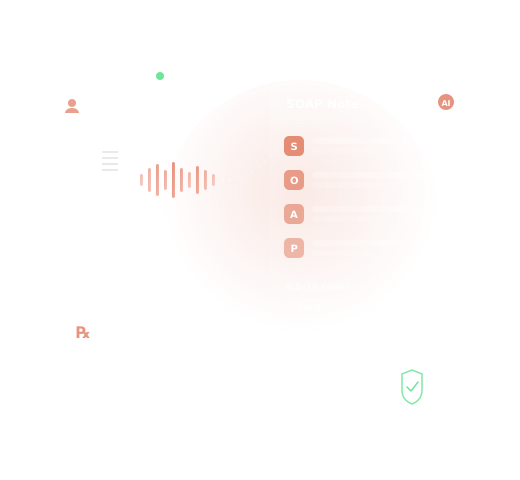
- Transcribe and structure the conversation: MedScribe converts the audio into text and applies speaker diarization to distinguish participants. The transcript is then organized into clinically relevant sections so the team does not have to work from an unstructured conversation log.
- Draft SOAP notes automatically: The system generates a SOAP-style draft from the encounter, giving clinicians and support teams a usable first version of the note. This is particularly helpful when the TPA desk needs a concise summary for internal coordination or supporting paperwork.
- Suggest coding references: Based on the documented encounter, the product surfaces ICD-10 and CPT suggestions to support downstream review. These suggestions help teams identify likely coding pathways, while final validation remains with the responsible human team.
- Review, edit, and sign off: The clinician or authorized reviewer checks the draft, makes edits, confirms accuracy, and finalizes the record. This human checkpoint is essential before the note is used for billing support, pre-authorisation packets, or claim documentation.
- Choose deployment posture for operations: Organizations can evaluate on-premise or private deployment options based on workflow, IT, and governance needs. This is best treated as an operational decision about data handling and system access, not as a blanket compliance claim.
Local context
In India, insurance desk operations often need to balance speed with documentation clarity. Hospitals may manage cashless approvals, package checks, procedure justification, and discharge-related paperwork under tight timelines. At the same time, clinicians are under pressure to keep OPD and inpatient workflows moving. An AI medical scribe in India fits this environment because it reduces the burden of turning spoken clinical interactions into organized notes that other teams can actually use.
For multi-specialty hospitals and growing clinics, language diversity is another practical factor. Consultations may include English medical terminology mixed with Hindi or other regional language phrases. Multilingual support can therefore improve usability in day-to-day settings. Deployment flexibility also matters in India healthcare organizations that prefer internal control over infrastructure decisions. The goal is not to promise guaranteed outcomes, but to support a more workable documentation process for local operational realities.
Use cases
Insurance TPA desk teams can use MedScribe in several practical scenarios. During pre-authorisation preparation, the desk can work from a structured clinical summary instead of chasing fragmented notes. For planned procedures, coding suggestions can help staff prepare cleaner internal documentation before final billing review. In discharge coordination, summarized notes can support communication between the treating team, billing, and insurance-facing staff. In OPD-heavy specialties, the product can help standardize note quality across multiple doctors and shifts.
An AI medical scribe in India is also relevant when hospitals want to reduce repeated clarification loops. If the initial note is more complete, TPA desk staff spend less time going back to the doctor for basic details. This can improve internal turnaround without changing the clinician's natural consultation style. For organizations evaluating documentation modernization, the product offers a practical bridge between conversation capture and final record preparation.
FAQ
Common questions from hospitals and clinics evaluating this workflow are answered below.
Can the product replace clinician review?
No. MedScribe is designed to support documentation creation, but the final note should be reviewed, edited where needed, and signed off by the appropriate clinician or authorized reviewer before record finalization.
Is it useful only for doctors?
No. While the core output is clinical documentation, the resulting structured notes can also help insurance desk, billing, and medical records teams work from a clearer source document.
How does it help the TPA desk specifically?
It helps by turning consultation conversations into structured notes and coding suggestions that are easier to review for pre-authorisation support, claim documentation preparation, and internal coordination.
Can hospitals choose how the system is deployed?
Yes. Deployment posture such as on-premise or private setup can be evaluated based on operational and governance preferences. These options should be assessed as workflow decisions rather than assumed legal guarantees.
CTA
If your hospital or clinic wants a more consistent way to prepare clinical documentation for insurance-facing workflows, MedScribe offers a practical starting point. Explore how an AI medical scribe in India can support your insurance TPA desk with structured notes, coding support, multilingual usability, and review-first workflows. Visit the product pages for more detail on capabilities, features, integrations, and pricing, then evaluate the setup that best fits your operational model.